Joints & mobility Guide
Spondylosis in dogs: symptoms, causes and how to support your dog
Spondylosis in dogs: what the bony spurs on the spine are, when they cause pain, what your vet can offer and how to keep your dog’s back comfortable.
Key takeaways
- Spondylosis is the formation of small bony outgrowths (spurs) along the edges of the vertebrae, mainly in older dogs and in boxers.
- It is very often found by chance on an X-ray and causes no pain at all in most cases.
- A dog with a hunched back, difficulty jumping or that yelps when touched should be examined: spondylosis is not always the real cause, and a slipped disc or an infection must be ruled out.
- The spurs won’t go away, but comfort can be preserved: pain relief from your vet if needed, a healthy weight, regular gentle exercise and an adapted home.
Contents
Spondylosis in dogs (or spondylosis deformans) is the growth of small bony outgrowths, or spurs, along the edges of the vertebrae as a dog gets older. It is common and usually painless, and is often found by chance on an X-ray. So when your dog has back pain, there are two things to do: check that spondylosis really is the cause, then protect your dog’s comfort with simple day-to-day measures.
What is spondylosis in dogs?
The spine is made up of vertebrae separated by discs, which act as shock absorbers. Over time, these discs wear and the whole structure becomes slightly less stable. In response, the body lays down new bone on the lower edge and sides of the vertebrae: these are osteophytes, often called bone spurs because of their shape.
These outgrowths develop slowly:
- Small spurs on the edge of a vertebra, not touching the next one.
- Longer spurs that reach towards the neighbouring vertebra.
- A complete bony bridge between two vertebrae, which stiffens that part of the back.
Ankylosing spondylosis in dogs: what does it mean?
People often talk about ankylosing spondylosis when bony bridges fuse several vertebrae together. The term can be confusing: in humans, ankylosing spondylitis is a very different, inflammatory disease. In dogs, it is an advanced form of spondylosis deformans, sometimes confused with another condition, diffuse idiopathic skeletal hyperostosis (DISH), in which the ligament running beneath the vertebrae turns to bone more extensively.
Spondylosis or arthritis of the spine?
In everyday language, many owners talk about arthritis in their dog’s spine. That’s an approximation: arthritis affects joints (including the small joints between the vertebrae), whereas spondylosis affects the edges of the vertebral bodies, around the discs. The two can exist side by side in an older dog, and caring for them day to day is very similar. For arthritis in the legs, see our guide to arthritis in dogs.
Which dogs are affected?
- Older dogs: the frequency rises markedly with age. In a large Dutch radiographic study (Kranenburg et al., 2011), 18% of the 2,041 dogs examined had spondylosis, and these dogs were older than the others.
- Boxers: in the same study, more than half of boxers (55%) had spondylosis. A genetic predisposition is strongly suspected.
- Medium to large dogs, but also many small breeds. The areas most often affected are the lower back and the lumbosacral region, just in front of the tail.
Spondylosis is linked to the ageing of the discs. A US study (Levine et al., 2006) found a possible link with type II disc disease, which develops slowly, but not with acute type I disc herniation. To understand these two forms, read our article on IVDD in dogs.
Symptoms: when does spondylosis cause pain?
In most cases, it causes no symptoms at all. When it does become a problem, the signs are often subtle and come on gradually:
| What you notice | What it may mean |
|---|---|
| Stiffness on getting up, moving ‘in one piece’ | Loss of flexibility in the back |
| Refusing to jump into the car or onto the sofa | Pain when the back is extended |
| Hesitating on the stairs | Discomfort when the pelvis moves |
| A dog that stands with its back hunched | Back pain |
| Flinching or growling when stroked along the back | An area that is painful to touch |
| Shorter steps with the back legs, weakness | Possible pressure on a nerve root (less common) |
| Less playful, more irritable | Chronic discomfort |
Hunched back and pain: don’t jump to conclusions
A dog with a hunched back that is in pain does not necessarily have spondylosis. Because spurs are so common and often silent, seeing them on an X-ray does not prove they are causing the pain. Your vet will need to rule out other causes:
- a slipped disc, especially in at-risk breeds such as the dachshund or the French bulldog;
- discospondylitis, an infection of a disc and the neighbouring vertebrae, sometimes with fever and lethargy;
- lumbosacral stenosis (compression of the nerves in the lower back);
- abdominal pain (pancreatitis, a digestive upset), which also makes dogs hunch up;
- arthritis in the hips or another cause of lameness, which you can explore in our article on dog limping.
Diagnosis and veterinary treatment
How your vet makes the diagnosis
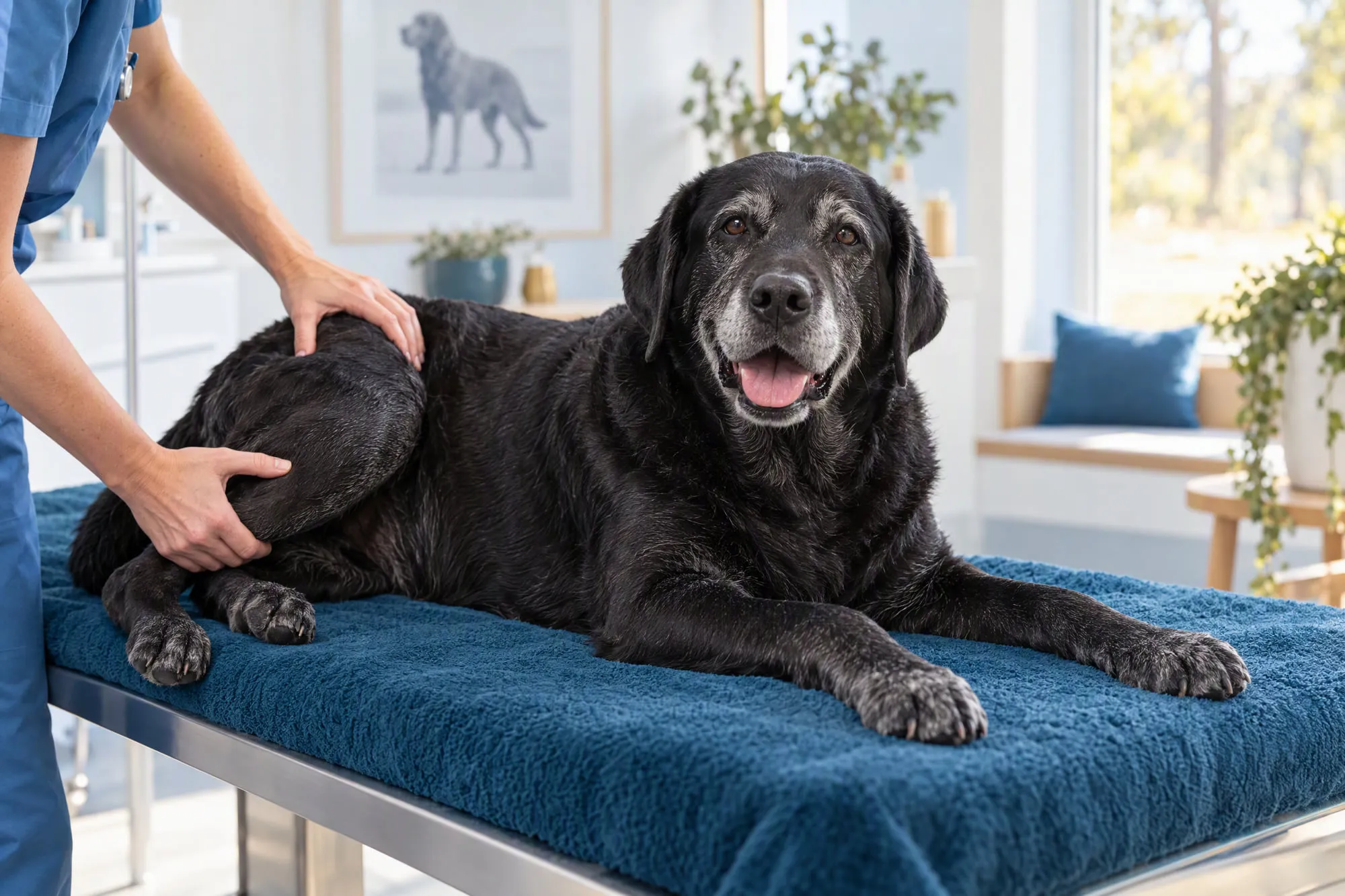
- Orthopaedic and neurological examination: feeling along the back, looking for painful areas, testing reflexes and how the dog places its feet.
- X-rays: these show spurs and bony bridges clearly. They also help to spot other abnormalities.
- CT or MRI scan, if your dog has neurological signs (weakness, loss of balance): only these scans show the spinal cord and the discs.
Treatment options
The spurs can’t be made to disappear, and there’s no need when they aren’t causing problems. The aim is comfort:
- Pain relief prescribed by your vet if your dog is in pain, suited to its age and its kidney and liver function. Only your vet should choose the medicine and the dose.
- Rehabilitation: physiotherapy, hydrotherapy, massage and gentle warmth can help to maintain flexibility and muscle in the back.
- Surgery: rarely needed, and only when imaging shows that a nerve is being compressed.
How to help a dog with spondylosis
This is where you can make the biggest difference day to day.
A healthy weight comes first
Every extra kilo increases the strain on the spine and the joints. You should be able to feel your dog’s ribs easily under a thin layer of fat. Our article on the overweight dog and its joints explains how to assess your dog’s body shape and help it lose weight without frustration.
Regular, gentle exercise
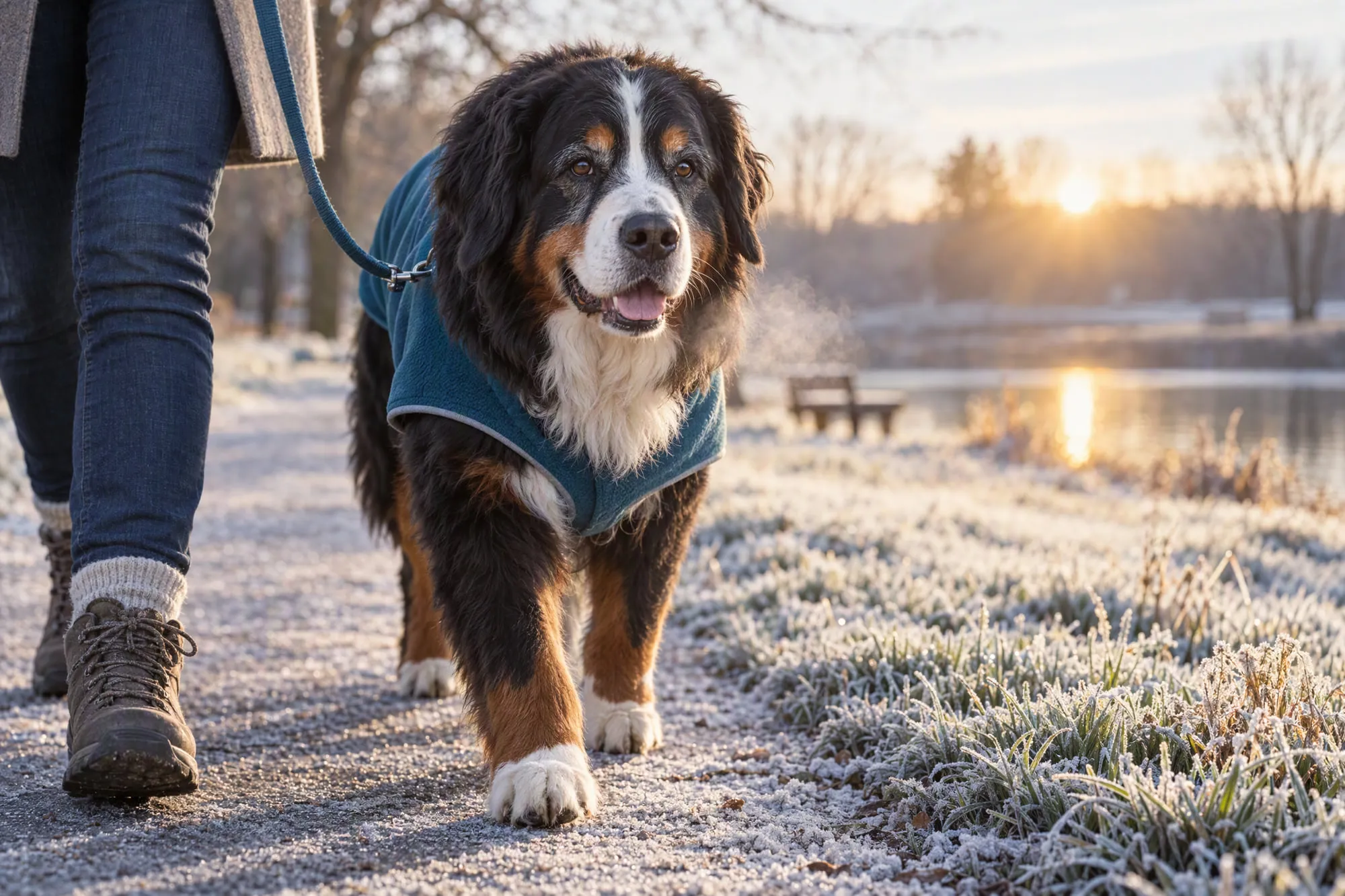
- Two or three walks a day of moderate length are better than one long outing at the weekend.
- Use a harness rather than a collar, so you don’t pull on the neck and back.
- Avoid jumping, sudden stops and tight turns (repeated ball throwing, frisbee).
- Walking in water or supervised swimming lets your dog exercise without impact.
Weight shifts while standing
- Stand your dog squarely on all four legs on a non-slip floor.
- Gently place your hand on its hip and push very slightly to the side, just enough for it to rebalance.
- Release, then do the same on the other side, and then at shoulder level.
- Do 5 to 10 gentle pushes on each side, rewarding your dog as you go.
Good to know: your dog should neither fall over nor step away. If it gives way, whimpers or turns towards your hand, stop and talk to your vet.
Slow sit-to-stands
- Stand facing your dog with a treat in your hand, on a floor that isn’t slippery.
- Ask your dog to sit up straight, then to stand up slowly by following the treat forwards.
- Repeat 5 times, checking that your dog sits evenly without rolling onto one hip.
- Gradually build up to 10 repetitions if the exercise is easy for your dog.
Good to know: this exercise strengthens the muscles that support the spine. You’ll find more ideas in our exercises for dogs with arthritis.
A home that’s kind to your dog’s back
- Non-slip rugs on tiled and wooden floors, in the places where your dog gets up and turns.
- A ramp for the car and the sofa, or a stair gate if your dog hesitates on the stairs.
- A thick, firm bed away from draughts: cold makes stiffness worse.
- Slightly raised bowls if bending down seems uncomfortable.
Our guide to home adaptations for a senior dog goes through these ideas room by room.
Massage, warmth and nutrition
Gentle massage along the back muscles, never directly on the spine, helps your dog relax: see how in our article on massage for dogs with arthritis. A lukewarm hot-water bottle wrapped in a towel, placed for a few minutes on the lower back muscles, is often appreciated after a walk.
When it comes to diet, marine omega-3s (EPA, DHA) are the best-researched nutrients for joint comfort in dogs. Some owners also choose a complementary feed for mobility, such as Novalia Hip & Joint, which contributes to supporting joint function alongside their vet’s advice.
Long-term follow-up
Spondylosis progresses slowly. Regular check-ups let you adjust your dog’s care:
- A vet visit at least once a year, and every six months for older dogs.
- A diary: note how easily your dog gets up and into the car, and how long walks last. A gradual decline is easier to see on paper than from day to day.
- A prompt reassessment if anything changes suddenly: a dog with spondylosis can also have a slipped disc, which is an emergency.
Key points on caring for a dog with spondylosis
Spondylosis is a common companion of the ageing dog, and most of the time it causes no suffering. If your dog has back pain, first have your vet confirm the cause. Then focus on the essentials: a healthy weight, gentle and regular exercise, a home free of hazards and pain relief if needed. These simple measures allow the vast majority of dogs to stay active and happy.
Frequently asked questions
Is spondylosis painful for dogs?
Most of the time, no: many dogs have spurs visible on an X-ray without any signs at all. Pain can develop when the outgrowths limit the flexibility of the back or press on a nerve root. Your vet will also check that something else isn’t causing the pain.
What is ankylosing spondylosis in dogs?
The term usually describes advanced spondylosis, where the spurs on two neighbouring vertebrae join up and form a bony bridge that stiffens that part of the back. It should not be confused with ankylosing spondylitis in humans, which is a different, inflammatory disease. In dogs, very extensive bone formation can also point to another condition, diffuse idiopathic skeletal hyperostosis (DISH).
How long can a dog live with spondylosis?
Spondylosis does not, on its own, shorten life expectancy: it is an age-related change that is often silent. What matters is day-to-day comfort. With weight kept under control, suitable exercise and pain management where needed, most dogs keep a good quality of life.
My dog has a hunched back and seems to be in pain: is it spondylosis?
Not necessarily. A hunched back is often a sign of pain, which may come from the spine (a slipped disc, an infected disc) but also from the abdomen (pancreatitis, a digestive problem). See your vet promptly, and the same day if your dog’s back legs are weakening or it can no longer get up.
Can a dog with spondylosis still go for walks and play?
Yes, and it’s actually recommended: regular movement helps maintain flexibility and muscle. Go for several walks on the lead with a harness, at a steady pace, and limit jumping, sharp turns and very intense ball games. Adjust things on your vet’s advice if your dog is in pain.
This article is for information only and does not replace a veterinary consultation. If in doubt, or if your dog is in pain or changes suddenly, contact your vet.
Transparency: Novalia develops and sells a complementary feed for dogs. Our articles stay independent: the product is only mentioned where relevant, always clearly labelled, and never in place of veterinary advice.
Sources and references
- Spondylosis Deformans in Dogs
- Diffuse idiopathic skeletal hyperostosis (DISH) and spondylosis deformans in purebred dogs: a retrospective radiographic study
- Evaluation of the association between spondylosis deformans and clinical signs of intervertebral disk disease in dogs: 172 cases (1999-2000)
- Naturally occurring spinal hyperostosis in dogs as a model for human spinal disorders