Exercise & rehab Exercises
Exercises for dogs with arthritis: 10 gentle routines to do at home
Exercises for dogs with arthritis: 10 gentle routines to do at home, a warm-up, a 7-day plan and the warning signs that mean it’s time to stop a session.
Key takeaways
- A dog with arthritis needs to keep moving: well-maintained muscles stabilise the joints and limit stiffness, whereas complete rest speeds up muscle loss.
- Keep sessions short and regular (5 to 15 minutes, once or twice a day) on a non-slip surface, always after a few minutes' warm-up.
- Start with two or three easy exercises (slow sit-to-stands, weight shifts, treat stretches) and add no more than one new exercise a week.
- The 24-hour rule: if your dog is stiffer or limping more the next day, halve the session and talk to your vet.
- Ask your vet to approve the programme, especially if pain is not yet under control: you can’t build muscle on a dog that is in pain.
Contents
Yes, a dog with arthritis should keep exercising, but not just any exercise: the movements need to be slow, short, regular and impact-free. Five to fifteen minutes a day of well-chosen exercises for dogs with arthritis is enough to maintain the muscles that protect the joints. Below you will find the safety rules, a warm-up, 10 step-by-step exercises, a sample one-week plan and the signs that mean you should stop. You can start this evening, in your living room.
Why exercise is essential for dogs with arthritis
Arthritis in dogs is a chronic disease of the cartilage. It can’t be made to go away, but you can have a big influence on how your dog lives with it. Movement is one of the most powerful tools, for three reasons:
- Muscles stabilise the joints. Well-muscled thighs and shoulders absorb some of the load and limit the small abnormal movements that keep inflammation going.
- Cartilage needs movement. It has no blood supply of its own: it is nourished by joint fluid, which is circulated with every movement.
- Activity helps maintain a healthy weight, and every kilo lost takes strain off the hips, elbows and knees.
On the other hand, a dog that moves less because it hurts loses muscle, becomes less stable, hurts even more… and moves even less. Exercise is how you break this vicious circle. In overweight dogs with arthritis, one study observed improved mobility with a diet combined with a physiotherapy programme, with the best results seen on the more intensive programme. Another, more recent study observed an increase in thigh circumference after five weeks of structured therapeutic exercise.
Exercise for older dogs: less intensity, more regularity
With age and arthritis, the logic changes: the goal is no longer performance but regularity. Three short sessions spread through the day are better than one big outing on a Sunday. Dogs can’t pace themselves: when excited, they will chase a ball despite the pain… and pay for it that evening or the next day. So it is up to you to set the limits.
Safety rules before you start the exercises
These rules come before everything else. They prevent most missteps.
- Get your vet’s go-ahead. Your vet confirms the diagnosis, identifies the affected joints and checks that pain is under control. You can’t build muscle on a dog that is in pain: if needed, your vet will first prescribe suitable treatment.
- Work on a non-slip surface: a yoga mat, carpet, short grass. Never on slippery tiles or wooden floors.
- Keep it short and frequent: 5 to 15 minutes, once or twice a day, rather than one long session.
- Always warm your dog up before the exercises (see below).
- Add only one new exercise a week, so you know which one is the problem if your dog seems worse.
- Apply the 24-hour rule: if your dog is stiffer, limping more or reluctant to get up the next day, halve the session.
- No exercise during a painful flare-up: relative rest and a call to your vet.
- Never force a joint. A successful exercise happens without whimpering, without trembling and without your dog trying to get away.
- Count the treats: take them from the day’s food allowance or use small pieces of vegetable, or the sessions will make your dog put on weight.
The warm-up: 5 minutes before every session
A warmed-up muscle is more supple, and a gently mobilised joint is less stiff. Never skip this step, especially in the morning or in cold weather.
5-minute warm-up routine
- Walk your dog on the lead at a slow pace for 3 minutes on flat ground (garden, hallway, pavement).
- Move up to a normal walking pace for 1 minute, making a few wide turns in both directions.
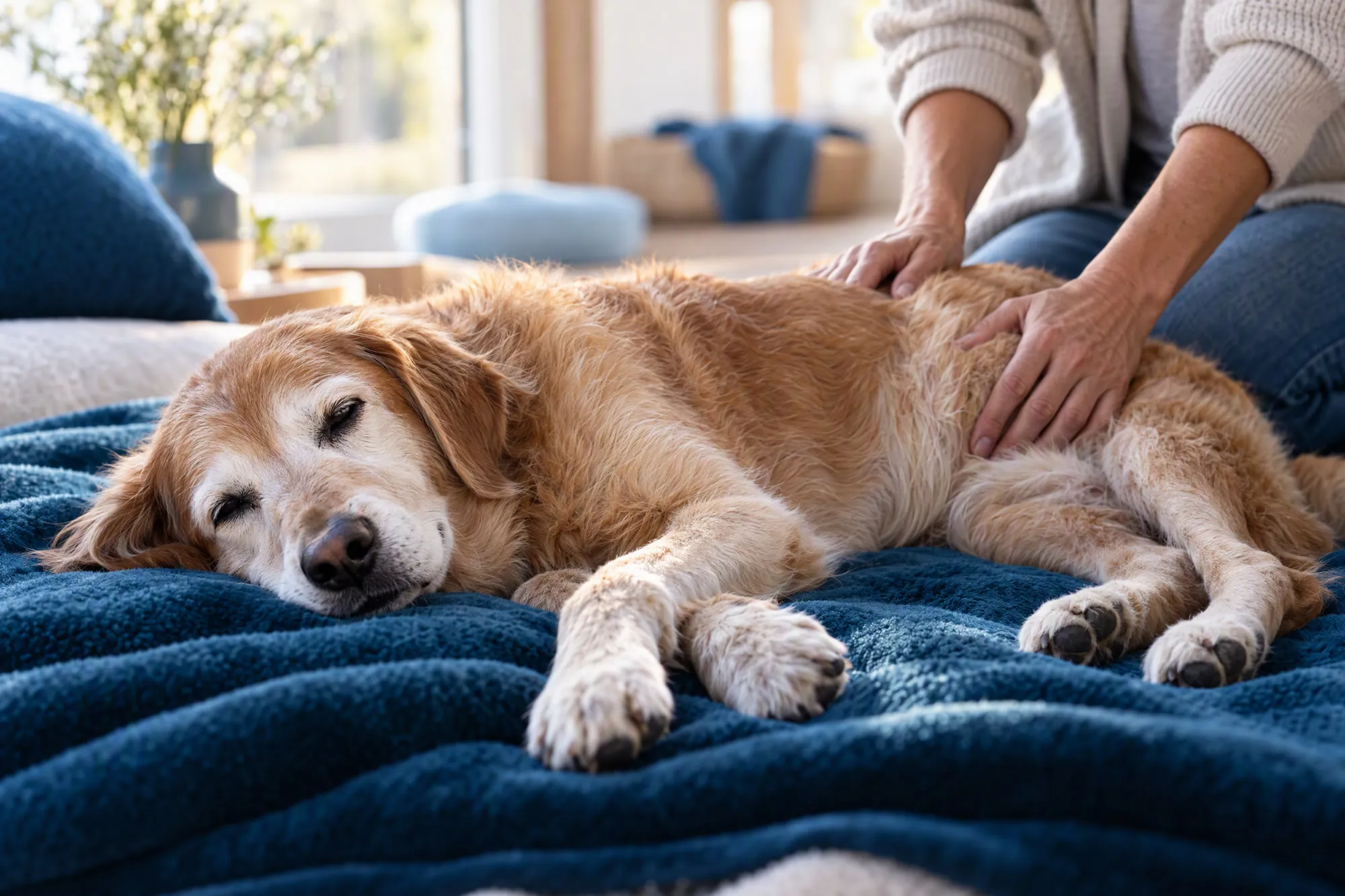
- Stop, let your dog stand still, and slowly stroke the thighs, the shoulders and along the back, from top to bottom, for 1 minute.
- Start the chosen exercise straight away, before your dog lies down again.
Good to know: in cold weather, do the warm-up indoors. A blanket or a coat for short-coated dogs helps keep the muscles warm.
10 gentle exercises for dogs with arthritis
These strengthening and mobility exercises are commonly used in canine rehabilitation. They are grouped by goal. To begin, choose two or three ‘Easy’ exercises, practise them for a week, then add one more. Keep your dog on a lead or in a harness if needed, and reward every success.
Strengthening the back legs
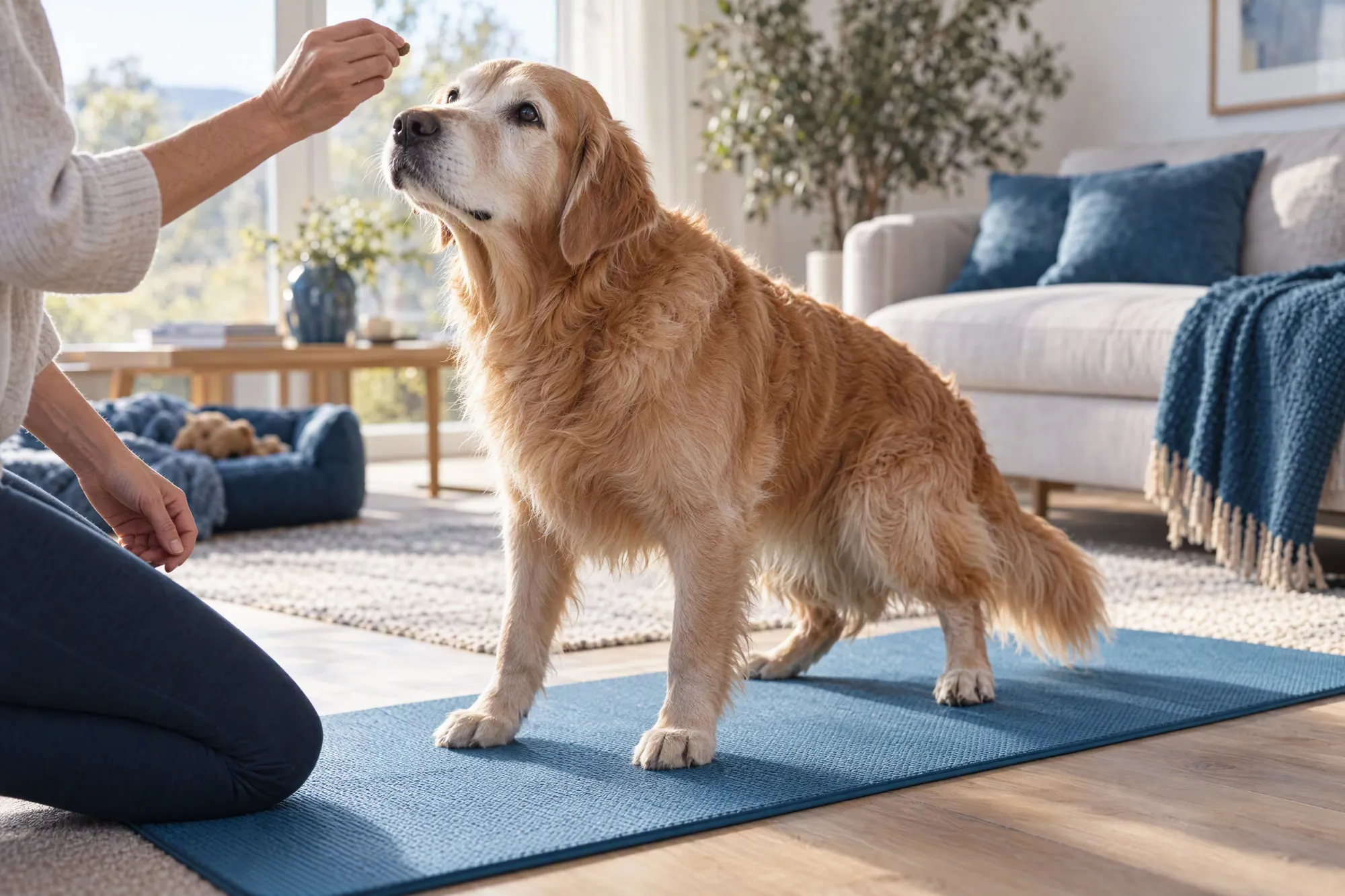
1. Slow sit-to-stands
- Stand your dog on a mat, with one side along a wall or sofa to help them sit straight.
- Hold a treat in front of the nose, then slowly move it back over the head: your dog sits.
- Count 2 seconds, then move the treat forwards and slightly upwards so your dog stands up, without jumping.
- Do 3 to 5 repetitions to start with, aiming for 2 sets of 5 to 8 after a few weeks.
- Make sure your dog sits with both back legs neatly tucked underneath, not with one leg stuck out to the side.
Good to know: if your dog finds it very hard to get up, have them sit on a low step or a firm cushion: the range of movement is smaller and the effort easier. A dog that always sits lopsided should be seen by a vet.
2. Weight shifts
- Your dog stands squarely on all four legs, on a non-slip surface.
- Place your hands flat on the hips and push very gently sideways, by just a centimetre or two.
- Your dog should resist by tensing the muscles without moving the paws. Hold for 3 seconds, then release.
- Do the same on the other side, then at the shoulders, then from front to back.
- Do 5 pushes per area.
Good to know: the pressure should be barely noticeable. If your dog wobbles, moves a paw or sits down, you are pushing too hard.
3. Three-legged stand
- Only start once your dog can do the weight shifts easily.
- With your dog standing calmly, gently lift one front paw a few centimetres, holding the wrist without pulling.
- Hold for 3 to 5 seconds, then put it down. Your dog should stay steady on the other three legs.
- Do 3 repetitions per front leg, then, if that is easy, try the back legs.
- Gradually build up to a 10-second hold.
Good to know: lifting a back leg puts more weight on the other back leg. If a hip or knee is very painful, ask your vet which leg you can lift.
Maintaining flexibility and range of movement
4. Treat stretches
- Your dog is standing. Position yourself beside them with a treat.
- Slowly bring the treat towards the shoulder: your dog turns its head to follow it. Hold for 3 to 5 seconds, then give the treat.
- Repeat, guiding the nose towards the flank, then towards the hip.
- Do the same on the other side.
- Finish by guiding the treat between the front legs, so your dog gently lowers the chin towards the chest.
- Do 3 repetitions per position.
Good to know: if your dog lifts or moves its feet to reach the treat, you are going too far. If your dog has a known back or neck problem, such as spondylosis, ask your vet first.
5. Figure-of-eight walking
- Place two markers (cones, chairs, buckets) 2 to 3 metres apart on a non-slip surface.
- With your dog on the lead, walk slowly in a figure of eight around the two markers.
- Do 5 or 6 figures of eight, changing direction halfway through.
- Over the weeks, gradually move the markers closer together to tighten the turns.
Good to know: the turns make your dog bend the spine and shift weight from one side to the other. Stay at a walk, never a trot.
6. Ground poles (cavaletti)
- Lay 4 to 6 broom handles flat on the ground in a line, spaced roughly your dog’s height at the withers apart.
- Walk your dog slowly over the poles on the lead, so that one paw lands between each pole.
- Do 4 to 6 passes, in both directions.
- After two or three weeks with no difficulty, you can raise the poles by a few centimetres (on books or bricks), but never higher than your dog’s wrists.
Good to know: biomechanical studies show that stepping over low obstacles increases flexion of the elbows, wrists, knees and hocks. If your dog often knocks the poles, move them closer together or lower them again.
Working on balance and body awareness
7. Paw targeting
- Choose a target: a lid or a drinks coaster.
- Put it on the floor in front of your dog. As soon as your dog touches it with a front paw, even by chance, praise and reward.
- Repeat until your dog deliberately puts a paw on it.
- Then move the target slightly to the side or a little further away, so your dog has to shift weight onto the other three legs.
- Work one front paw, then the other, for 5 to 10 repetitions.
Good to know: this exercise works the brain too. For an older dog that goes on fewer walks, it is excellent mental stimulation.
8. Balance cushion
- Start with a slightly unstable surface: a firm sofa cushion or a softly inflated balance cushion, placed on a non-slip mat.
- Encourage your dog to put both front paws on it, with the back legs staying on the floor.
- Hold for 10 to 20 seconds with a treat in front of the nose, then let your dog step down calmly.
- Do 3 to 5 repetitions.
- When that is easy, try with the back legs on the cushion and the front legs on the floor, supporting your dog with one hand under the belly.
Good to know: always stay right next to your dog. Avoid very unstable surfaces (exercise balls, wobble boards) at home: keep them for sessions supervised by a professional.
Building stamina gently
9. Controlled walking on varied surfaces
- After the warm-up, walk on a short lead at a steady pace, with no sudden stops or bursts of speed.
- Alternate stretches of 1 to 2 minutes on different surfaces: short grass, an earth path, slightly longer grass, wet firm sand.
- Avoid pebbles, deep dry sand, steep slopes and slippery surfaces.
- Add a gentle uphill stretch if your dog is comfortable: walking uphill works the hips and thighs harder.
- Increase the total time by no more than 2 to 5 minutes a week.
Good to know: watch for tiredness: a dog that lags behind you, scuffs its nails on the ground or stumbles should head home, even if the planned walk isn’t finished.
10. Slow climbs up a ramp or steps
- Use 3 to 5 low, non-slip steps, or a gently sloping ramp.
- Put your dog in a harness and keep them on a short lead so they can’t rush up.
- Have your dog climb one step at a time, slowly, pausing briefly on each step if possible.
- To come down, use the ramp or carry your dog if small: going down puts a heavy load on the shoulders and elbows.
- Do 3 to 5 climbs, with a one-minute break between each.
Good to know: this exercise isn’t suitable for every dog. Ask your vet first if your dog has advanced hip or elbow arthritis, or has had surgery.
Sample weekly plan for a dog with arthritis
Here is a sample starter programme for a dog with moderate arthritis whose pain is under control. Every session begins with the 5-minute warm-up. The numbers refer to the exercises above.
| Day | Morning session (5 to 10 min) | Evening session (5 to 10 min) | Walks |
|---|---|---|---|
| Monday | 1 + 2 | 4 + 7 | 2 to 3 calm outings |
| Tuesday | 5 + 2 | 4 | 2 to 3 outings, one with varied surfaces (9) |
| Wednesday | 1 + 6 | 4 + 7 | 2 to 3 calm outings |
| Thursday | Active rest: walk only | Treat stretches (4) | 2 to 3 short outings |
| Friday | 1 + 2 + 5 | 4 + 7 | 2 to 3 outings, one with varied surfaces (9) |
| Saturday | 6 + 3 (if approved) | 4 | A slightly longer outing if your dog was on good form on Friday |
| Sunday | Active rest | Gentle massage | 2 to 3 calm outings |
After two to three weeks with no negative reaction, you can add exercises 8 and 10, then lengthen the sessions by a few minutes. If a day has been busy (visitors, a long walk, play with another dog), make the next day’s session lighter.
Walking a dog with arthritis: adapt the walk rather than cut it out
Walks remain the foundation of activity for a dog with arthritis. They maintain muscle, weight and morale. A few adjustments make them far more comfortable:
- Split them up: two or three outings of 15 to 30 minutes are often better tolerated than an hour in one go.
- Keep a steady pace and avoid sudden stop-start movements, chasing games with other dogs and ball throwing.
- Choose flat, soft ground: short grass, earth paths. Limit long stretches of tarmac and rough terrain.
- Think about the way home: a dog doesn’t save energy for the return trip. Turn back before your dog tires, or plan a short loop.
- Allow breaks of a few minutes if your dog slows down, and take water when it’s warm.
- Cut out jumping: a ramp for the car, no jumping off the sofa or out of the boot.
- Use a harness rather than a collar, and a harness with a handle if your dog needs support.
- Protect your dog from cold and damp: towel dry after walks and let your dog rest on a soft bed, away from draughts.
How long should you walk a dog with arthritis?
Start from what your dog can comfortably manage today without being stiff the next day. Keep to that for a week or two, then increase by 5 minutes at a time. If your dog is stiff the next morning, go back to the previous level. An older dog that is struggling to stand up will make better progress with several 10-minute mini-outings than with a single long one.
Signs that mean you should stop an exercise
Your dog won’t tell you it hurts; your dog will show you. Learn to spot these signals during and after a session:
| What you see | What it often means | What to do |
|---|---|---|
| Heavy panting with no effort or heat | Pain or excessive tiredness | Stop and let your dog rest quietly |
| Trembling legs | Muscle fatigue | Stop, shorten future sessions |
| Lameness that appears or gets worse | Overloaded joint | Stop, relative rest for 24 to 48 hours |
| Refusing, yawning, lip licking, turning the head away | Discomfort or stress | Go back to an easier exercise |
| Persistent licking of a joint after the session | Local pain | Ease off, keep an eye on it, mention it to your vet |
| Sitting or lying down mid-exercise | Exhaustion or pain | End the session |
| Noticeably more stiffness the next day | Session too intense | Halve the session |
| Yelping, whimpering, defensive reaction | Sharp pain | Stop and call your vet |
If these signs keep coming back despite lighter sessions, the pain is probably not well enough controlled. Check in with your vet again before you resume.
What complements the exercises day to day
Exercises work best as part of an overall management plan agreed with your vet:
- Weight: often the first thing to tackle. See our advice on helping an overweight dog lose weight safely.
- Massage: a few minutes after a session relaxes the muscles that are compensating. See our massage techniques for dogs with arthritis.
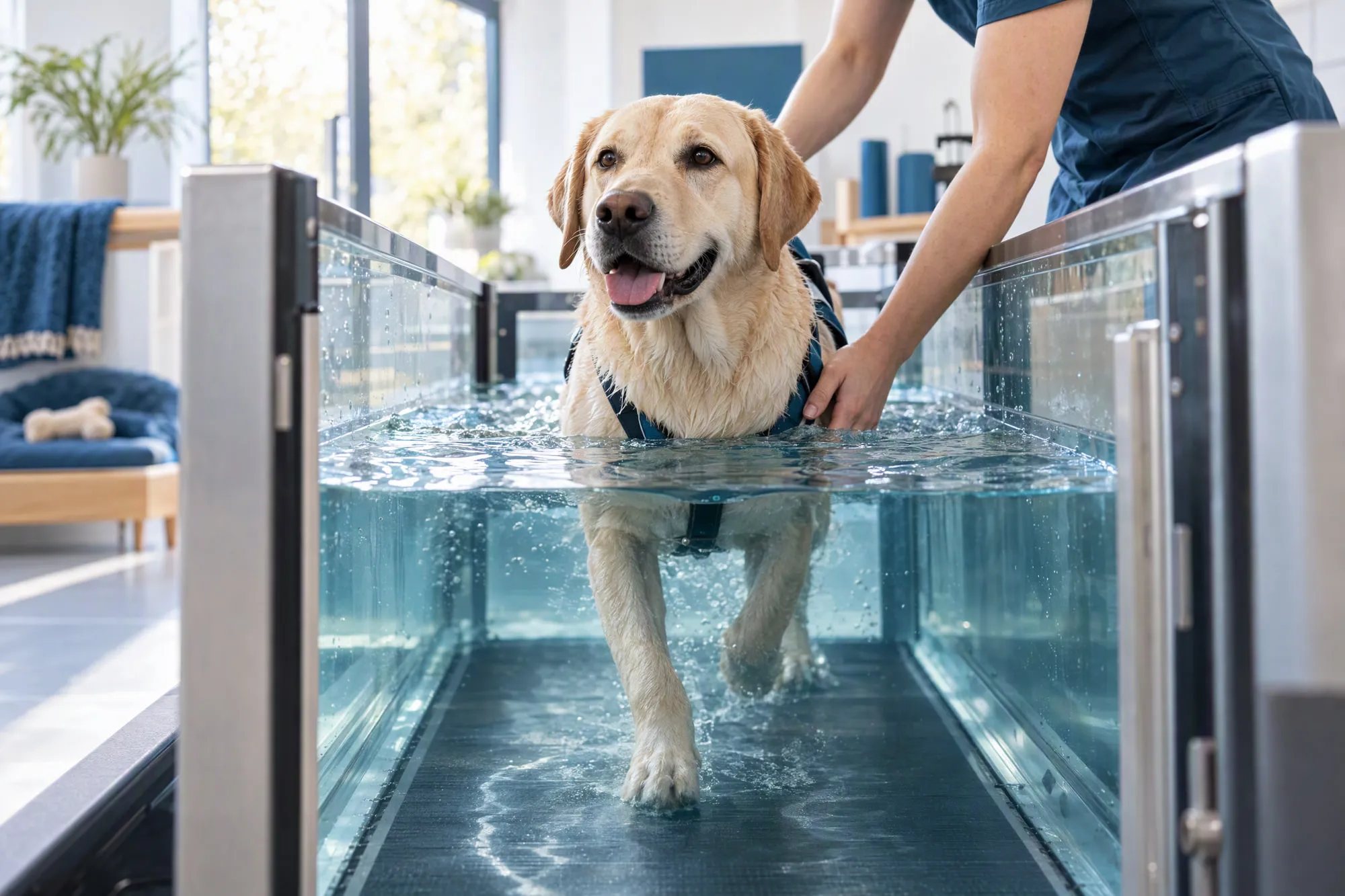
- Supervised rehabilitation: a professional can draw up a tailored programme and offer the underwater treadmill. It is all explained in our guide to dog physiotherapy and hydrotherapy.
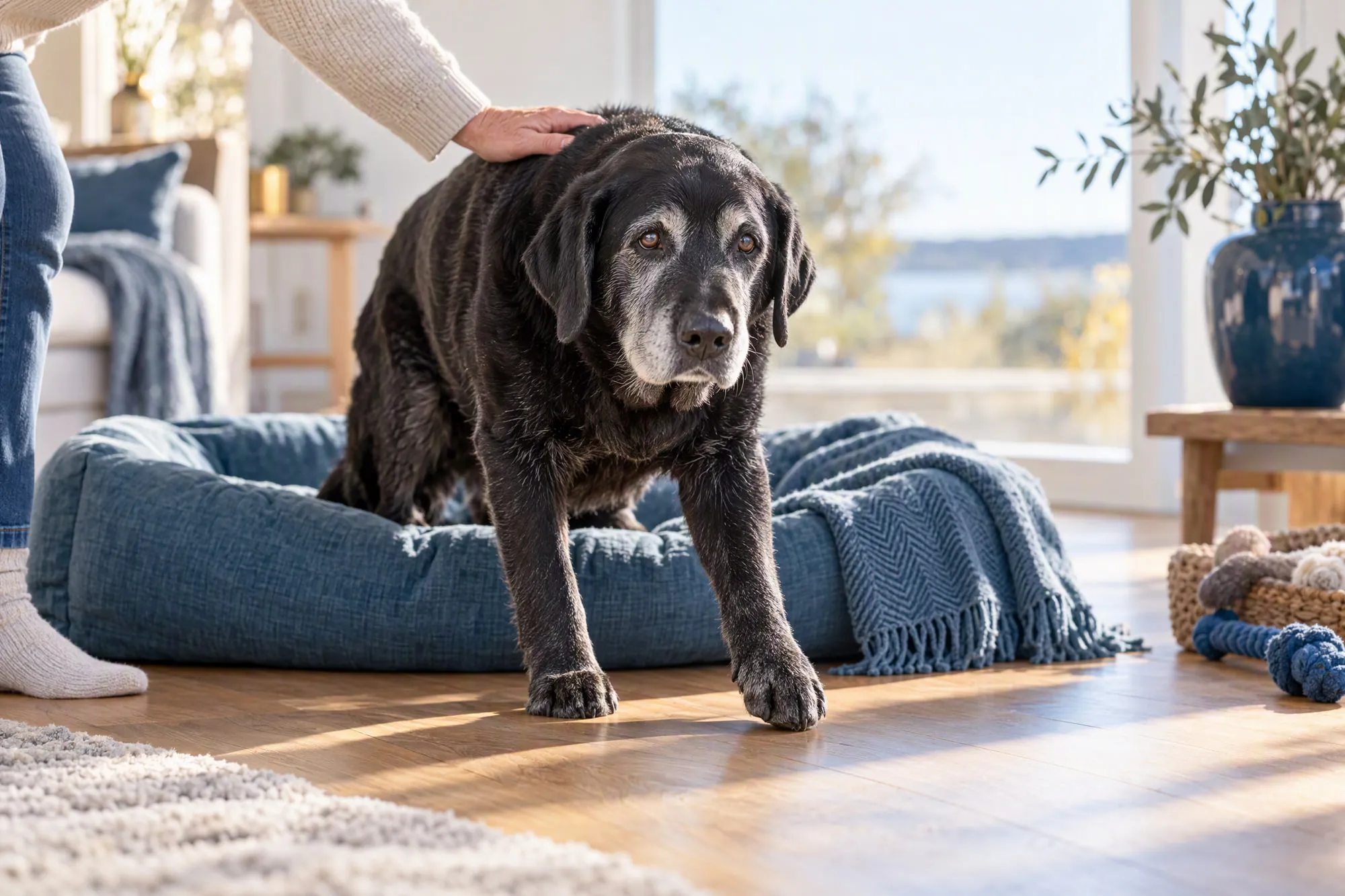
- The home: non-slip rugs, ramps and an orthopaedic bed prevent the slips that undo all your hard work. See our home adaptations for a senior dog.
- Diet and supplements: with your vet’s agreement, a complementary feed such as Novalia Hip & Joint can contribute to supporting joint function, alongside activity and veterinary follow-up.
Key points for keeping your dog with arthritis moving
A dog with arthritis needs to move every day, but in small doses: a warm-up, two or three slow exercises, walks split into shorter outings and good-quality rest. Start simple, watch how your dog is the day after each session and progress in small steps. With regular practice, many dogs get up more easily and show more enthusiasm within a few weeks. You will find more routines in our dog exercise and mobility section.
Frequently asked questions
What exercise is good for a dog with arthritis?
The best exercises are slow, low-impact and done little and often: controlled sit-to-stands, weight shifts, figure-of-eight walking, stepping over poles on the ground and lead walks on flat ground. They strengthen the muscles that support the joints without jarring them. Avoid ball throwing, sprinting and jumping.
How far should I walk a dog with arthritis?
There is no one-size-fits-all answer: it depends on how severe the arthritis is and how fit your dog is. In practice, two or three outings of 15 to 30 minutes at a steady pace are often better tolerated than one long walk. The best guide is how your dog is the next day: if they are stiffer, shorten the walks.
Should a dog with arthritis rest?
Strict rest is only useful during a painful flare-up, and on your vet’s advice. In the long term, inactivity wastes muscle, stiffens the joints and encourages weight gain, all of which make the pain worse. The aim is moderate, suitable daily activity, not stopping all activity.
Can a dog with arthritis use the stairs?
A few steps climbed slowly, on the lead and with a harness, can even be used as a strengthening exercise if your vet agrees. Going down is harder on the shoulders and elbows: use a ramp or carry small dogs. Avoid repeated flights of stairs several times a day.
How can I strengthen my old dog’s back legs?
Slow sit-to-stands, gentle climbs up a ramp or a few steps, and walking up a slight slope all work the thighs and hindquarters well. Start with three to five repetitions and build up very gradually over several weeks. If your dog slips, struggles to get up or sits lopsided, ask your vet for a check-up before pushing on.
Is swimming good for dogs with arthritis?
Swimming works the muscles and the cardiovascular system without impact, which makes it a worthwhile activity for many dogs with arthritis. It should still be supervised: a buoyancy aid, water that is neither too cold nor choppy, an easy way out and short sessions. At a hydrotherapy centre, an underwater treadmill allows more controlled work.
This article is for information only and does not replace a veterinary consultation. If in doubt, or if your dog is in pain or changes suddenly, contact your vet.
Transparency: Novalia develops and sells a complementary feed for dogs. Our articles stay independent: the product is only mentioned where relevant, always clearly labelled, and never in place of veterinary advice.
Sources and references
- Modifying exercise routines
- Osteoarthritis in Dogs
- Pye C. et al. Current evidence for non-pharmaceutical, non-surgical treatments of canine osteoarthritis (PMID 37776028)
- Mlacnik E. et al. Effects of caloric restriction and a moderate or intense physiotherapy program for treatment of lameness in overweight dogs with osteoarthritis (PMID 17144822)
- Holler PJ. et al. Kinematic motion analysis of the joints of the forelimbs and hind limbs of dogs during walking exercise regimens (PMID 20594074)
- Török M. et al. Structured therapeutic exercise program effect on PROM and muscle mass in dogs with osteoarthritis: a prospective clinical study