Nutrition & supplements Practical tips
Overweight dog: protect their joints and help them get back to a healthy weight
Overweight dog? Score their body condition from 1 to 9, set a realistic ideal weight and follow a safe plan to slim them down and spare their joints.
Key takeaways
- If you can’t easily feel your dog’s ribs and can no longer see a waist from above, they are probably overweight: their body condition score is above 5 out of 9.
- Excess weight overloads the joints and fuels inflammation; in obese dogs with arthritis, losing around 6 to 9% of body weight was already enough to reduce lameness noticeably.
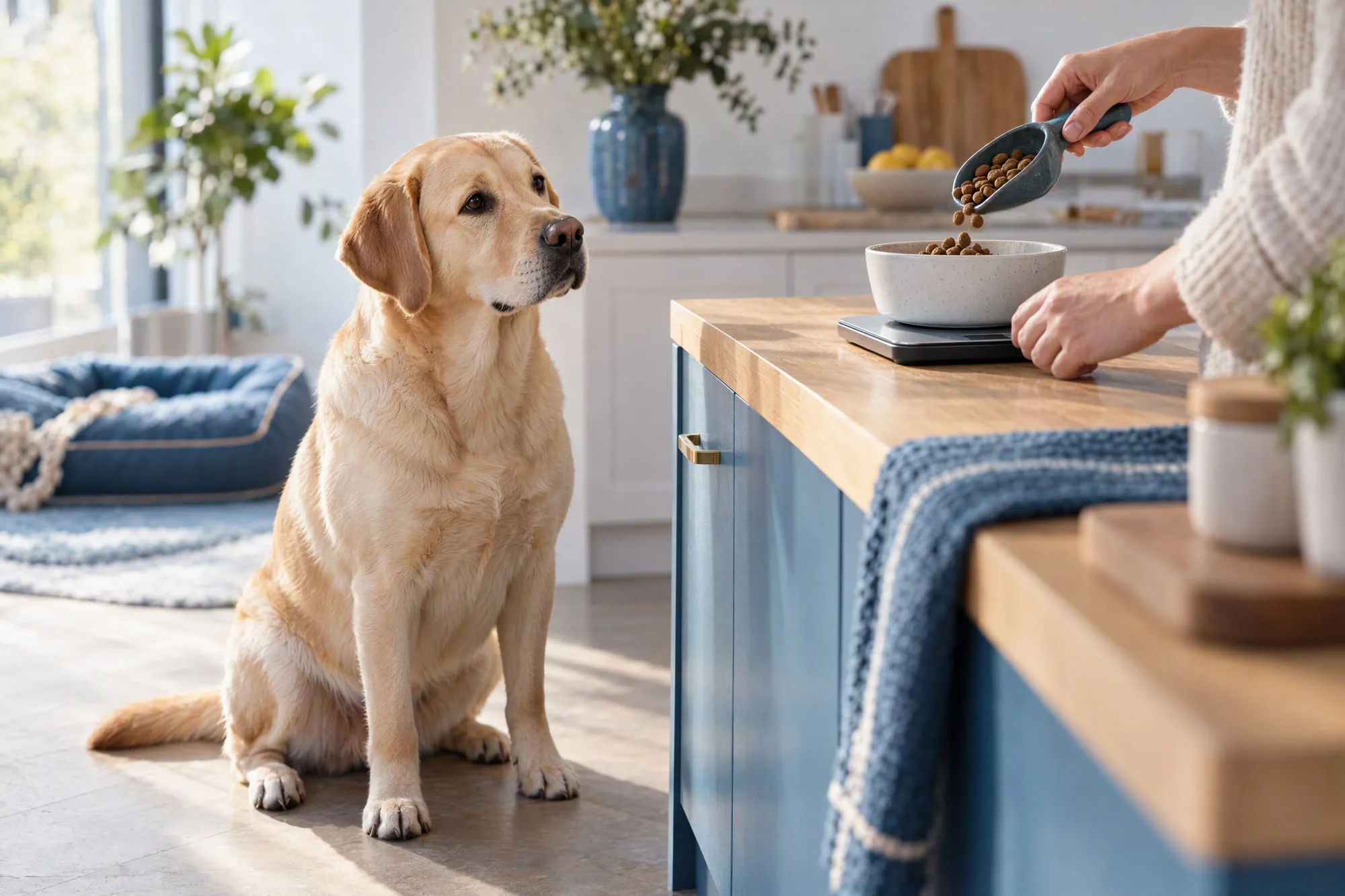
- Safe weight loss is gradual, around 1 to 2% of body weight per week, with a daily food allowance calculated by your vet and weighed every day.
- Treats should make up no more than about 10% of the day’s intake and must be taken out of the daily allowance.
- Before any diet, a vet check rules out a medical cause and lets you adapt activity if your dog has arthritis.
Contents
Your dog is probably overweight if you can’t easily feel their ribs under your fingers and, looking down from above, you can no longer see a waist behind the ribcage. It isn’t just about looks: every extra kilo weighs on their hips, elbows and knees, and fat itself fuels inflammation. The good news is that modest weight loss is often enough to make them noticeably more comfortable. Here is how to assess your dog at home, set a realistic target and help them lose weight safely.
Why being an overweight dog damages the joints
Constant mechanical overload
With every step, the joints carry part of the body’s weight, and much more when your dog jumps or goes down stairs. A few extra kilos therefore mean additional strain, repeated thousands of times a day, on cartilage that barely renews itself.
Fat that fuels inflammation
Fatty tissue isn’t simply an inert store: it produces substances that promote low-grade inflammation throughout the body, including in the joints. That is one of the reasons excess weight makes arthritis pain worse beyond the effect of the weight alone.
Obese dogs and arthritis: a vicious circle
An overweight dog tires quickly and moves less. If they have arthritis, pain reduces their activity even further. They lose muscle, their joints are less well supported, they hurt more… and they gain more weight. Excess weight is also a recognised risk factor for cruciate ligament rupture and makes the signs of hip dysplasia worse.
What the studies show
- Less lameness after modest weight loss. In 14 obese dogs with arthritis put on a diet, lameness fell significantly once they had lost around 6% of their body weight, and objective gait measurements improved from around 9%.
- A longer life. In a study of 48 Labradors followed throughout their lives, dogs fed 25% less food than their paired littermate lived longer, and signs of chronic disease appeared later.
- In pet dogs too. Across more than 50,000 neutered middle-aged dogs, median lifespan was shorter for overweight dogs in all 12 breeds studied, with a difference of up to two and a half years depending on the breed.
Body condition score: how to tell if your dog is overweight
Scales alone are not enough: 30 kg may be perfect for one dog and too much for another of the same breed. Vets use a body condition score (BCS) on a scale of 1 to 9, which assesses the amount of body fat by sight and touch.
The 1 to 9 body condition score
| Score | Category | What you see and feel |
|---|---|---|
| 1 | Emaciated | Ribs, spine and pelvic bones visible from a distance, no body fat, obvious muscle loss |
| 2 | Very thin | Ribs, spine and pelvic bones clearly visible, no palpable fat |
| 3 | Thin | Ribs easy to feel and sometimes visible, very pronounced waist and tuck |
| 4 | Ideal (lean) | Ribs easy to feel under a thin layer of fat, waist clearly visible, belly tucked up |
| 5 | Ideal | Ribs can be felt without excess fat, waist visible behind the ribs from above, belly tucked up from the side |
| 6 | Slightly overweight | Ribs can be felt under a slight layer of fat, waist visible but not pronounced |
| 7 | Overweight | Ribs hard to feel, fat deposits over the lower back and base of the tail, waist absent or barely visible |
| 8 | Obese | Ribs impossible to feel or only with firm pressure, heavy fat deposits, no waist, no abdominal tuck |
| 9 | Severely obese | Massive fat over the chest, back and tail, deposits on the neck and legs, distended belly |
Based on the WSAVA chart.
Check your dog's body condition score in 2 minutes
- Ribs: with your dog standing, place your hands flat on each side of their chest and slide your fingers along. The ribs should be easy to feel, a bit like the bones on the back of your hand. If they feel more like your knuckles when you make a fist, your dog is too thin; if you have to press to find them, as on your palm, your dog is too heavy.
- Waist: look down at your dog from above. There should be a waist just behind the ribs, like a gentle hourglass.
- Belly: look at your dog from the side. The line of the belly should rise from the chest towards the back legs.
- Fat stores: run your hand over the lower back and the base of the tail. A “cushion” of fat in these areas is a sign of excess weight.
- Write down the result and the day’s weight in a notebook so you can track progress.
Good to know: with long-haired or thick-coated dogs, the eye is easily fooled. Trust your hands rather than the silhouette.
Working out your dog’s ideal weight
A simple rule helps you estimate the target: each point above 5 corresponds to roughly 10% excess weight. Take a 33 kg dog scored at 7 out of 9: they are carrying about 20% extra weight, so their ideal weight is around 33 ÷ 1.2, or about 27.5 kg. This calculation is only an estimate: your vet will refine it, taking into account your dog’s build and muscle.
Don’t forget the muscles
An older dog or a dog with arthritis can be carrying too much fat and have lost muscle, particularly on the thighs and along the spine. That is why vets also assess muscle condition. For this type of dog, a diet must go hand in hand with suitable activity to preserve, or even rebuild, muscle mass.
Helping your dog lose weight: the principles of a safe plan
1. Start with a vet check
Before any diet, have your dog examined. Some hormonal diseases, such as hypothyroidism or Cushing’s disease, and some medicines encourage weight gain. Your vet will also assess joint pain: a dog that hurts won’t move, and the diet will be harder. Finally, they will set the target weight and the right daily food allowance.
2. Set a realistic pace
Vets generally aim for weight loss of 1 to 2% of body weight per week. For a 30 kg dog, that is 300 to 600 grams a week. Any faster and the dog is hungry, loses muscle and is likely to put it all back on. In an international study across 27 countries using a vet-supervised plan, 97% of 926 dogs lost weight, shedding on average just over 11% of their body weight in three months.
3. Choose the right food and the right amount
- A food formulated for weight loss, high in protein and fibre, cuts calories while still covering protein, vitamin and mineral needs, and keeps your dog feeling fuller.
- Don’t simply cut the portion of a standard food: your dog could end up with deficiencies.
- The amount is calculated for the target weight, not the current weight.
- Avoid sudden changes: switch from one food to another over about a week.
4. Weigh the food rather than guessing
Use kitchen scales: a measuring cup can easily lead to large errors. Weigh out the day’s allowance in the morning, put it in a container, and take from it for both meals and rewards.
5. Monitor and adjust
Weigh your dog every two to four weeks, at home or at the practice, always on the same scales. Many vet practices run weight clinics, and PDSA notes that regular weigh-ins make weight loss more successful. If weight loss stalls for more than four weeks, the food allowance needs to be adjusted with your vet. Once the target is reached, a stabilisation phase is needed, with a slightly larger but still measured allowance.
Treats: still spoiling your dog without piling on the weight
Treats should make up no more than about 10% of the day’s intake, and whatever they provide must be taken out of the daily allowance. A few simple tricks make a big difference:
- Set aside some kibble from the daily allowance and use it as rewards, especially during exercises.
- Cut treats into tiny pieces: for your dog, it’s the gesture that counts, not the size.
- Replace some rewards with attention: play, a fuss, a short sniffing game.
- Use slow-feeder bowls or food-dispensing toys to make meals last longer.
- Put one person in charge of feeding in the household, and tell friends and family.
- Put your dog in another room while you eat to cut down on begging.
| Fine in small amounts | Never give |
|---|---|
| Slices of raw carrot | Grapes, raisins, sultanas and currants |
| Plain green beans, cooked or raw | Chocolate |
| Cucumber | Onion, garlic, leek |
| Pieces of apple without the core or pips | Products containing xylitol (chewing gum, some desserts) |
| Kibble taken from the daily allowance | Macadamia nuts |
Cheese, ham and other cold meats, bread and table scraps are very high in calories for a dog: a small piece for you can be a significant share of their daily needs.
Exercise: moving more without damaging fragile joints
Exercise alone rarely makes a dog lose weight, but it preserves muscle during the diet, lifts their mood and keeps the joints working. For a dog with arthritis, diet and suitable exercise reinforce each other: the diet takes weight off the joints, and the exercise maintains the muscles that stabilise them.
- Split walks up: two or three outings of 15 to 30 minutes at a steady pace rather than one long walk.
- Build up very gradually, by 5 minutes a week, watching how your dog is the next day.
- Choose low-impact activities: lead walks on soft ground, gentle slopes, supervised swimming. Avoid ball throwing, sprinting and jumping.
- Add gentle exercises at home: our exercises for dogs with arthritis take 5 to 15 minutes.
- Consider hydrotherapy: an underwater treadmill lets your dog walk with less load on the joints. Find out what a session involves in our guide to dog physiotherapy and hydrotherapy.
- Exercise their brain: scent games (kibble hidden in the grass, snuffle mats) keep them busy without straining the joints.
When to involve your vet
Your vet is your best ally for a successful diet. Many practices offer weight monitoring with regular weigh-ins, often run by a veterinary nurse.
An older dog that is putting on weight and struggling to get up is often dealing with excess weight, muscle loss and pain all at once: our advice for an old dog struggling to stand up is a useful complement to this approach.
Keeping the weight off throughout life
- After neutering, energy needs fall while appetite often rises: adjust the food allowance from the time of the operation and weigh your dog every month for six months.
- In large breed puppies, growing too fast and carrying excess weight put strain on developing joints: follow our advice on protecting large breed puppy joints.
- With age, activity decreases: reassess body condition score once a month and the food allowance at least twice a year.
- After a diet, keep up the good habits: weighed food allowance, counted treats, monthly weigh-in.
Key points for helping your overweight dog
Start by assessing your dog with your hands: ribs, waist and belly tell you more than the scales. Then set a target with your vet and progress gradually, with a suitable food, a weighed allowance, counted treats and gentle activity every day. Every kilo lost lightens the load on their joints: a few per cent is often enough for them to get up more easily and enjoy their walks again. You will find more advice in our dog nutrition section.
Frequently asked questions
What is the ideal weight for my dog?
Your dog’s ideal weight depends on their frame, not just their breed: two dogs of the same breed can be several kilos apart and both be in good shape. The most reliable tool is the body condition score: a dog at an ideal weight has ribs that are easy to feel, a visible waist and a tucked-up belly. Your vet can use it to work out a target weight in kilos.
How can I help my dog lose weight fast?
Speed is exactly what to avoid: losing weight too quickly burns muscle, leaves your dog hungry and makes weight regain more likely. Vets generally aim for 1 to 2% of body weight per week, which is 300 to 600 grams for a 30 kg dog. For a very overweight dog, that means allowing several months.
How many treats a day can a dog on a diet have?
Treats should provide no more than about 10% of daily energy, and whatever they contain must be taken out of the main meals. The easiest way is to set aside some of the day’s kibble to use as rewards. A few low-calorie vegetables, such as carrot or plain green beans, are a good addition.
Can being overweight cause arthritis in dogs?
Excess weight is a recognised risk factor: it increases the stress on the joints and maintains low-grade inflammation. In a lifelong study of Labradors, dogs fed more moderately developed signs of chronic disease later than their more generously fed littermates. For a dog that already has arthritis, losing weight is one of the most effective things you can do for their comfort.
Will light dog food be enough to help my dog lose weight?
Not always. Light foods are mainly designed to maintain weight, and if you feed too much of them, your dog won’t slim down. Proper weight loss usually relies on a food specifically formulated for weight loss, high in protein and fibre, fed in an amount calculated by your vet. Drastically cutting the portion of a standard food risks nutritional deficiencies.
My dog has put on weight since being neutered: what should I do?
Neutering lowers energy needs and often increases appetite, so weight gain is common if the food allowance stays the same. Weigh your dog every month after the operation and ask your vet to adjust the amount or type of food. Acting on the first extra kilos is much easier than tackling established excess weight.
This article is for information only and does not replace a veterinary consultation. If in doubt, or if your dog is in pain or changes suddenly, contact your vet.
Sources and references
- Body Condition Score (Dog)
- Marshall WG. et al. The effect of weight loss on lameness in obese dogs with osteoarthritis (PMID 20237844)
- Kealy RD. et al. Effects of diet restriction on life span and age-related changes in dogs (PMID 11991408)
- Salt C. et al. Association between life span and body condition in neutered client-owned dogs (PMID 30548336)
- Flanagan J. et al. Success of a weight loss plan for overweight dogs: the results of an international weight loss study
- Weight Management
- Obesity in dogs