Joints & mobility Guide
IVDD in dogs (slipped disc): warning signs, breeds at risk and treatment
IVDD in dogs: the warning signs, breeds at risk (dachshund, French bulldog), when it’s an emergency, and whether surgery or strict crate rest is best.
Key takeaways
- IVDD (intervertebral disc disease) happens when a disc between two vertebrae ruptures or bulges and presses on the spinal cord: signs range from simple back pain to paralysis.
- Chondrodystrophic breeds, led by the dachshund and the French bulldog, are by far the most affected, often between 3 and 6 years of age.
- A dog that is wobbly, can’t walk or can’t pass urine must be seen as an emergency the same day: the more severe the damage, the more every hour counts.
- Mild cases can be managed without surgery (strict rest for at least 4 weeks plus pain relief), but surgery is recommended as soon as a dog can no longer walk.
- Most dogs operated on that still have deep pain perception in their legs walk again; rehabilitation and a healthy weight reduce lasting effects and relapses.
Contents
IVDD in dogs (intervertebral disc disease, often called a slipped disc) occurs when a disc between two vertebrae ruptures or bulges into the spinal canal and presses on the spinal cord. It can cause anything from simple back pain to sudden paralysis of the back legs. Dachshunds, French bulldogs and other short-legged breeds are the most at risk. If your dog is wobbly, can’t walk or can’t pass urine, it’s an emergency: see a vet the same day. Treated in time, the vast majority of dogs recover.
What is IVDD in dogs?
Between each pair of vertebrae sits an intervertebral disc, which acts as a shock absorber. It is made up of a jelly-like central nucleus surrounded by a tough fibrous ring (the annulus). Just above runs the spinal cord, which carries messages from the brain to the legs and controls the bladder.
When the disc degenerates, its contents can escape or bulge towards the spinal cord. The damage depends on the force of the impact, how much the cord is compressed and for how long. Around 65% of disc herniations affect the back (the thoracolumbar region) and up to 18% the neck (the cervical region), according to the American College of Veterinary Surgeons (ACVS).
Type I and type II disc disease (Hansen classification)
| Hansen type I (extrusion) | Hansen type II (protrusion) | |
|---|---|---|
| Mechanism | The hardened, calcified nucleus is forced out suddenly through the ruptured ring | The ring thickens and gradually bulges towards the spinal cord |
| Dogs affected | Chondrodystrophic breeds (dachshund, French bulldog, Pekingese, beagle, Lhasa Apso…) | Large, non-chondrodystrophic dogs (German shepherd, Labrador…) |
| Typical age | Often between 3 and 6 years | Usually between 5 and 12 years |
| Course | Acute: within a few hours | Slow: over weeks or months |
| Signs | Severe pain, sometimes sudden paralysis | Gradual weakness, stiff gait, sometimes mistaken for arthritis |
Other forms exist, such as acute extrusions of a healthy nucleus during violent exertion, which bruise the spinal cord without compressing it for long. They are described in the classification review by Fenn and Olby (2020).
Type II disc disease can go hand in hand with bony spurs on the vertebrae: on this subject, read our article on spondylosis in dogs.
Breeds at risk: IVDD in dachshunds, French bulldogs and others
So-called chondrodystrophic breeds have short legs and discs that age prematurely: within the first few years, the nucleus loses water and calcifies. In these dogs, this accelerated ageing is linked to a genetic feature (a copy of the FGF4 gene on chromosome 12), described in the ACVIM consensus statement (2022).
- The dachshund is by far the most affected: it accounts for 45 to 70% of IVDD cases, according to the ACVS. Its risk is 10 to 12 times higher than that of other breeds, and an estimated 19 to 24% of dachshunds show signs during their lifetime (Packer et al., 2016).
- The French bulldog has become a breed of major concern, with a particularly high risk of recurrence after surgery.
- Other breeds to watch: Pekingese, beagle, Lhasa Apso, shih tzu, cocker spaniel, basset hound, pug.
- Large dogs (German shepherd, Labrador…) tend to develop type II disc disease, which appears later and progresses gradually.
IVDD symptoms in dogs: from pain to paralysis
The signs follow a fairly predictable progression, which vets classify into grades. The higher the grade, the more the spinal cord is affected.
| Grade | What you notice |
|---|---|
| 1 | Pain only: hunched back, trembling, yelping when picked up, refusing to jump or climb stairs |
| 2 | Your dog can still walk but is wobbly, crosses its back legs or scuffs the tops of its toes on the ground |
| 3 | Your dog can no longer walk unaided but can still move its back legs |
| 4 | Back legs paralysed, but your dog still feels a firm pinch of the toes (deep pain perception intact); often unable to empty its bladder |
| 5 | Complete paralysis and loss of deep pain perception: the most serious form, an absolute emergency |
If the disc is in the neck
A slipped disc in the neck mainly causes intense pain: the dog keeps its head low, refuses to lift or turn it, yelps for no obvious reason and sometimes limps on a front leg. In severe cases, all four legs may be weak.
Back legs paralysed: it isn’t always IVDD
Sudden paralysis can also be caused by a fibrocartilaginous embolism (a tiny fragment of disc that blocks a blood vessel in the spinal cord, often without pain), an injury, a tumour or, in older large breed dogs, degenerative myelopathy, which progresses slowly. Only a veterinary examination can tell them apart. For lameness without weakness, see our article on dog limping.
Diagnosis: neurological examination and imaging
- Neurological examination: your vet watches how your dog walks, tests reflexes and foot placement, looks for the painful area and checks deep pain perception by pinching the toes. This examination determines the grade and how urgent the situation is.
- X-rays: these sometimes show calcified discs or a narrowed space, but do not show the spinal cord. A normal X-ray therefore doesn’t rule out IVDD.
- MRI or CT scan: these are the gold-standard tests for locating the disc and planning surgery. They require a general anaesthetic and are usually carried out at a referral centre (neurology or surgery).
Treatment: strict rest or surgery?
The choice depends mainly on the grade, how things are progressing and how many episodes there have been.
Conservative treatment for mild cases
For a dog that can still walk (grades 1 and 2), especially during a first episode, medical treatment is often offered. According to the ACVIM consensus statement (2022), it relies on:
- at least 4 weeks of restricted activity, in a crate or a small room with no furniture, to let the disc’s outer ring heal;
- pain relief chosen by your vet, never combining medicines on your own initiative;
- monitoring of the bladder and regular check-ups.
Relapses after medical treatment are common, ranging from 15% to 66% in the studies cited by the ACVIM. Any deterioration (walking getting worse, a dog that can no longer walk) means going back to the vet immediately.
IVDD surgery: when and how?
Surgery is recommended as soon as a dog can no longer walk (grade 3 and above), and may be considered for a dog that can walk if the pain persists, the signs get worse or episodes keep recurring. The surgeon opens a small window in the vertebra (a hemilaminectomy) to remove the disc material pressing on the spinal cord. They often also perform a fenestration, partly emptying the ruptured disc and sometimes the neighbouring discs, to reduce the risk of recurrence.
Chances of recovery according to the meta-analysis by Langerhuus and Miles (2017), which is based on case series rather than comparative trials:
| Grade | Dogs recovering after surgery | After conservative treatment |
|---|---|---|
| 3: can no longer walk unaided | 93% | 79% |
| 4: paralysed, deep pain perception intact | 93% | 62% |
| 5: paralysed, no deep pain perception | 61% | 10% |
After the operation, dogs usually stay in hospital for 3 to 7 days, then need at least 4 weeks of restricted activity at home, with rehabilitation. Imaging and surgery at a specialist referral centre can cost several thousand pounds: don’t hesitate to ask for an estimate, and check what your pet insurance policy covers.
Strict crate rest: how to manage it at home
Strict rest is the hardest part for owners, yet the most important, whether or not the dog has had surgery. A dog that feels better after five days has not healed: its disc is still repairing.
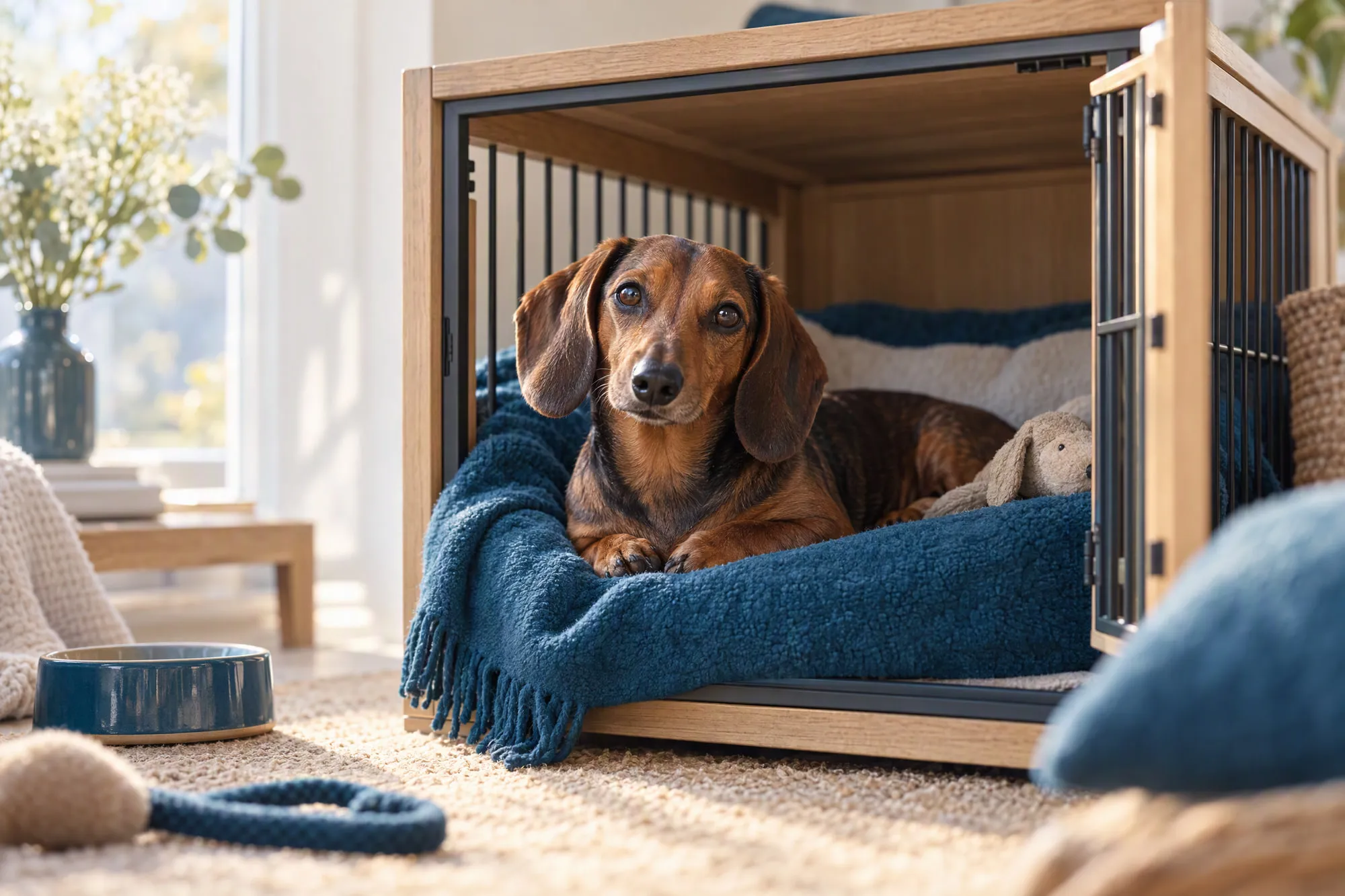
- The crate or pen: big enough for your dog to stand up, turn round and lie stretched out, but no bigger. Failing that, a small room with no sofa or stairs.
- Going outside: only for toilet breaks, on a short lead and a harness, for a few minutes, then straight back to rest. No free time, not even in the garden.
- Moving around: carry your dog by supporting the chest and the pelvis, with the back level. No stairs, no jumping, no games.
- Comfort: a thick, washable bed, water within reach, and the crate in a living area so your dog doesn’t feel isolated.
- Keeping busy: lick mats, food toys filled with part of the daily ration, sniffing for treats hidden in a towel, short calm-settling exercises.
- Bladder and skin: if your dog is paralysed, your vet will show you how to express its bladder. Turn your dog every few hours and keep it clean and dry to prevent pressure sores and urine scalding.
Passive range of motion for the back legs (bicycling)
- Lay your dog on its side on a comfortable mat, with its back straight.
- Hold the upper leg, one hand above the knee and the other under the foot.
- Slowly bend the leg towards the tummy, then extend it backwards, in a bicycling motion, without forcing.
- Do 10 to 15 gentle movements, then switch sides.
Good to know: only start this exercise if your vet or physiotherapist has prescribed it and shown you how. Stop if your dog whimpers, tenses up or tries to roll over.
Rehabilitation and life after IVDD
Rehabilitation speeds up recovery and helps your dog regain strength and coordination. Depending on the case, it combines floor exercises, underwater treadmill walking, massage and balance work. Our article on dog physiotherapy and hydrotherapy explains these techniques and how to find a qualified professional.
Some dogs are left with minor after-effects: a slightly wobbly gait, or toes that scuff when they’re tired. Most of them nevertheless live very happily. For a dog that doesn’t regain the use of its back legs, a dog wheelchair can give back real independence, and an adapted home makes daily life simpler: see our ideas for home adaptations for a senior dog.
Reducing the risk of IVDD (and of it coming back)
You can’t change a dachshund’s genes, but some simple measures reduce the strain on its spine:
- A healthy weight: excess weight increases the load on the back. Our article on the overweight dog and its joints helps you take stock.
- Regular daily exercise: in the DachsLife survey of more than 2,000 dachshunds (Packer et al., 2016), dogs that exercised for more than an hour a day were affected less often, and those exercising for less than 30 minutes more often. This link still needs confirming, but it makes the case for an active, well-muscled dog rather than an over-protected one.
- A harness rather than a collar, especially for dogs that pull, to spare the neck.
- Ramps and non-slip floors, particularly after a first episode: repeated jumps from a height and slips are best kept to a minimum.
- Responsible breeding: in some countries, breed clubs use X-rays of calcified discs to select breeding dogs. Ask the breeder about this before taking on a puppy.
No supplement or diet has been shown to prevent IVDD. Acting quickly at the first signs remains the best protection. Find our other guides in the dog joints and spine section.
Key points on IVDD in dogs
IVDD is common in short-legged breeds and can range from simple pain to paralysis. Above all, remember this: a dog that is wobbly, can’t walk or can’t pass urine must be seen the same day. Mild cases often recover with well-managed strict rest, more serious ones with surgery, and the chances of recovery are very good when deep pain perception is intact. With patience, rehabilitation and a few changes at home, most dogs go back to a happy, active life.
Frequently asked questions
Can a dog recover from IVDD without surgery?
Yes, often, when the case is mild: pain only, or a dog that can still walk despite an unsteady gait. Treatment then combines strict rest for at least four weeks with pain medication prescribed by your vet. The risk of relapse is higher than after surgery, however, and any deterioration means going straight back to the vet.
Can a dog paralysed in its back legs walk again?
Often, yes. In a 2017 meta-analysis, more than 90% of paralysed dogs that still had deep pain perception walked again after surgery, compared with around 60% when that sensation had been lost. How quickly the dog is treated and well-run rehabilitation make a big difference.
How long does recovery from IVDD surgery take?
Dogs usually stay in hospital for a few days, then need at least four weeks of restricted activity at home, with rehabilitation exercises. A dog that could still walk often recovers within a few weeks; a paralysed dog may take several weeks to several months. Your surgeon will give you a timetable suited to your dog.
How can I tell if my dog has back pain?
A dog with back pain often stands hunched, moves cautiously, refuses to jump or climb the stairs, trembles or yelps when picked up. With neck pain, it keeps its head low and avoids turning it. These signs mean you should see your vet promptly, especially with a dachshund or a French bulldog.
Can my dachshund climb stairs and jump on the sofa?
After an episode of IVDD or during strict rest, no: stairs, jumping and boisterous play are off limits. For a healthy dachshund, studies don’t clearly show that banning jumping prevents disc disease, but limiting repeated jumps from a height, using ramps and keeping up regular exercise remain sensible precautions.
This article is for information only and does not replace a veterinary consultation. If in doubt, or if your dog is in pain or changes suddenly, contact your vet.
Sources and references
- ACVIM consensus statement on diagnosis and management of acute canine thoracolumbar intervertebral disc extrusion
- Proportion recovery and times to ambulation for non-ambulatory dogs with thoracolumbar disc extrusions treated with hemilaminectomy or conservative treatment: a systematic review and meta-analysis of case-series studies
- Current Approaches to the Management of Acute Thoracolumbar Disc Extrusion in Dogs
- Classification of Intervertebral Disc Disease
- DachsLife 2015: an investigation of lifestyle associations with the risk of intervertebral disc disease in Dachshunds
- Intervertebral Disc Disease