Senior dogs Practical tips
Home adaptations for a senior or arthritic dog: 12 simple ideas
Senior dog slipping on tiles or struggling with the stairs? 12 simple home adaptations: non-slip rugs, ramps, an orthopaedic bed and the right bowls.
Key takeaways
- An older or arthritic dog that slips tenses up, hurts itself and ends up moving less: making floors safe is the number one priority.
- A firm orthopaedic bed that is warm and easy to get out of makes getting up less painful and sleep more restful.
- Ramps, stair gates and a support harness cut down on jumping and falls, the main sources of pain and injury.
- The best adaptations cost next to nothing: trimming claws, moving a rug, keeping the essentials on the ground floor.
- If your dog falls, slips or struggles to get up more and more often, see your vet: pain or nerve weakness may be the cause.
Contents
When planning home adaptations for a senior dog or a dog with arthritis, start with three priorities: floors that don’t slip, a firm, warm bed and no more jumping (sofa, car, stairs). These changes, often inexpensive, reduce pain, falls and fatigue, and give your dog back the urge to move. Here are 12 practical ideas, room by room, to help your dog every day.
Why make home adaptations for a senior dog?
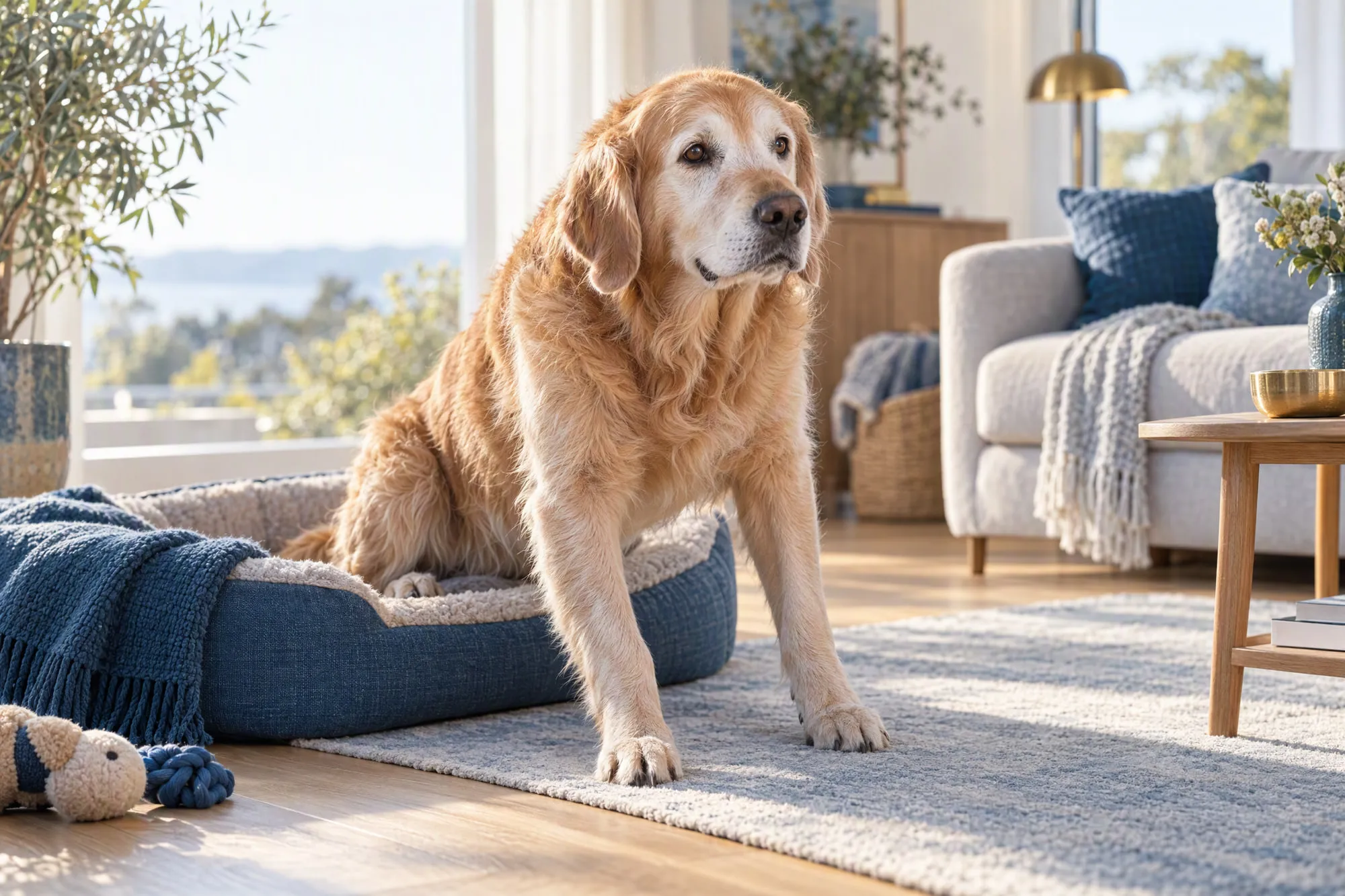
A home designed around a young dog can become an obstacle course for an older one. Every slip on a tiled floor puts sudden strain on joints that are already fragile. Every jump into the car or onto the sofa means a jolt on landing. The result: your dog is in pain, moves less, loses muscle… and its arthritis gets worse.
Signs it’s time to act:
- it slips, splays its legs or tiptoes ‘as if on eggshells’ across tiles or wooden floors;
- it hesitates for a long time before jumping onto the sofa or into the car, or no longer tries;
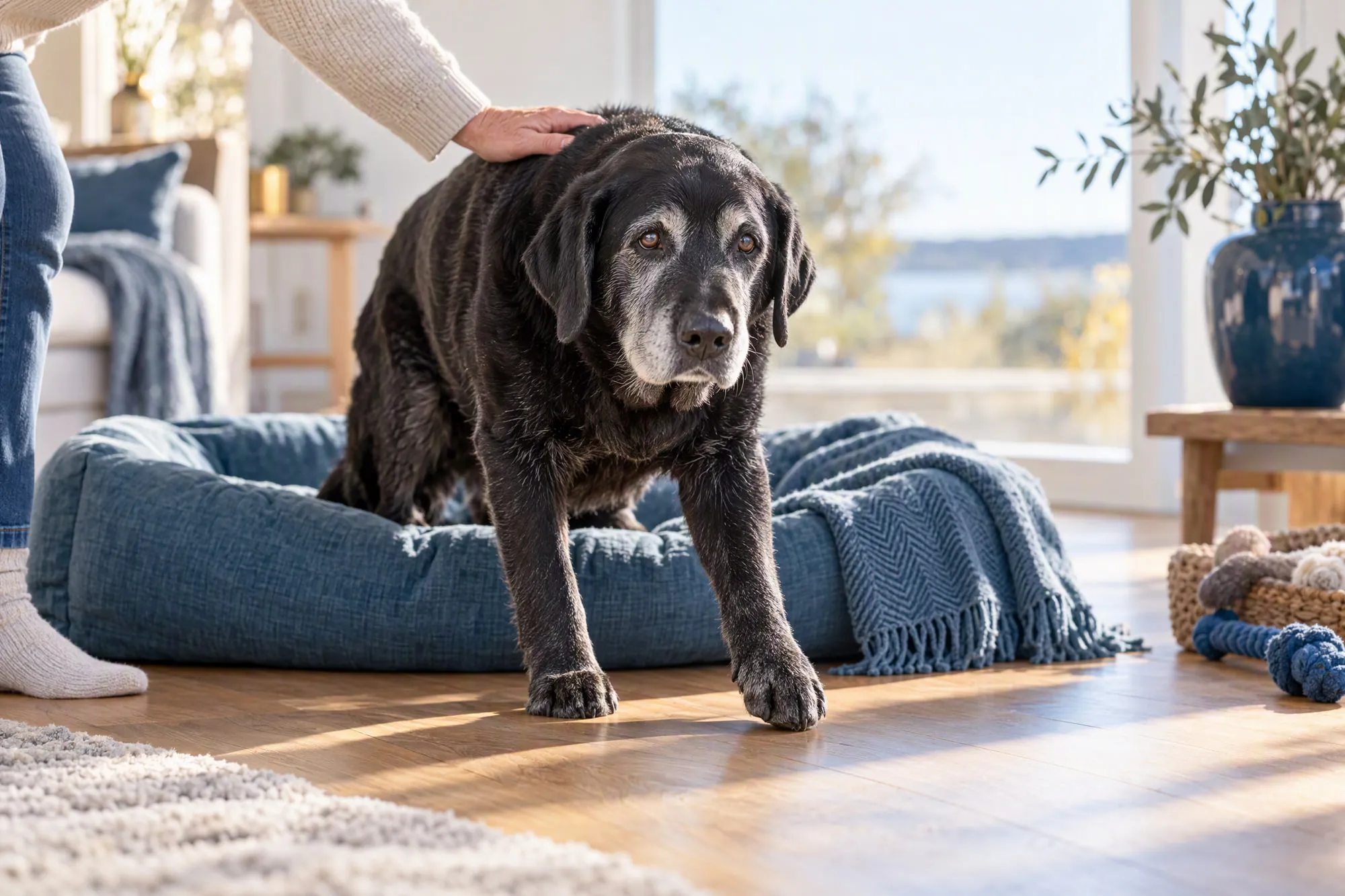
- it struggles to get up from its bed;
- it avoids certain rooms or stays on the ground floor;
- it sleeps on the cool floor rather than in a bed that is too soft or too high.
Floors: put a stop to slipping
1. Non-slip rugs along its routes
An older dog slipping on tiles needs safe ‘pathways’. Work out its daily routes (bed, bowls, front door, sofa) and cover them.
- Rubber-backed hall runners, easy to wash.
- Interlocking foam floor tiles (like gym mats or children’s play mats), cheap and easy to rearrange.
- Yoga mats for small areas: in front of the bowl, at the foot of the sofa.
- Avoid lightweight rugs that slide on the floor themselves, and fringes that claws can catch in.
Top priority: the spot where your dog lies down and gets up. That’s where it pushes hardest on its legs.
2. Short claws and clear pads
Overlong claws stop your dog placing its pads properly, and the pads are its ‘non-slip soles’. A useful rule of thumb: you shouldn’t hear its claws clicking on the tiles. Also have the fur sticking out between the pads trimmed. Your vet or a groomer can do this if your dog is difficult to handle.
3. Grip accessories, used with care
There are non-slip socks, soft boots and small rubber rings that fit over the claws. They can help a dog that slips a lot, as long as you introduce them gradually, check they don’t rub and take them off regularly to inspect the paws. They’re also useful for protecting the toes of a dog that drags its feet.
Bedding: sleep well, get up well
4. The right orthopaedic bed
A good orthopaedic dog bed spreads the weight, protects the joints and makes getting up easier. What to check:
- Memory foam or high-density foam, firm. A cushion that’s too soft sinks and forces the dog to ‘climb out’.
- Enough thickness: press your knee into the middle; you shouldn’t feel the floor.
- Size: your dog should be able to stretch out fully, legs extended.
- A low edge, or none on one side, so it can get in and out without stepping over.
- A washable cover and a waterproof liner if urine leaks start.
5. The right spot
- Warm and out of draughts: cold makes stiffness worse. Never straight on cold tiles or near a door.
- Close to family life, so your dog doesn’t have to keep getting up to join you.
- One bed per living area if possible, so it can rest wherever you are.
- On top of a non-slip rug, so it doesn’t slide as it gets up.
Stairs, sofa, car: cut out jumping
6. Make the stairs safe
Stairs are one of the riskiest places for an older dog, especially going down, when its weight rests on the front legs.
- Fit a stair gate at the top and bottom so it can’t tackle them alone, particularly at night.
- Put non-slip strips or treads on smooth steps.
- Go with your dog, on a short lead or with a support harness, at its own pace.
- If possible, keep the essentials on the ground floor: bed, water, access to the garden.
A few steps taken slowly are still good exercise for many dogs. It’s long, steep or slippery staircases, and rushing down them, that you need to avoid.
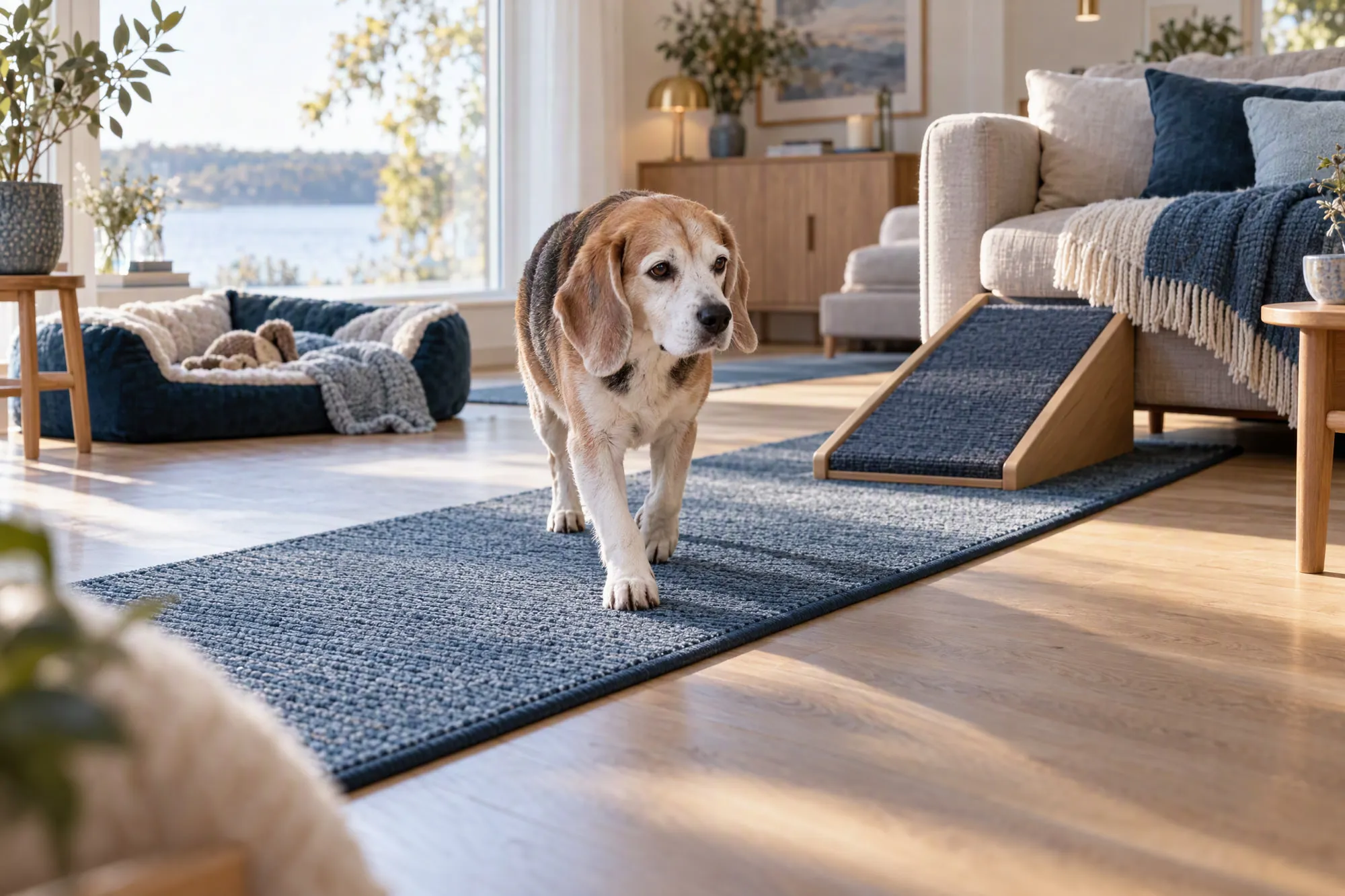
7. A ramp for the car and the sofa
A dog ramp removes the need to jump, which puts heavy strain on the elbows, shoulders and back on landing.
- Length: the longer the ramp, the gentler the slope. For a car boot about 70 cm high, allow at least 1.6 m.
- A non-slip surface (carpet, rubber, textured coating), ideally with small raised edges.
- Stability: it mustn’t shift or flex under your dog’s weight.
- Enough width that your dog isn’t afraid of falling off.
For the sofa or bed, dog steps with wide, fabric-covered treads are enough for a dog that is still mobile. For a very stiff dog, choose a ramp, or give it a comfortable bed on the floor instead.
Learning to use the ramp
- Lay the ramp flat on the floor and walk your dog along it on the lead, rewarding every step.
- Raise it very slightly (on a book or a step) and repeat, still at a walk.
- Gradually increase the height over several sessions until it reaches its final position.
- Keep a hand on the harness to reassure your dog and stop it jumping off the side.
Good to know: never push your dog up the ramp. A few short, happy sessions are better than one long, stressful one.
8. A support harness close to hand
For a heavy dog or one whose back legs are weakening, a harness with handles (front, back or both) helps it get up, get into the car, manage a step or go out into the garden. At a pinch, a rolled-up towel passed under the belly, just in front of the back legs, does the job. For tips on helping your dog get up properly, read our article on the old dog struggling to stand up.
Mealtimes: eating and drinking without effort
9. Bowls at the right height, on a floor with grip
Bending down to the floor can be painful for a dog with a sore neck, back or front legs. A slightly raised bowl on a stable stand helps it eat comfortably. Put it on a non-slip mat: a dog that eats with its legs splayed on tiles soon tires.
10. Several water stations
Older dogs sometimes feel less thirsty and are less keen to move about. Put a bowl of fresh water in every room where your dog spends time, and one upstairs if it sleeps there. It’s simple, and it matters for its kidneys as well as its comfort.
Outdoors and familiar landmarks: a safe, reassuring home
11. Easy access to the outdoors
- A ramp or an intermediate step to get over the doorstep or the garden steps.
- A clear, well-lit path to its usual spot, for late-evening toilet trips.
- A grassy area nearby: short, frequent walks are better than one long outing and help maintain its muscles. Take a look at our exercises for dogs with arthritis too.
- A fenced-off pool or pond: an older dog that falls into water may not be able to get out.
12. Stable landmarks and a night light
With age, eyesight and sometimes memory decline. A dog that can’t see well or becomes confused finds its way around thanks to a stable environment:
- avoid moving furniture around, and always keep its things in the same place;
- put a night light in the hallway and near its bed;
- pad sharp corners at head height and clear cluttered walkways;
- stick to regular routines (meals, walks, bedtime).
Where to start? Our summary
| Adaptation | Priority | Budget |
|---|---|---|
| Claws and fur between the pads trimmed | Very high | Next to nothing |
| Non-slip rugs along routes and beside the bed | Very high | Low |
| Firm orthopaedic bed in a warm spot | Very high | Medium |
| Stair gate | High | Low |
| Car ramp | High | Medium |
| Support harness | High if back legs are weak | Low to medium |
| Suitable bowls, several water stations | Medium | Low |
| Night light and stable landmarks | Medium | Next to nothing |
Don’t forget the most powerful factor of all, which you won’t see around the house: weight. A lean dog slips less, gets up more easily and spares its joints. Our advice on helping an overweight dog get back to a healthy weight goes hand in hand with these adaptations.
Key points for a home that suits your senior dog
Adapting your home for an older dog is mostly about removing three enemies: slippery floors, jumping and cold. Start with the free changes (claws, moving rugs, a bed in a warm spot), then, depending on your dog’s needs, invest in an orthopaedic bed, a ramp or a harness. Watch your dog: if it dares to cross the kitchen again or follows you into the living room, you’ve won. And remember that these adaptations support your vet’s pain management; they don’t replace it. You’ll find all our advice in our senior dog section.
Frequently asked questions
How do I stop my old dog slipping on tiled floors?
Lay non-slip rugs or foam floor tiles along its usual routes and where it lies down and gets up. Keep its claws short and have the fur that sticks out between its pads trimmed. If it keeps slipping despite all this, have it examined, as slipping can be a sign of pain or weakness in the legs.
What kind of bed is best for a dog with arthritis?
Choose an orthopaedic bed made of memory foam or high-density foam, thick enough that its hips and elbows never touch the floor, and big enough for it to stretch out fully. A low edge makes it easier to get in and out. A washable cover and a waterproof liner are useful for older dogs.
Can an old dog still use the stairs?
Many older dogs can still manage a few steps taken slowly, on the lead or with a harness, and it even helps maintain their muscles. However, long, steep or slippery staircases, and above all rushing down them, are best avoided. A stair gate stops your dog going up or down alone and prevents falls, especially at night.
Dog ramp or dog steps: which should I choose?
A ramp is better for dogs with arthritis or a lot of stiffness, because it removes the effort of bending to climb steps. Dog steps are more compact and are enough for a dog that is still mobile to reach the sofa or bed. Either way, the surface must be non-slip and the ramp or steps stable.
Should an old dog’s food bowl be raised?
A slightly raised bowl helps dogs with a sore neck, back or front legs. In large, deep-chested breeds, however, one study linked raised bowls to a higher risk of gastric dilatation-volvulus (bloat). Ask your vet for advice based on your dog’s breed and condition.
This article is for information only and does not replace a veterinary consultation. If in doubt, or if your dog is in pain or changes suddenly, contact your vet.