Joints & mobility Complete guide
Arthritis in dogs: symptoms, treatment and how to help your dog every day
Stiff mornings, limping, shorter walks: how to spot arthritis in dogs, the treatments your vet can offer and practical ways to help your dog at home.
Key takeaways
- Arthritis (osteoarthritis) is a chronic, progressive joint disease: it can’t be cured, but pain can be kept well under control and mobility preserved for years.
- The first signs are subtle: stiffness on getting up, hesitating at the car or the stairs, slower walks. A dog that is ‘slowing down’ is often in pain.
- Treatment is multimodal: weight control, suitable exercise, pain relief prescribed by your vet (NSAIDs, anti-NGF antibody), physiotherapy and sometimes surgery.
- At home, four things make a real difference: a healthy weight, short and regular walks, non-slip floors and a soft, warm bed.
- Never give your dog human medicines (paracetamol, ibuprofen, aspirin, naproxen): they can be seriously toxic to dogs.
Contents
Arthritis in dogs (vets usually call it osteoarthritis) is a chronic joint disease that causes pain, stiffness and loss of mobility. It can’t be cured, but it can be managed very well: with an early diagnosis, suitable pain relief prescribed by your vet and a few simple changes at home (weight, walks, floors, bedding), most arthritic dogs go back to a comfortable, active life. Here’s how to recognise the signs, understand the treatment options and, above all, what you can start doing today.
What is arthritis in dogs?
A healthy joint works like a well-oiled hinge: the ends of the bones are covered in smooth, shock-absorbing cartilage and bathed in joint fluid that keeps everything lubricated. In arthritis, this cartilage gradually wears away. The bone underneath reacts by thickening and forming bony outgrowths (osteophytes, or ‘bone spurs’), the joint lining becomes inflamed and the fluid loses its quality. The result: the joint becomes stiff, less mobile and painful.
It’s a vicious circle. The dog is in pain, so it moves less; its muscles waste away; the joint is less well supported; it deteriorates further and hurts even more. Every part of treatment aims to break this circle.
Which dogs are affected?
Arthritis is the most common joint disease in dogs. A large British study (VetCompass, more than 450,000 dogs) found the main risk factors to be age over 8 years, higher body weight, neutering and certain breeds such as the Labrador and the Golden Retriever. But arthritis is not just a problem of old dogs: most often it is secondary to another problem, sometimes from a very young age.
- Developmental diseases: hip dysplasia, elbow dysplasia, osteochondrosis.
- Injuries: cruciate ligament rupture, a luxating kneecap, a fracture involving a joint.
- Excess weight: it increases the load on the joints, and fat itself keeps inflammation going.
- Conformation and activity: large breeds, and working or sporting dogs under heavy strain.
The joints most often affected are the hips, elbows, knees and shoulders, but also the carpi (wrists) and the hocks. The spine can be affected too, in which case it’s called spondylosis.
Arthritis in dogs: the symptoms to look out for
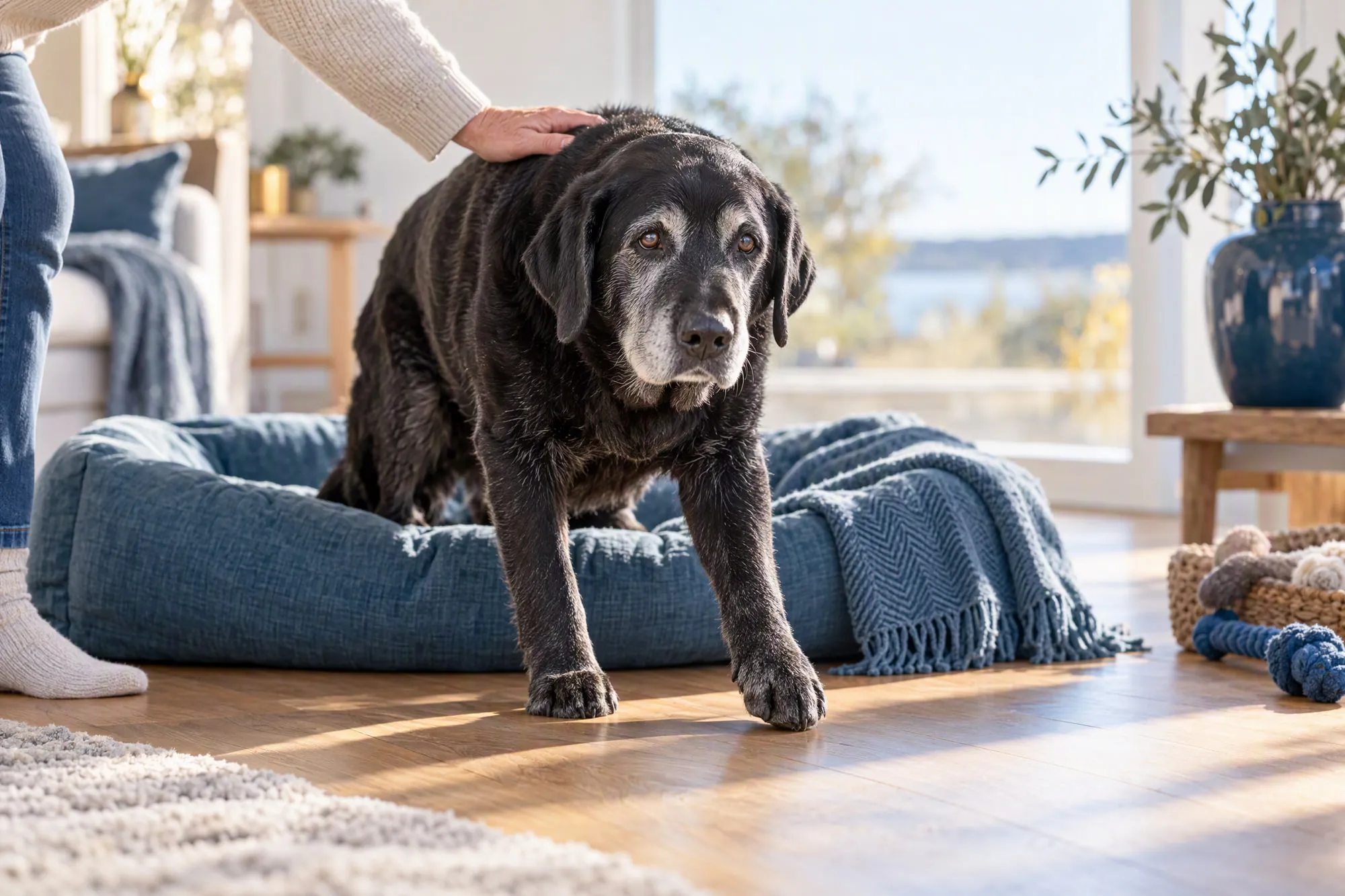
Dogs are champions at hiding pain. They almost never cry out: they adapt. That’s why the first symptoms of arthritis are often put down to ‘old age’ or ‘laziness’. Yet a dog that is slowing down is very often in pain.
Everyday signs
- Takes a while to get up, especially in the morning or after a nap, then ‘loosens up’ after a few minutes.
- Hesitates before jumping into the car or onto the sofa, or at the foot of the stairs.
- Walks behind you instead of leading the way, or stops more often.
- Limps on one leg, on and off, or switches legs.
- Sits lopsidedly, with one back leg stuck out to the side.
- Often licks a joint (wrist, knee), sometimes leaving a brownish saliva stain.
- Growls when brushed or when you touch the hips, or avoids being stroked along the back.
- Plays less, sleeps more, is less tolerant of other dogs.
Recognise your dog in several of these points? Our article on the old dog struggling to stand up covers the possible causes of this very common sign, and our guide to the dog limping helps you tell a minor limp from an emergency.
Signs of arthritis by stage
| Stage | What you see | What’s happening in the joint |
|---|---|---|
| Early | Stiffness on waking that wears off quickly, mild tiredness at the end of a walk, hesitant jumping | First cartilage damage, low-grade inflammation |
| Moderate | Limping after exercise or at rest, refusing some jumps, shorter walks, licking a joint | Thinner cartilage, osteophytes visible on X-ray, early muscle loss |
| Advanced | Difficulty getting up or lying down, constant limp, obvious muscle loss on the thighs, dog withdrawing or becoming irritable | Badly damaged cartilage, thickened joint with little movement, chronic pain |
Vets often use a more precise scale, the COAST tool, which grades arthritis from 0 (a healthy dog with no risk factors) to 4 (severe arthritis). It helps tailor treatment to the stage and track progress over time.
Diagnosis: how your vet confirms arthritis
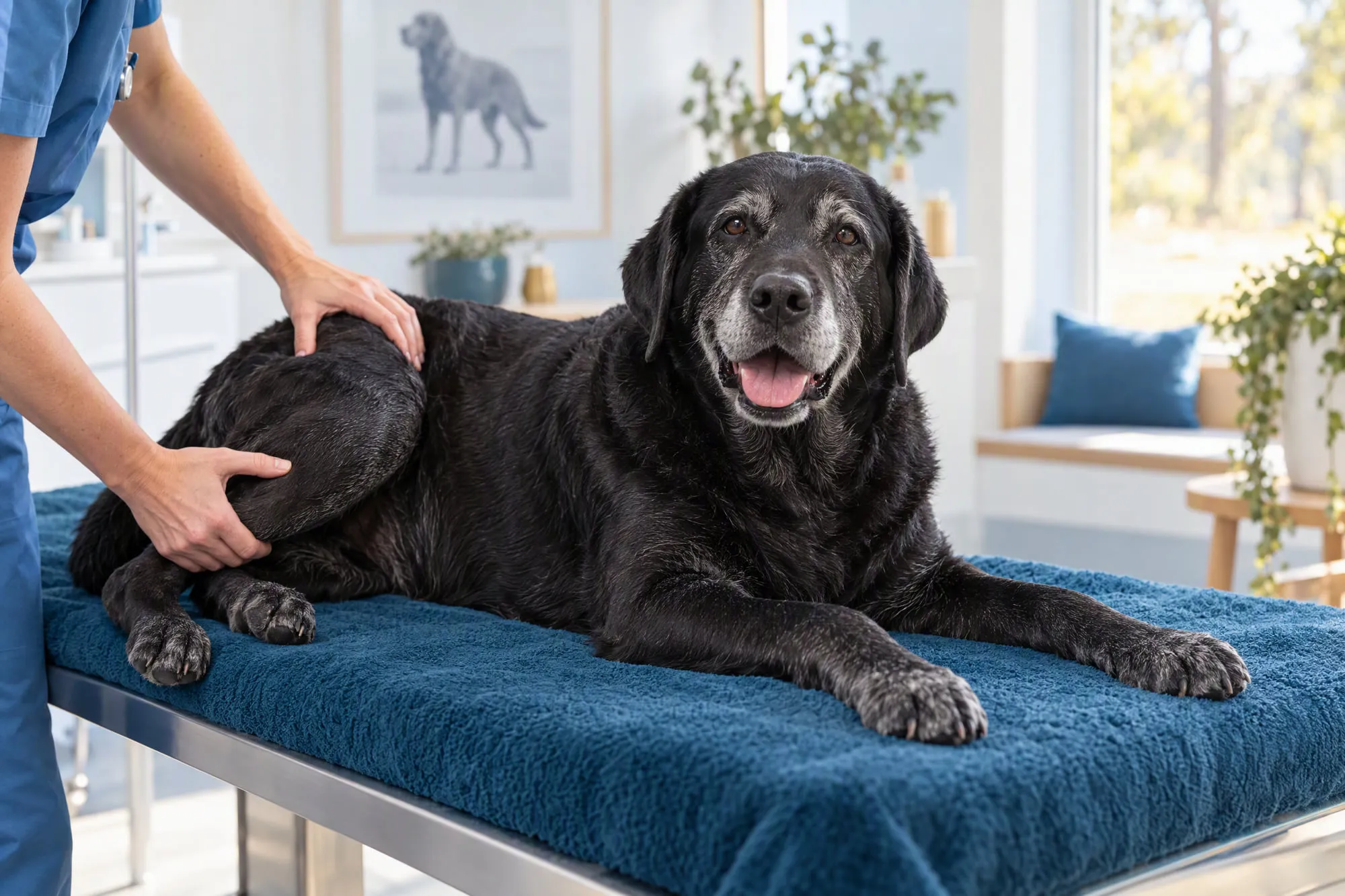
Diagnosis starts with a careful orthopaedic examination. Your vet watches your dog walk and trot, feels its legs, and moves each joint to check for pain, thickening, crackling or reduced range of motion, as well as assessing muscle mass.
Prepare for the appointment:
- Film your dog at home: getting up, on the stairs, out on a walk. At the vet practice, excitement often masks the limp.
- Write down what you’ve noticed: since when, at what time of day, after what kind of exercise, what makes it worse or better.
- List everything it gets: food, treats, supplements, any medicines already given.
X-rays (sometimes under sedation) confirm the changes and look for an underlying cause such as dysplasia. An important point: the image doesn’t always reflect the pain. Some dogs with severe arthritis on X-ray walk well, while others suffer with only mild changes. A blood test is often done before long-term treatment to check the kidneys and liver. Less often, a CT scan, MRI, joint fluid sampling or arthroscopy is needed, particularly to rule out another disease (infection, autoimmune disease, bone tumour, neurological problem).
Treatment for arthritis in dogs: the veterinary options
No treatment makes cartilage grow back. The goals are to control pain, slow progression and preserve muscle. International guidelines (the COAST group, 2023) emphasise a multimodal approach: several methods combined, tailored to the stage and the individual dog.
Non-steroidal anti-inflammatory drugs (NSAIDs)
These are the first-line painkillers for arthritis. There are several, designed specifically for dogs. Your vet chooses the drug and dose according to your dog’s weight, age and health, and plans blood tests if treatment is long-term.
- Never combine two NSAIDs, or an NSAID with a steroid.
- Stop and call your vet if your dog has vomiting, diarrhoea, black stools or a reduced appetite.
- Don’t change the dose yourself, even if your dog seems better.
Anti-NGF monoclonal antibody
This is the biggest innovation of recent years. NGF (nerve growth factor) is a protein found in excess in arthritic joints, where it amplifies pain signals. Bedinvetmab, a ‘caninised’ antibody, neutralises NGF. It is given as a monthly injection at the vet practice. In the key placebo-controlled study, it significantly improved pain as assessed by owners. It can be a useful option for dogs that don’t tolerate NSAIDs well, or as an add-on. Like any medicine, it has contraindications and possible side effects, which your vet will explain.
Other medicines and injections
Depending on the case, your vet may add other painkillers (for example gabapentin or amantadine), especially when chronic pain is well established. Joint injections (hyaluronic acid, platelet-rich plasma, stem cells) or polysulphated glycosaminoglycan injections are sometimes offered; results vary and the evidence is still limited.
Physiotherapy and rehabilitation
Veterinary physiotherapy is one of the most under-used tools. A vet with rehabilitation training or a qualified animal physiotherapist can offer tailored exercises, hydrotherapy (underwater treadmill, swimming), joint mobilisation, laser or electrotherapy. The aim: rebuild muscle without overloading the joint. Some dogs also benefit from acupuncture.
Surgery
Surgery comes in at two points. First, to treat the cause: stabilising a knee after a cruciate ligament rupture, correcting a luxating patella, operating on a dysplastic elbow. Second, in severe cases that no longer respond to medical treatment: hip replacement, femoral head excision, or fusing a joint (arthrodesis).
Arthritis in dogs: what can you do at home?
This is where you have the most influence. Everyday measures don’t replace pain relief, but they multiply its effect and often reduce the need for medication. Here’s how to help your arthritic dog day to day.
1. Get your dog back to a healthy weight
This is the single most effective measure, and it’s free. Every extra kilo puts strain on the joints and fuels inflammation. In obese dogs with arthritis, losing just 6 to 9% of body weight was enough to significantly reduce lameness. And in Labradors followed throughout their lives, those fed less lived longer and developed chronic diseases, including arthritis, later.
- You should be able to feel the ribs easily under a thin layer of fat, and see a clear waist from above.
- Weigh meals on kitchen scales rather than using a measuring cup.
- Count treats as part of the daily allowance (no more than around 10% of calories).
- Ask your vet for a target weight and a realistic rate of loss, often 1 to 2% of body weight per week.
Our guide to helping an overweight dog get back to a healthy weight explains the method step by step.
2. Adapt walks rather than stopping them
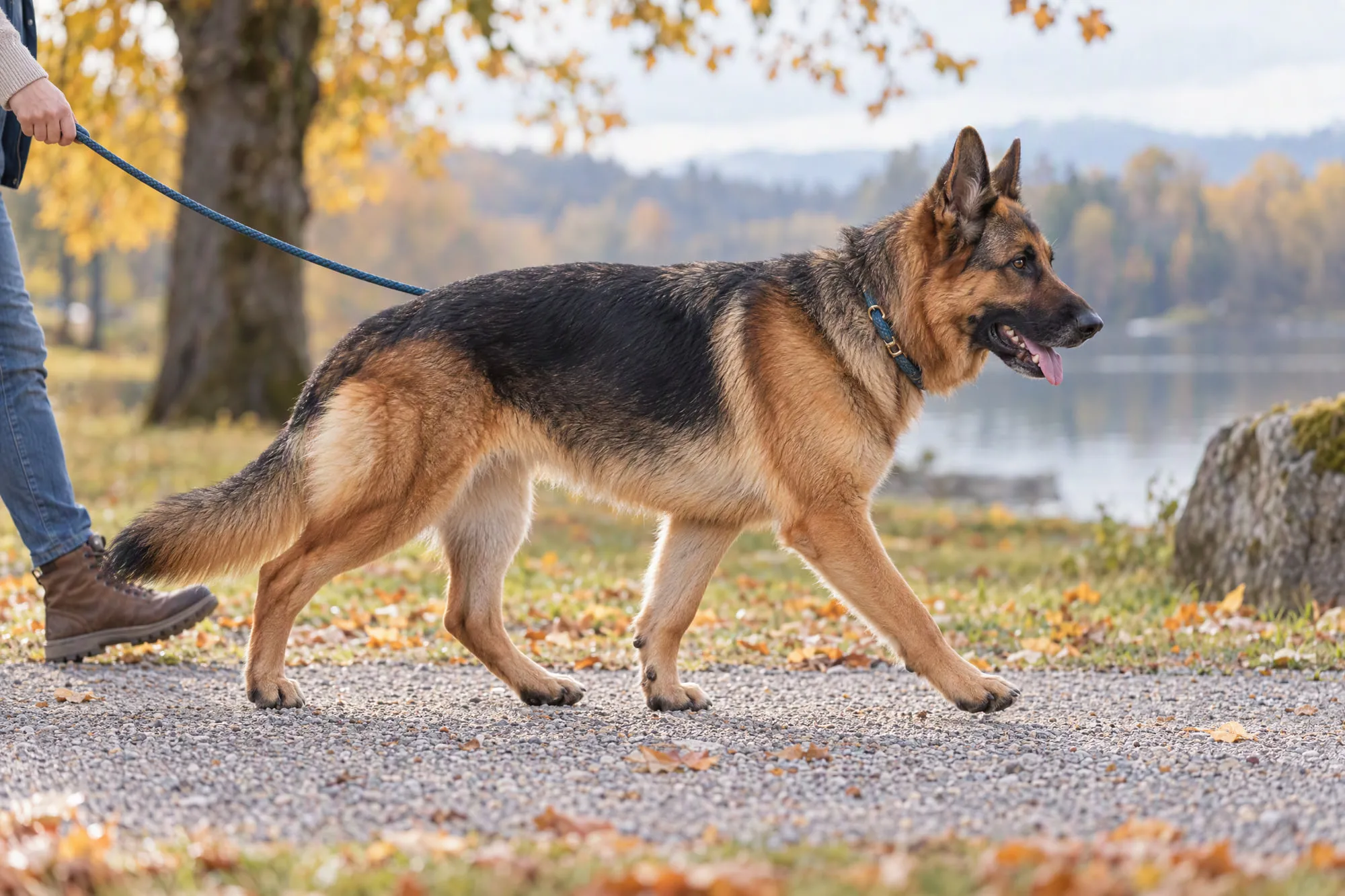
Complete rest makes arthritis worse: cartilage is nourished by movement and muscles waste quickly. The golden rule is consistency: the same amount of exercise every day, split up.
- Two to four walks of 10 to 20 minutes at a steady pace rather than one long ramble on a Sunday.
- Choose soft ground: grass, dirt paths, firm sand. Avoid long stretches of tarmac and steep descents.
- Let your dog warm up: the first five minutes should be very calm.
- Cut out ball throwing, sprinting, jumping, sudden stops and intense tug-of-war games.
- A useful rule of thumb: if your dog is stiffer the day after a walk, it was too long. Cut it by a third and build back up gradually.
- Swimming in calm, mild water is excellent, as long as your dog can get in and out without jumping.
3. Build muscle with gentle exercises
Strong muscles support the joint and take load off the cartilage. These exercises can be done at home on a non-slip surface once pain is under control. Check with your vet before you start, and stop if your dog limps more.
Slow sit-to-stands
- Stand your dog facing you on a rug or mat.
- Ask it to sit, gently guiding its head upwards with a treat.
- Get it to stand back up by slowly drawing the treat towards you.
- Start with 3 to 5 repetitions, then gradually build up to 10.
Good to know: the sit should be square, with both back legs tucked under the body. If your dog sits lopsidedly, position it alongside a wall.
Weight shifts
- Your dog is standing, square on all four legs.
- Place your hands flat on its hips and push very gently to one side for 2 to 3 seconds, just enough for it to resist.
- Do the same on the other side, then at shoulder level.
- Repeat 5 to 10 times per area.
Good to know: the aim isn’t to unbalance your dog but to get it to engage its stabilising muscles. It should stay still and relaxed.
Ground poles
- Lay 4 to 6 broom handles on the floor, spaced roughly the height of your dog’s shoulder (withers) apart.
- Walk your dog slowly over them on the lead.
- Do 3 to 5 passes in each direction.
- Once it’s easy, raise the poles slightly, by just a few centimetres.
Good to know: this exercise makes your dog bend its elbows, knees and hocks more. It should walk, never jump.
You’ll find more progressive routines in our selection of gentle exercises for dogs with arthritis.
4. Adapt your home
An arthritic dog that slips on tiles tenses up, hurts itself and eventually stops daring to move. The priorities:
- Non-slip rugs along its usual routes and where it gets up and lies down.
- A thick, firm orthopaedic bed with memory foam, easy to get out of, away from draughts.
- A ramp for the car and, if needed, the sofa; a stair gate in front of the stairs.
- Raised bowls at elbow height if your dog has a sore neck or front legs.
- Short claws, and the fur between the pads trimmed for better grip.
Our dedicated article offers 12 home adaptations for a senior dog or a dog with arthritis.
5. Use warmth
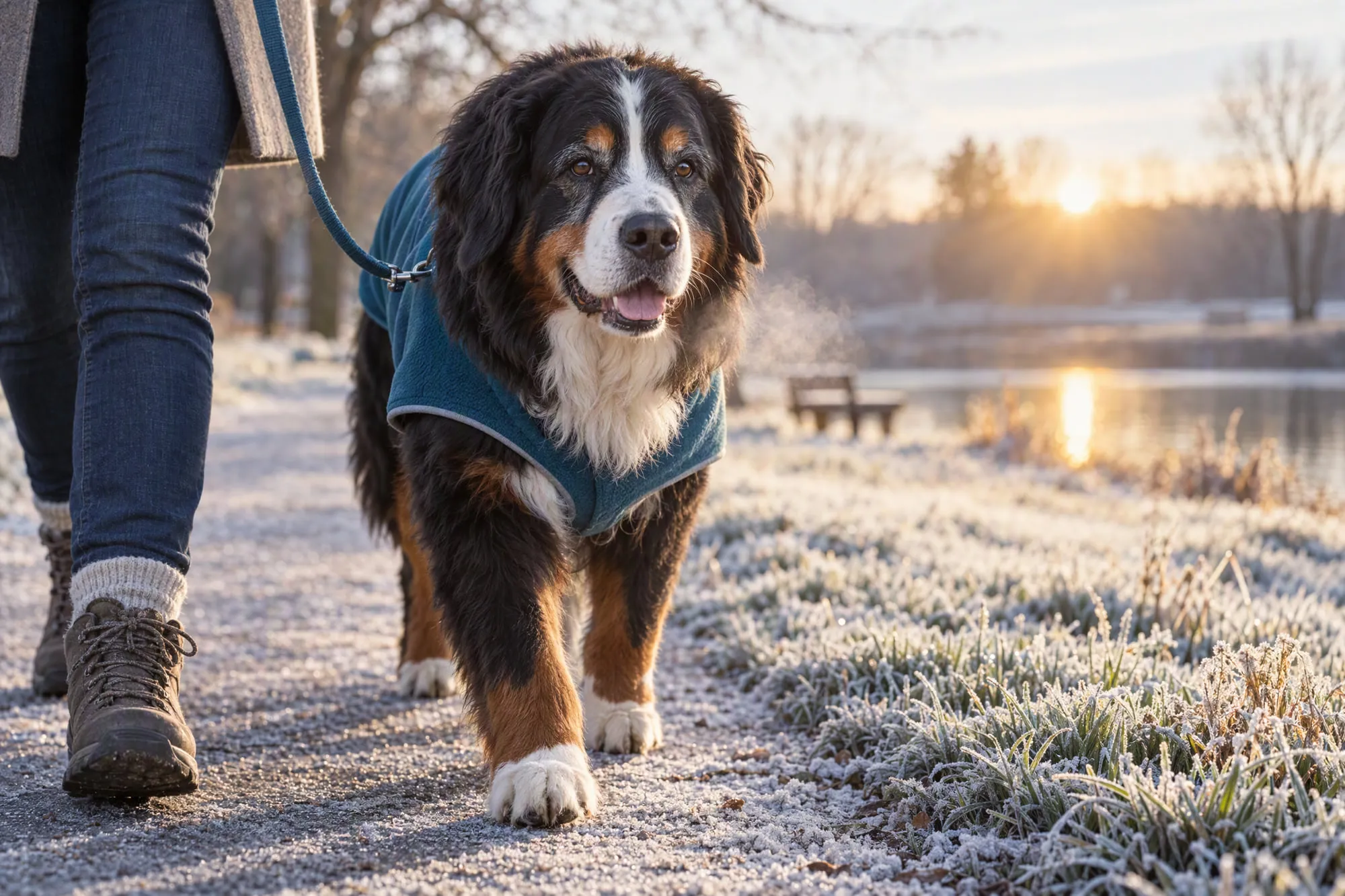
Cold and damp often make stiffness worse. A coat for winter walks and a warm bed help a lot. Before a walk, a lukewarm hot-water bottle wrapped in a towel and placed on a stiff hip or elbow for 10 to 15 minutes loosens the joint.
- Always test the temperature on your forearm: it should feel pleasantly warm, never hot.
- Don’t apply heat to a joint that is already hot or swollen, or straight after an injury.
- Avoid electric heat mats under a dog that can’t move off them by itself: there’s a risk of burns.
6. Massage your dog
A gentle 5 to 10 minute massage relaxes tense muscles around painful joints and strengthens your bond. Start with long strokes in the direction of the fur, from neck to tail, then small, slow circles on the large muscle groups (thighs, shoulders), never directly on the joint. Stop if your dog tenses, turns round or moves away. Step-by-step techniques are covered in our guide to massage for dogs with arthritis.
Diet and supplements for dogs with arthritis
Omega-3: the best supported
Marine omega-3 fatty acids (EPA and DHA, from fish oil) have the strongest evidence. A 2022 meta-analysis covering 72 trials concluded that diets and supplements enriched with omega-3 had a clear effect on arthritis pain. In one controlled trial, dogs fed a diet rich in fish oil put more weight on their worst-affected leg after three months. Your vet may also suggest a veterinary ‘joint’ diet, formulated to support mobility and weight control.
Other ingredients: what the studies say
| Ingredient | What the studies say | Why it’s used |
|---|---|---|
| Fish oil (EPA, DHA) | Several positive controlled trials; the clearest effect in the 2022 meta-analysis | Helps regulate inflammatory mediators; the best-documented ingredient |
| Green-lipped mussel (Perna canaliculus) | Several encouraging trials on mobility, carried out in small numbers of dogs | Provides particular omega-3s (ETA, EPA, DHA) and glycosaminoglycans |
| Undenatured type II collagen | A few positive trials on mobility; considered promising by the 2022 meta-analysis, which calls for further studies | Used in very small amounts, it is thought to work via the gut’s immune system |
| Glucosamine and chondroitin | Mixed results: improvement reported in some trials, no clear effect on pain in the 2022 meta-analysis | Natural components of cartilage, often combined with omega-3 and green-lipped mussel in complete formulas |
| Boswellia, turmeric | Still few studies in dogs, with vets noting improvement in some of them | Plants studied for their effects on inflammatory pathways |
These ingredients work on different mechanisms, which is why many formulas combine them. Whatever the product, give it every day for at least 6 to 8 weeks before judging, and review it with your vet.
To read a label properly, compare formulas and spot exaggerated claims, see our guide to choosing joint supplements for dogs.
A supplement never replaces pain relief: if your dog is in pain, it’s the treatment your vet prescribes that will ease it. Supplements have their place in the overall approach, alongside a healthy weight, suitable exercise and regular vet check-ups. Tell your vet about everything you give, especially if your dog is already on medication.
Arthritis flare-ups in dogs: what to do
A flare-up is when a stable arthritic dog suddenly becomes much more painful: it limps noticeably, struggles to get up, groans when lying down, pants at rest, licks a joint or refuses its walk. The joint may feel warm.
Common triggers
- Unusual exertion: a long hike, rough play with another dog, a day at the beach.
- A slip or an awkward movement.
- Cold, damp weather and changes of season.
- Stopping or forgetting a pain relief medicine.
- Gradual weight gain.
What to do
- Call your vet. They can adjust or step up pain relief for a few days and check that it isn’t another problem (cruciate ligament, slipped disc).
- Restrict activity: short lead walks for toilet breaks only for 24 to 72 hours, no stairs, no jumping. Avoid strict rest for long periods, though.
- Give your dog a soft bed somewhere warm, on a floor that isn’t slippery.
- No heat on a hot, swollen joint. In that case, a cold pack wrapped in a cloth for 10 minutes can be soothing, if your dog accepts it.
- No human medicines, not even ‘just half a tablet’.
- Build activity back up gradually, starting with very short walks.
Arthritis in older dogs: what’s different
Arthritis is very common in older dogs, but it is still too often blamed on age. ‘He’s just getting old’ often means ‘he’s in pain’. Many owners find that once the pain is managed, their old dog seems younger: it asks to play again, tackles the stairs or goes back to leading the way on walks.
A few specific points to know:
- Muscle loss is rapid in senior dogs: a few weeks of inactivity is enough. Gentle exercises are all the more useful.
- The choice of medicines takes other diseases into account (kidneys, liver, heart). Regular blood tests are therefore essential, and the anti-NGF antibody can be a useful alternative.
- Other causes can overlap with arthritis: neurological disease, muscle weakness, cognitive decline, failing eyesight. If something changes suddenly, see your vet.
- A senior health check every six months lets your vet adjust treatment as things change.
Reducing the risk of arthritis or slowing it down
Not everything can be prevented, especially inherited diseases, but you can do a great deal.
- From puppyhood: slow, controlled growth, a diet suited to large breeds, no strenuous exercise or slippery floors during growth.
- Throughout life: keep your dog at a healthy weight. It’s the most powerful protective factor.
- Regular, moderate activity, rather than occasional bursts of intense effort.
- Screening: for at-risk breeds, have your dog screened for dysplasia and choose a breeder who health-tests their breeding dogs. In the UK, ask to see both parents’ results under the BVA/Royal Kennel Club hip and elbow schemes.
- See your vet early for any limp lasting more than a few days: dealing quickly with a cruciate ligament rupture or dysplasia limits the arthritis that follows.
- An annual check-up, then every six months after the age of 7 or 8, to pick up the first signs.
Key points for living well with a dog with arthritis
Arthritis doesn’t have to confine your dog to its bed. Remember three priorities: manage pain with your vet, keep a healthy weight and move a little every day. Add floors that don’t slip, a good bed and plenty of patience. Watch your dog, note its progress, and don’t hesitate to check in with your vet whenever something changes: it’s a team effort, and it’s well worth it.
Frequently asked questions
Is arthritis painful for dogs?
Yes. Arthritis is first and foremost a painful disease, even when the dog doesn’t whimper. Dogs mainly show pain through changes in behaviour: they move less, get up slowly, avoid jumping or become grumpy when touched. Managing pain is an essential part of the treatment.
What is the best treatment for arthritis in dogs?
There is no single treatment: the best results come from combining several approaches. Weight loss where needed, regular exercise and suitable pain relief (an NSAID or an anti-NGF antibody, depending on the dog) form the foundation. Physiotherapy, a diet rich in omega-3 and sometimes surgery complete the plan you put together with your vet.
Can I give my arthritic dog human painkillers?
No. Ibuprofen, paracetamol, aspirin or naproxen from your medicine cabinet can cause stomach ulcers, kidney or liver damage in dogs, which can sometimes be fatal. Only a vet can prescribe pain relief that suits your dog, its weight and its overall health.
Should I keep walking a dog with arthritis?
Yes, movement is essential: it maintains the muscles that stabilise the joints and nourishes the cartilage. The idea is to split exercise up, for example two to four walks of 10 to 20 minutes at a steady pace on soft ground, rather than one long walk at the weekend. Avoid sprinting, jumping and ball throwing.
How long can a dog live with arthritis?
Arthritis is not a fatal disease in itself, and a well-managed dog can live a normal lifespan. What matters is quality of life: poorly controlled pain, significant muscle loss or being unable to get up weigh far more than how the arthritis looks on an X-ray. That’s why regular check-ups matter.
How can I help my dog’s arthritis naturally?
The most effective ‘natural’ measures are also the simplest: helping an overweight dog slim down, adapting walks, building muscle with gentle exercises, laying non-slip rugs and providing a warm bed. Among supplements, omega-3 has the best evidence. These measures support your vet’s treatment; they don’t replace it when your dog is in pain.
This article is for information only and does not replace a veterinary consultation. If in doubt, or if your dog is in pain or changes suddenly, contact your vet.
Transparency: Novalia develops and sells a complementary feed for dogs. Our articles stay independent: the product is only mentioned where relevant, always clearly labelled, and never in place of veterinary advice.
Sources and references
- COAST Development Group's international consensus guidelines for the treatment of canine osteoarthritis
- Osteoarthritis in Dogs
- Osteoarthritis
- Arthritis in Dogs
- A 2022 Systematic Review and Meta-Analysis of Enriched Therapeutic Diets and Nutraceuticals in Canine and Feline Osteoarthritis
- The effect of weight loss on lameness in obese dogs with osteoarthritis
- BVA Hip Dysplasia Scheme for dogs