Exercise & rehab Practical tips
Massage for dogs with arthritis: simple techniques, heat and what to avoid
Massage for dogs with arthritis: 6 step-by-step techniques, heat or cold, gentle stretches and the mistakes to avoid so your dog can relax safely.
Key takeaways
- A gentle 10 to 15-minute massage relaxes the muscles that compensate for pain, calms your dog and helps you spot a hot, swollen or tender area early.
- Massage the muscles around the joints, never the painful joint itself, and never press on the spine.
- Gentle heat suits chronic stiffness, cold suits a hot, swollen joint after exertion: 10 to 15 minutes at most, always through a cloth.
- Massage complements the treatment prescribed by your vet but does not replace it: it does not repair cartilage.
- Stop as soon as your dog tenses up, turns towards your hand or tries to move away: a massage should never be endured.
Contents
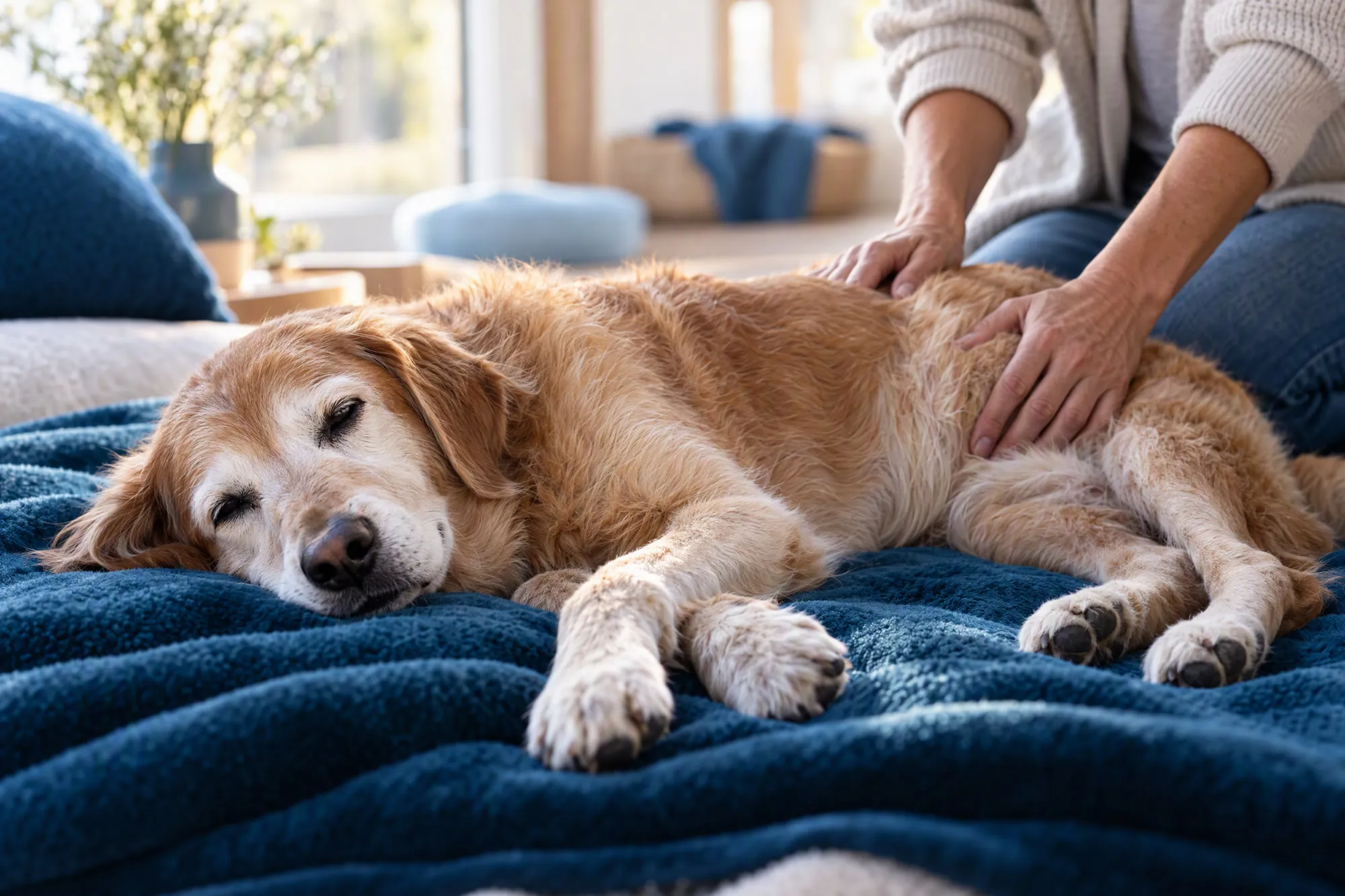
Yes, massage for dogs with arthritis can genuinely help: 10 to 15 minutes of slow, gentle strokes relaxes muscles tensed by pain, encourages relaxation and makes exercise more comfortable. The golden rule is simple: massage the muscles around the joints, never the painful joint itself, and stop at the first sign of discomfort. Here are six step-by-step techniques, a complete routine, how to use heat and cold properly, and the mistakes to avoid.
What massage can (and can’t) do for a dog with arthritis
When a hip or an elbow hurts, your dog changes the way it stands and walks. Other muscles take over: the shoulders and neck when the hindquarters are sore, the back when your dog gets up by ‘hauling’ itself on its front legs. These compensating muscles become tense, and sometimes painful in turn.
Massage can:
- relax these tight muscles and improve comfort at rest;
- calm your dog: slow massage triggers the body’s relaxation mechanisms, which also helps with sleep;
- prepare the joints before a walk or a session of exercises for dogs with arthritis;
- help you keep an eye on your dog’s body: by massaging regularly, you will quickly notice a warm area, a lump or a new tender spot.
On the other hand, massage does not repair cartilage and is no substitute for a diagnosis or the treatment prescribed by your vet. Studies specific to dogs are still few: many of the expected benefits are inferred from research in people. So it is an excellent complement, safe when done properly, within the overall management of arthritis in dogs.
Before you massage your dog: preparation and golden rules
A good massage starts before you put your hands on your dog.
- Choose the right moment: a quiet time when your dog is already relaxed, for example in the evening after the last walk. Never straight after a meal or when your dog is excited.
- Make your dog comfortable: lying on its side on its bed or a thick rug. If your dog prefers to lie on its tummy, go with it.
- Warm your hands and take off rings and bracelets.
- Get the pressure right: to start with, imagine pressing on your closed eyelid without discomfort. You can press a little more on the big thigh muscles, never on the bones.
- Go slowly: a slow stroke soothes, a fast one stimulates. For a dog with arthritis, relaxation is the aim.
- Watch your dog all the time. A dog that is enjoying it sighs, closes its eyes, relaxes or stretches. A dog that is uncomfortable tenses up, turns its head towards your hand, licks its lips, yawns or tries to get up.
Massage techniques for dogs with arthritis, step by step
These techniques follow on in order: always start with stroking (effleurage) and always finish with it. If you are short of time, just do techniques 1, 2 and 3.
1. Effleurage: long strokes
- Rest one hand flat on the back of your dog’s neck and leave it there for a few seconds without moving, so your dog gets used to it.
- Slowly slide your open hand from the neck to the base of the tail, in the direction of the coat, alongside the spine.
- Do the same over the shoulders and down the front legs, then over the thighs and down the back legs to the hock.
- Allow about 3 to 4 seconds per stroke, without ever losing contact with your dog.
- Repeat 5 to 10 times on each area.
Good to know: effleurage on its own is already a real massage. For a very old or very sore dog, it is often the only technique to use at first.
2. Gentle kneading of the large muscles
- Shape your hand into a ‘C’ on your dog’s thigh, thumb on one side, fingers on the other.
- Gently lift the muscle, as if kneading soft dough, then release. Move a few centimetres along and repeat.
- Work the whole thigh, from hip to knee, then the back of the thigh.
- Do the same on the shoulder and the upper front leg.
- Along the back, knead only the muscles on either side of the spine, two finger-widths away from it, never on the vertebrae.
- Finish each area with a few long strokes.
Good to know: a compensating muscle is often firmer and warmer than the one opposite. Always compare both sides: it is useful information to pass on to your vet.
3. Small circles around the joints
- Find the joint you want to work around, for example the hip.
- Place the tips of two or three fingers on the muscle just next to the joint, not on the bone.
- Make small, slow circles, moving the skin over the tissues rather than sliding over the coat.
- Make 5 or 6 circles, move your fingers a centimetre, and work all the way around the joint.
- Repeat around the other stiff joints: knee, elbow, shoulder.
Good to know: keep the pressure light. If your dog turns its head towards your hand or pulls its leg away, go back to long strokes.
4. Skin rolling along the back
- Your dog is lying on its tummy or side, relaxed.
- Gently pinch a fold of skin between your thumbs and index fingers, beside the spine, at shoulder level.
- Move this fold towards the tail by ‘rolling’ the skin between your fingers, like a wave.
- Do 3 to 4 passes on each side of the spine.
Good to know: in some dogs, the skin is tight and the movement is uncomfortable. Don’t persist: move on to the next technique. Avoid this technique if your dog has known back pain.
5. Passive flexion and extension
- Your dog is lying on its side. Work on the uppermost leg.
- Hold the leg with one hand above the joint and the other below it, so it is fully supported.
- Very slowly bend the joint until you feel slight resistance, and go no further.
- Then slowly straighten it, always within the comfortable range.
- Do 10 to 15 movements per joint, then turn your dog over to work the other side.
Good to know: range of movement is gained over weeks, never in a single session. Ask your vet or a rehabilitation professional to show you these movements the first time.
Stretches for dogs: gentle, passive and always after massage
Stretches extend the benefits of massage, but they call for even more care. Only stretch a dog that is warmed up, never ‘from cold’. For a dog that stands easily, the active treat stretches described in our exercises are often simpler and safer.
6. Gentle hip extension stretch
- Your dog is lying on its side, relaxed, after the massage.
- Place one hand under the knee and rest the other flat on the hip to keep it steady.
- Slowly draw the whole leg backwards, keeping it parallel to the floor, until you feel slight resistance.
- Hold for 15 to 20 seconds, without jerking, then gently bring the leg back.
- Do 2 to 3 repetitions per side.
Good to know: never pull on the foot, as this puts tension on the knee and hock instead of the hip. If your dog turns round, tenses up or pulls the leg away, stop.
A complete 10 to 15-minute routine
Here is how to link the techniques together for a full massage, ideally in the evening:
| Step | Technique | Approximate time |
|---|---|---|
| 1 | Long strokes over the whole body | 2 to 3 min |
| 2 | Kneading the thighs, shoulders and back muscles | 3 to 4 min |
| 3 | Small circles around the stiff joints | 2 to 3 min |
| 4 | Passive movements or a gentle stretch (if approved) | 2 to 3 min |
| 5 | Final long strokes, then rest somewhere warm | 1 to 2 min |
For a dog that is very stiff in the morning, a short 5-minute version (long strokes, then kneading the thighs) before the first walk often helps to loosen up the joints.
Heat or cold: which is better for a dog with arthritis?
Heat and cold are simple, useful tools, as long as you use them at the right time.
| Situation | Heat? | Cold? |
|---|---|---|
| Usual stiffness on waking or in cold weather | Yes | No |
| Before a massage or exercises | Yes | No |
| Hot, swollen joint after too much exertion | No | Yes |
| Wound, irritated skin, area with reduced feeling | No | No |
| Sharp pain or sudden lameness | No: see your vet | No: see your vet |
Heat for dog arthritis: how to do it properly
- A warm hot water bottle or a heated wheat bag, always wrapped in a towel.
- Test the temperature on the inside of your wrist: it should feel pleasant, never hot enough to burn.
- 10 to 15 minutes on the muscles around the stiff joint, staying beside your dog.
- No electric heated blanket under a dog that can’t move by itself: an older or less mobile dog can get burned without being able to move away.
- Day to day, a thick bed away from draughts, and a coat for short-coated dogs in cold weather, do a lot for comfort.
Cold: only during a flare-up
- A gel pack or a bag of frozen peas, always wrapped in a cloth, never ice directly on the skin.
- 10 minutes maximum, which you can repeat two or three times a day if needed.
- If the joint stays hot and swollen for more than 24 to 48 hours, or your dog stops putting weight on the leg, call your vet.
What to avoid when massaging a dog with arthritis
- Pressing on a painful joint or on the vertebrae. Always work around them.
- Tapping and percussion: these stimulating techniques are not suitable for a dog in pain.
- Percussion massage guns and powerful vibrating devices, unless a rehabilitation professional advises otherwise.
- Human anti-inflammatory creams and gels: your dog will lick them off, with a risk of poisoning. The same goes for any human medicine, which should never be given without a vet’s prescription.
- Essential oils: some, such as tea tree oil, are toxic to dogs.
- Forcing the range of movement during passive movements or stretches.
- Holding on to a dog that wants to leave: let your dog go and try again later, for a shorter time.
- Massaging a joint that has heated up straight after an intense exercise session: rest, or even cold, is better.
When to call in a professional
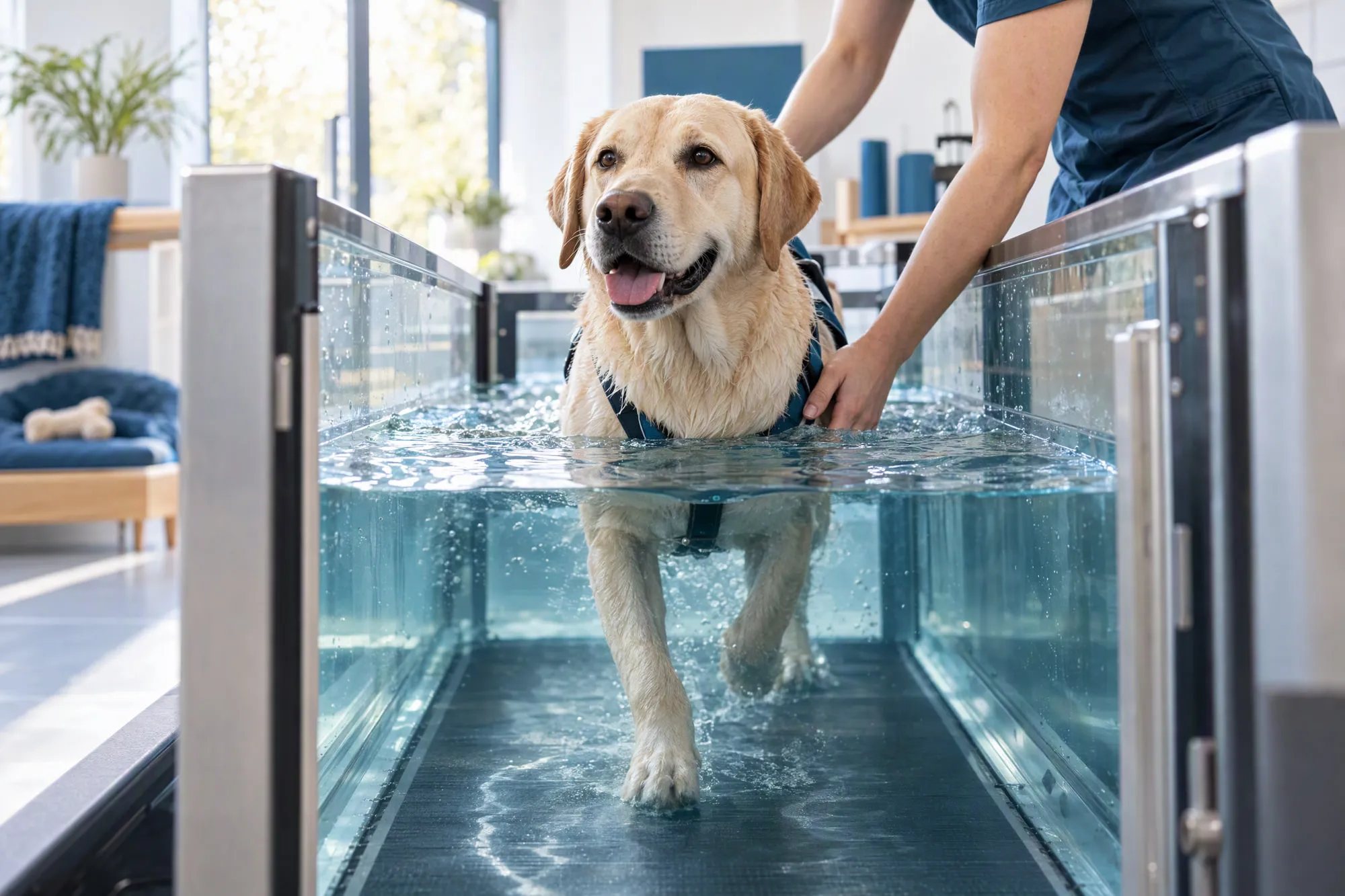
If your dog remains very stiff despite your care, doesn’t like being handled, or after surgery, a rehabilitation professional can assess your dog, target the areas that are compensating and teach you the techniques suited to your dog’s needs. They may also suggest other options, such as hydrotherapy. To find out who to contact and what a session involves, read our guide to dog physiotherapy and hydrotherapy. Think about the environment too: a dog that slips on tiled floors is tense all the time, which is why it is worth making home adaptations for a senior dog.
Key points on massage for your dog with arthritis
A few minutes of slow, attentive massage a day is enough to make your dog more comfortable and strengthen your bond. Start with long strokes, go at your dog’s pace, use heat for stiffness and cold only during a flare-up. And if your dog finds it hard to get up in the morning, combine massage with our tips for an old dog struggling to stand up and suitable activity, working with your vet. More routines are waiting for you in our dog exercise and mobility section.
Frequently asked questions
How do you massage a dog with arthritis?
Settle your dog lying on its side somewhere quiet, then start with long, slow strokes from head to tail. Next, gently knead the large muscles of the thighs and shoulders, and finish with small circles around the joints, without pressing on them. A 10 to 15-minute session is enough.
How often should I massage my dog with arthritis?
One short massage a day, or at least three to four times a week, is a good rhythm. The most useful times are in the evening, after the last walk, and in the morning before exercises to help loosen up stiff joints. Regularity matters more than duration.
Is heat or cold better for dog arthritis?
Gentle heat suits the everyday stiffness of arthritis, for example in the morning or in cold weather. Cold is for when a joint is hot or swollen, typically after too much exertion. If in doubt, or if the flare-up lasts more than 24 to 48 hours, ask your vet for advice.
Can I use a hot water bottle for my dog’s arthritis?
Yes, as long as it is warm rather than hot, wrapped in a towel and applied for 10 to 15 minutes under supervision. Check the temperature on the inside of your wrist before putting it in place. Never let an older or less mobile dog sleep on a heat source it can’t move away from by itself.
Can I put human anti-inflammatory gel on my dog?
No. Anti-inflammatory gels and creams made for people can be licked off and cause serious poisoning in dogs. Essential oils pose the same problem, and some are toxic even in small amounts. Your hands are all you need for massage; anything applied to the skin should be approved by your vet.
Should I stretch my old dog?
Very gentle stretches, done after a warm-up or a massage, can help an older dog stay supple. They should never be forced: support the joint and stay within the range your dog accepts without tensing. Ask your vet or a rehabilitation professional to show you how to do them properly.
This article is for information only and does not replace a veterinary consultation. If in doubt, or if your dog is in pain or changes suddenly, contact your vet.
Sources and references
- Corti L. Massage therapy for dogs and cats (PMID 25454377)
- Complementary therapies
- Pye C. et al. Current evidence for non-pharmaceutical, non-surgical treatments of canine osteoarthritis (PMID 37776028)
- Millis DL, Levine D. The role of exercise and physical modalities in the treatment of osteoarthritis (PMID 9243787)
- Osteoarthritis in Dogs