Joints & mobility Guide
Luxating patella in dogs: grades, symptoms and treatment
Does your dog skip for a few steps, then carry on as normal? Luxating patella in dogs: grades 1 to 4, symptoms, surgery or not, and what helps at home.
Key takeaways
- Patellar luxation happens when the kneecap slips out of its groove at the front of the knee; it mainly affects small dogs and usually slips towards the inside of the leg.
- The tell-tale sign: the dog is running normally, then lifts a back leg for a few steps, as if skipping, before carrying on as if nothing had happened.
- Luxation is classified into 4 grades: from grade 1, often of no consequence, to grade 4, where the kneecap stays out of place permanently and the leg is deformed.
- A luxation that causes no symptoms is monitored; surgery is mainly considered from grade 2 when the dog is lame, and more than 90% of owners are satisfied with the result, according to the ACVS.
- A healthy weight, well-maintained muscles, non-slip floors and limited jumping help the knee day to day, whether or not it has been operated on.
Contents
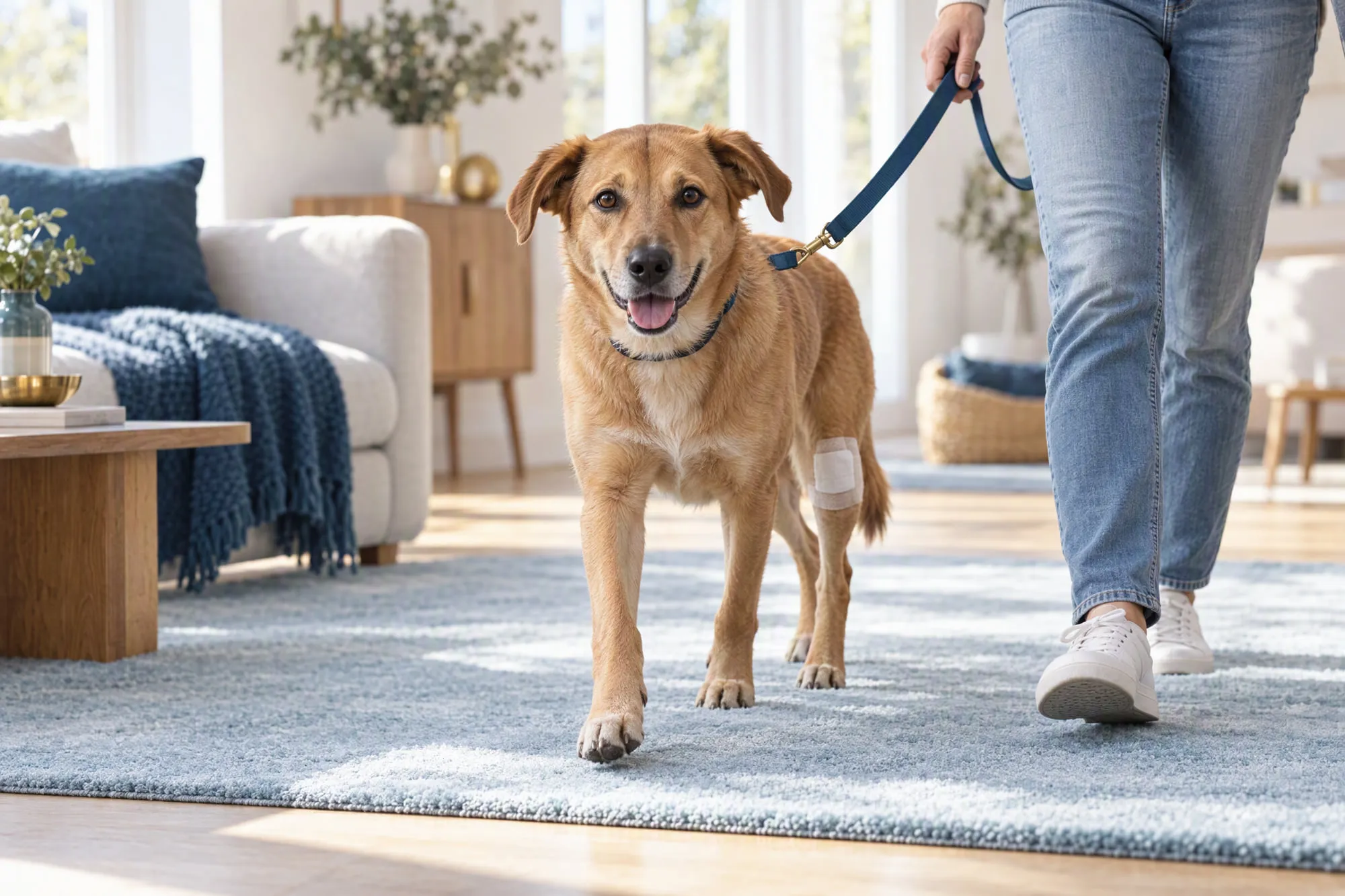
Your dog is trotting along happily, then suddenly lifts a back leg and hops on three legs for a few metres before carrying on as normal? That is the classic sign of a luxating patella in dogs: the small kneecap slips out of its groove, then back in again. Very common in small dogs, it ranges from a harmless quirk to a real problem that warrants surgery. Here is how to understand the 4 grades, recognise the signs, know when surgery is needed and what to do day to day.
Luxating patella in dogs: understanding the problem
What the kneecap does
The kneecap (patella) is a small bone set inside the tendon of the large thigh muscle (the quadriceps). It glides in a groove at the front of the femur, the trochlea, rather like a train on its track. The thigh muscle, the kneecap and its tendon, which attaches to a ridge on the tibia, form a chain that allows the dog to straighten the leg. When this chain is properly aligned, the kneecap stays on its track.
Medial or lateral luxation
Patellar luxation is when the kneecap slips off its track as the knee bends:
- Medial luxation (towards the inside of the leg): by far the most common, especially in small dogs.
- Lateral luxation (towards the outside): rarer, and proportionally more common in large dogs.
In about half of cases, both knees are affected.
Why the kneecap slips out
In the vast majority of cases, it is not an accident but a misalignment present from puppyhood: a groove that is too shallow, a slightly bowed femur or tibia, a misaligned ridge on the tibia, thigh muscles that pull off-centre. The ACVS (American College of Veterinary Surgeons) estimates that patellar luxation is diagnosed in about 7% of puppies, making it one of the most common orthopaedic conditions. Less often, a hard knock to the knee can dislocate a previously normal kneecap: the lameness is then sudden and obvious.
Luxating patella in small dogs: the breeds affected
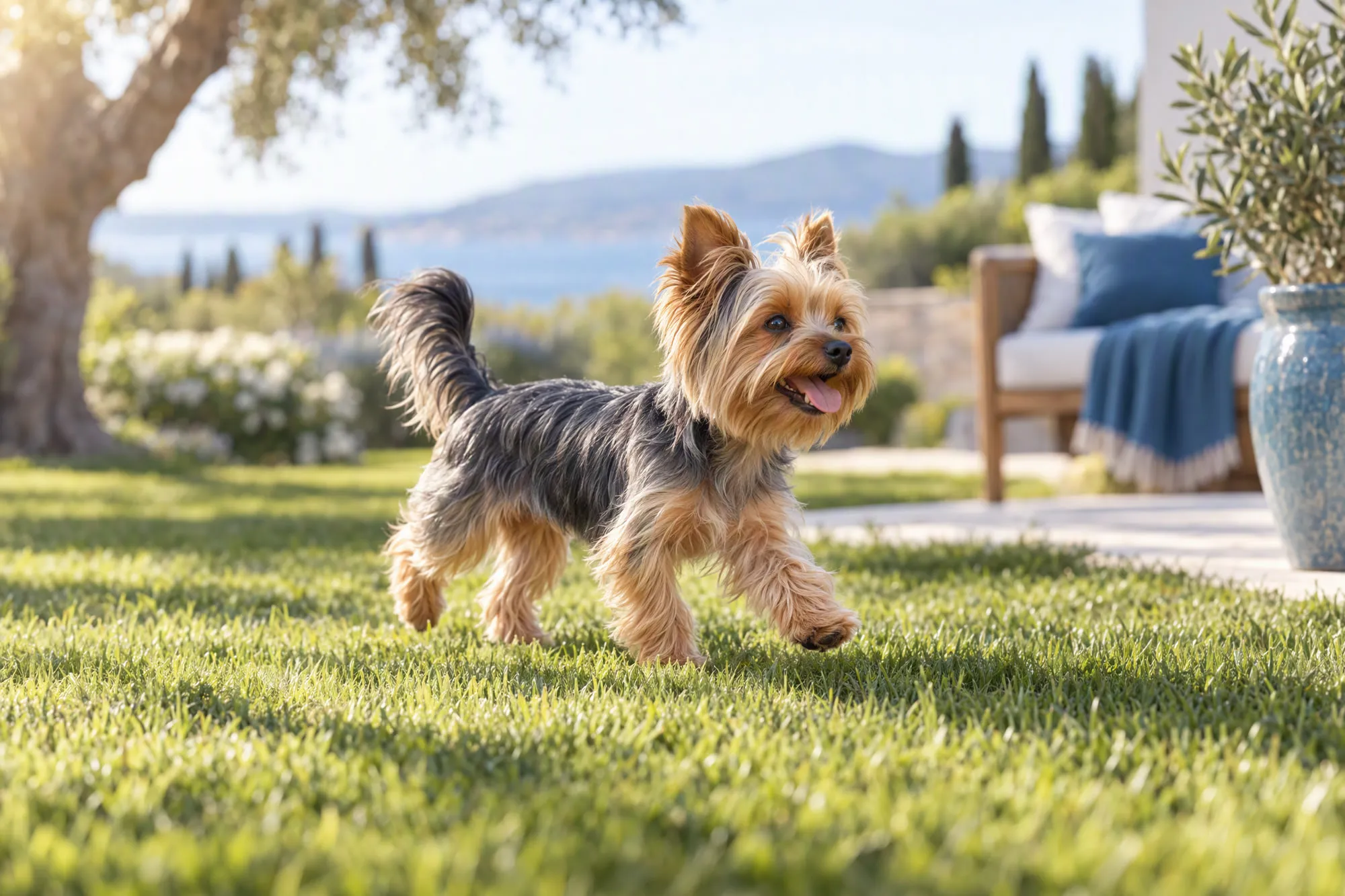
Patellar luxation is first and foremost a small-dog problem. A large study by the Royal Veterinary College’s VetCompass programme, covering more than 210,000 dogs seen at veterinary practices in England, found a patellar luxation diagnosis in 1.3% of dogs, with a much higher risk in certain breeds (O’Neill et al., 2016):
| Breed | Risk compared with a crossbred dog |
|---|---|
| Pomeranian | About 6.5 times higher |
| Chihuahua | About 6 times higher |
| Yorkshire Terrier | About 5.5 times higher |
| French Bulldog | About 5.4 times higher |
Other small breeds are regularly mentioned, such as the Miniature and Toy Poodle and the Boston Terrier. Females appeared slightly more affected than males in this study. In large dogs, luxation is less common but increasing, in breeds such as the Shar Pei, Akita, Flat-coated Retriever and Pyrenean Mountain Dog; it is then often associated with other abnormalities, such as hip dysplasia.
Symptoms: when a dog’s kneecap pops out
The signs depend largely on the grade:
- The ‘skip’: the dog suddenly lifts a back leg for a few steps, then puts it down again as if nothing had happened. This is the moment the kneecap slips off its track and back on.
- The dog stretches or kicks the leg backwards to pop the kneecap back into place.
- Intermittent lameness that becomes more frequent over time.
- A crouched gait, with bow-legged back legs (medial luxation), or knock knees (lateral luxation).
- Difficulty jumping onto the sofa, reluctance to play or go on long walks.
- In severely affected puppies, deformity of the back legs that worsens as they grow.
Many dogs with grade 1 luxation show no signs at all: it is found by chance during a routine check-up. If your dog is limping and you don’t know why, see also our guide to dog limping and what to do.
The 4 grades of patellar luxation
Vets classify luxating patella into 4 grades, according to how easily the kneecap slips off its track and back again. The grade is assigned by feeling the knee, and may differ from one leg to the other.
| Grade | What the vet finds | What you see day to day |
|---|---|---|
| Grade 1 | The kneecap can be pushed out by hand but returns on its own as soon as it is released | Usually nothing; sometimes an occasional skip |
| Grade 2 | The kneecap slips out by itself when the knee bends and stays out until the dog straightens the leg or it is put back | Intermittent skipping, the dog stretches the leg to ‘click it back’ |
| Grade 3 | The kneecap is out most of the time; it can be put back by hand but slips straight out again | Frequent or constant lameness, crouched gait, bowed legs |
| Grade 4 | The kneecap is permanently out and cannot be put back; the bones are often deformed | Leg held bent, difficulty straightening it, very abnormal gait |
The grade is not fixed: without care, a luxation can get worse as the track wears down with each passage of the kneecap.
Diagnosis at the vet practice
- Examining the knee: by gently manipulating the leg, the vet feels the kneecap slip out and back in, which allows them to assign a grade.
- Checking the cruciate ligament: luxation weakens the knee and makes a cruciate ligament rupture more likely, so this needs to be looked for, sometimes under sedation.
- X-rays of the pelvis, knee and tibia, to assess the shape of the bones, any osteoarthritis and any associated hip dysplasia.
- A CT scan in some severe cases, to plan the correction of a bowed bone.
Treating a luxating patella: monitoring or surgery?
When monitoring is enough
According to the ACVS, a luxation that causes no symptoms can be monitored without surgery, especially in small dogs. This applies to many grade 1 cases and some very mild grade 2 cases. Monitoring is not passive: it means keeping a healthy weight, maintaining good muscle tone and having the knee checked at annual health checks. During a painful flare-up, your vet may prescribe suitable pain relief and rest.
In the English study mentioned above, newly diagnosed dogs were in fact far more often managed medically (about 39%) than surgically (about 13%).
When to operate
Surgery is most often considered from grade 2, when the dog is lame or the problem is getting worse. It is also considered earlier in young dogs whose legs are becoming deformed as they grow, and when there is an associated cruciate ligament rupture. The surgeon takes into account how often the dog is lame, their age, weight, activity level and the state of the other knee.
What the surgeon does
There is no single operation, but a combination of procedures chosen for each dog, sometimes adjusted during surgery:
- Deepening the groove in the femur (trochleoplasty) so that the kneecap stays seated.
- Moving the ridge on the tibia, where the kneecap tendon attaches, and fixing it with small pins, to realign the muscle–kneecap–tendon chain.
- Tightening the tissues on one side and releasing them on the other around the knee.
- Correcting a bowed femur with a bone cut fixed by a plate, in severe cases.
The results are good: according to the ACVS, more than 90% of owners are satisfied with their dog’s progress after surgery, and recurrence is rare. The outlook is a little more guarded in large dogs with other abnormalities (marked bone deformity, hip dysplasia).
After surgery
- Rest for about 6 to 8 weeks, with toilet trips on a short lead, no jumping and no stairs.
- A check-up X-ray if bone cuts were made.
- A gradual return to walking, ideally supported by a programme of dog physiotherapy and hydrotherapy.
- If both knees are affected, they are often operated on one after the other, a few weeks or months apart.
Kneecap popping out: what to do day to day
In the moment
- Stay calm and let your dog sort it out: most put the kneecap back themselves by stretching the leg or taking a few steps.
- Don’t force the knee: clumsy handling can hurt.
- Note down or film the episode: which leg, how long it lasted, the circumstances (setting off, jumping off the sofa and so on). This diary helps your vet follow how things change.
- See your vet the same day if the leg stays lifted, your dog is in pain or the knee swells.
Weight, muscle and floors: the habits that really help
- Keep your dog slim: in a small dog, an extra 500 g is a significant load for a fragile knee. See our guide to the overweight dog and joint health.
- Maintain the thigh muscles: strong muscles help keep the kneecap on track. Favour regular lead walks on varied ground rather than frantic running.
- Limit jumping: a ramp or pet steps for the sofa and bed, and lifting your dog into the car.
- Make floors grippy: non-slip rugs in living areas, short nails, and trimmed fur between the paw pads. You will find more ideas in our guide to home adaptations for a senior dog.
- Use a harness rather than a collar, so your dog doesn’t rear up on the back legs when pulling.
Two simple exercises to strengthen the thighs, to do outside painful phases and with your vet’s agreement (after surgery, wait for the go-ahead):
Sit-to-stands on a mat
- Place your dog on a non-slip mat, facing you.
- Ask for a straight ‘sit’, with both back legs folded underneath.
- Using a treat, encourage them to stand up slowly, without jumping.
- Do 5 repetitions, take a break, then another 5.
Good to know: for a small dog, use tiny treats and deduct them from the daily ration.
Slow walking on varied ground
- On the lead, walk slowly over different surfaces: grass, firm sand, a gently sloping path.
- Keep a steady pace so your dog places each foot firmly.
- Add a few wide turns and figures of eight at a slow pace.
- Finish with 2 minutes of easy walking on flat ground.
Good to know: this kind of walking works the small stabilising muscles without jolts. You will find more ideas in our exercises for dogs with arthritis.
Long-term complications to watch for
Rubbing off its track, the kneecap wears away cartilage: a long-standing luxation, even a mild one, encourages arthritis in the knee. It also increases the risk of cruciate ligament rupture. Warning signs: lameness that no longer disappears within a few steps, stiffness on getting up, loss of thigh muscle, refusal to jump. An annual knee check, or more often as your dog gets older, allows care to be adjusted in good time.
Puppies, breeding and screening
- Ask your vet to feel your puppy’s knees at the vaccination appointments, especially if they belong to a predisposed breed.
- Watch their growth: a small-breed puppy whose back legs are bowing should be seen promptly, as correction during growth can prevent permanent deformity.
- Choose a responsible breeder: the ACVS recommends that affected dogs are not bred from, as luxation has a genetic component. Ask whether the parents have been examined.
Luxating patella in dogs: the key points
A luxating patella is very common in small dogs and often well tolerated in its mild forms. The grade guides the decision, but what matters most is how much it bothers your dog: a knee that causes no problems is monitored, and surgery is carried out once lameness sets in, with excellent results in the vast majority of cases. In between, a slim, well-muscled dog protected from slippery floors has every chance of keeping comfortable knees for a long time.
Frequently asked questions
Is a luxating patella painful for a dog?
In mild cases, the dog often feels little or no pain: the kneecap slips out, then pops back in within a few steps. Over time and at higher grades, the rubbing wears the cartilage, leads to osteoarthritis and can become genuinely painful. A dog that is limping more and more often should be examined again.
Can I pop my dog’s kneecap back in myself?
Many dogs put it back themselves by stretching the leg backwards or giving it a shake. Avoid handling the knee yourself: you could hurt your dog and get bitten. If the kneecap doesn’t go back into place or your dog won’t put the leg down, see your vet the same day.
How long is recovery after luxating patella surgery?
Allow 6 to 8 weeks of restricted activity in general, with short-lead walks, then a gradual return to exercise after the check-up X-ray. Most dogs start using the leg again within days and get back to normal activity within 2 to 3 months, with the surgeon’s agreement.
Should a dog with a luxating patella be bred from?
It is not advisable. Patellar luxation is largely genetic and developmental in origin, and the ACVS recommends that affected dogs are not bred from. If you are choosing a puppy from a predisposed breed, ask the breeder whether the parents have been examined.
My dog has a grade 1 luxating patella: what should I do?
If there is no lameness, simply keep an eye on it. Keep your dog slim and well muscled, limit repeated jumping off the sofa and have the knee checked at the annual health check. If skipping episodes appear or become more frequent, talk to your vet again.
This article is for information only and does not replace a veterinary consultation. If in doubt, or if your dog is in pain or changes suddenly, contact your vet.