Joints & mobility Guide
Cruciate ligament rupture in dogs: symptoms, surgery or not, and recovery
Dog limping on a back leg? Cruciate ligament rupture in dogs: the signs, whether to operate, TPLO, TTA or lateral suture, and a recovery timeline.
Key takeaways
- Cranial cruciate ligament rupture is one of the leading causes of hind-leg lameness in dogs; it usually results from slow degeneration of the ligament rather than a one-off accident.
- Typical signs: sudden or intermittent lameness, toe-touching on the leg, sitting with the leg out to the side, stiffness after rest and loss of thigh muscle.
- Surgery (TPLO, TTA or lateral suture) is the only way to stabilise the knee long term; conservative management may suit some small dogs or cases where surgery is not possible.
- After TPLO, expect about 8 weeks of tightly restricted activity, then 2 to 4 months of gradual return: rehabilitation clearly improves the outcome.
- Up to half of dogs affected in one knee go on to rupture the ligament in the other: a healthy weight and good muscle condition are the best protection.
Contents
Has your dog suddenly started limping on a back leg, barely touching it to the ground or sitting with the leg stuck out to the side? A cruciate ligament rupture is one of the most likely causes. Cruciate ligament rupture in dogs is one of the most common orthopaedic injuries vets see, and it responds well to treatment: surgery gets the vast majority of dogs back to an active life, and some small dogs recover without an operation. Here is how to recognise the signs, how to decide between surgery and conservative management, what TPLO, TTA and lateral suture involve, and what the months of recovery look like.
The cruciate ligament in dogs: its role and why it ruptures
A dog’s knee (the stifle) is the joint halfway up the back leg. Inside it, two ligaments cross over to connect the femur (thigh bone) to the tibia (shin bone). The cranial cruciate ligament, the equivalent of the anterior cruciate ligament (ACL) in people, stops the tibia sliding forwards every time the dog puts weight on the leg. When it gives way, the knee becomes unstable: the tibia ‘slides forwards’ under the femur with each step, which is painful, inflames the joint and can crush the meniscus, a small pad of cartilage that absorbs shock.
Slow wear rather than an accident
Unlike a footballer who tears a ligament on an awkward landing, a dog usually has a degenerative disease of the ligament: the fibres weaken over months, then an everyday movement (a jump, a sudden start, a slip) completes the rupture. This is why partial tears that progress to complete ruptures are so common, and why the other knee is often affected later.
Dogs most at risk
- Certain breeds: Labrador, Rottweiler, Newfoundland, Staffordshire terriers, Mastiff, Akita and St Bernard, but also small dogs such as the West Highland White Terrier or the Yorkshire Terrier.
- Overweight or poorly muscled dogs, which load their ligaments without the protection of good muscle.
- ‘Weekend warriors’: inactive during the week, worked hard at the weekend.
- Dogs with a luxating patella, which weakens the knee.
- Large-breed dogs neutered very young: a study of Labradors and Golden Retrievers linked neutering before 6 months of age with more joint disorders, including cruciate ligament tears (Hart et al., 2014). The right age should be discussed case by case with your vet.
Cruciate ligament rupture in dogs: the symptoms to look for
Complete rupture
- Sudden lameness on a back leg, sometimes not bearing weight at all for the first few days, then just touching the toes to the ground.
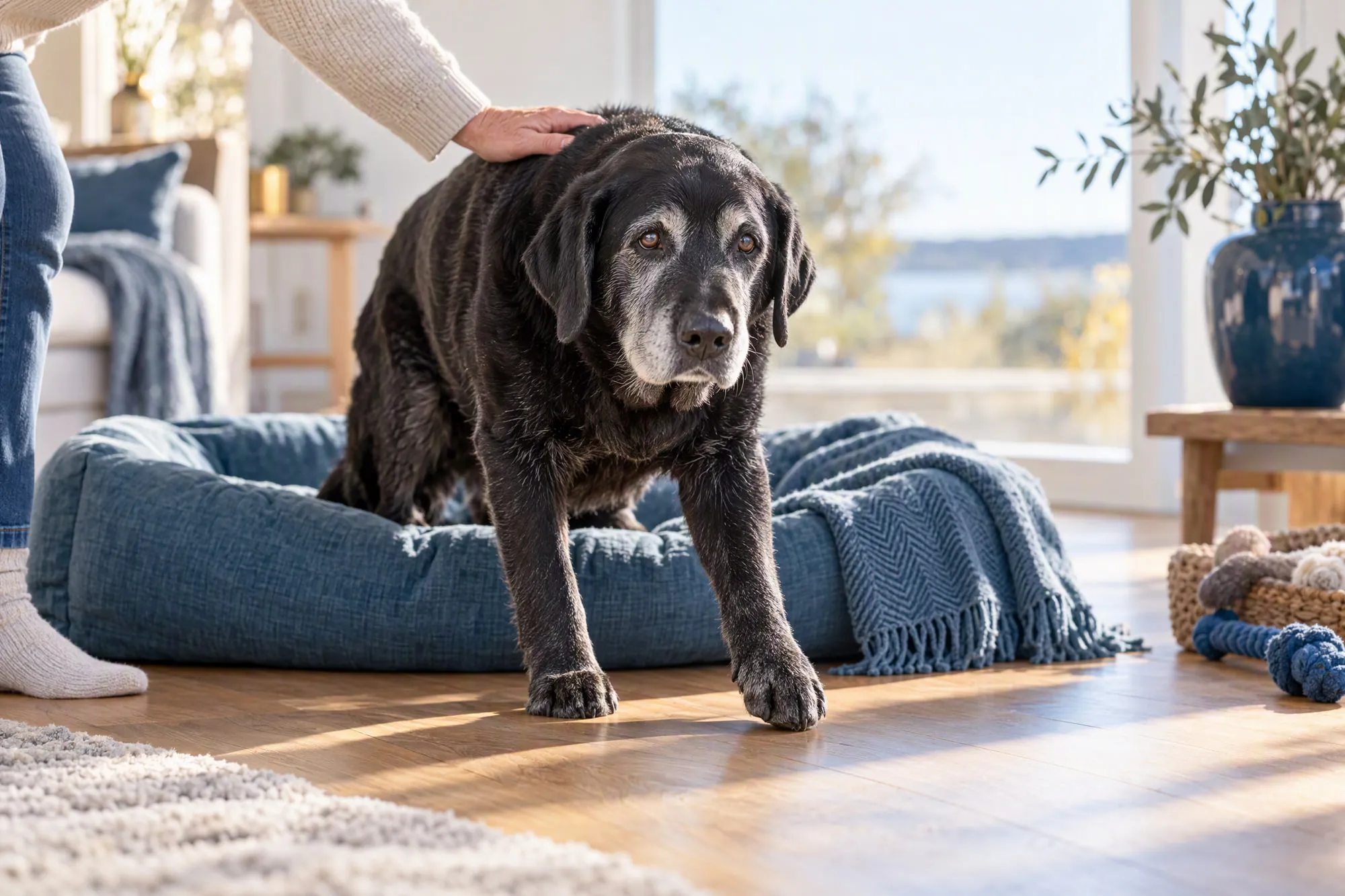
- Sitting ‘crookedly’: the dog keeps the affected leg stretched out to the side instead of tucking it underneath. Vets call this a positive ‘sit test’.
- Difficulty getting up or jumping into the car or onto the sofa.
- Swelling of the knee, sometimes a firm thickening on the inner side of the knee when the rupture is long-standing.
- Loss of thigh muscle after a few weeks.
Partial tear: the limp that comes and goes
A partial tear is harder to spot: the dog limps after a long walk or on getting up, seems better after a few days’ rest, then the limp returns. If this pattern keeps repeating, see your vet, because a partial tear almost always progresses to a complete rupture. If you are unsure where a limp is coming from, our guide to dog limping will help you take stock.
The meniscal ‘click’
A small clicking sound, heard or felt as your dog walks, can signal a meniscal tear. It is very painful and often makes the lameness much worse, sometimes several weeks after the original rupture.
How the vet makes the diagnosis
- Watching the gait and doing the ‘sit test’.
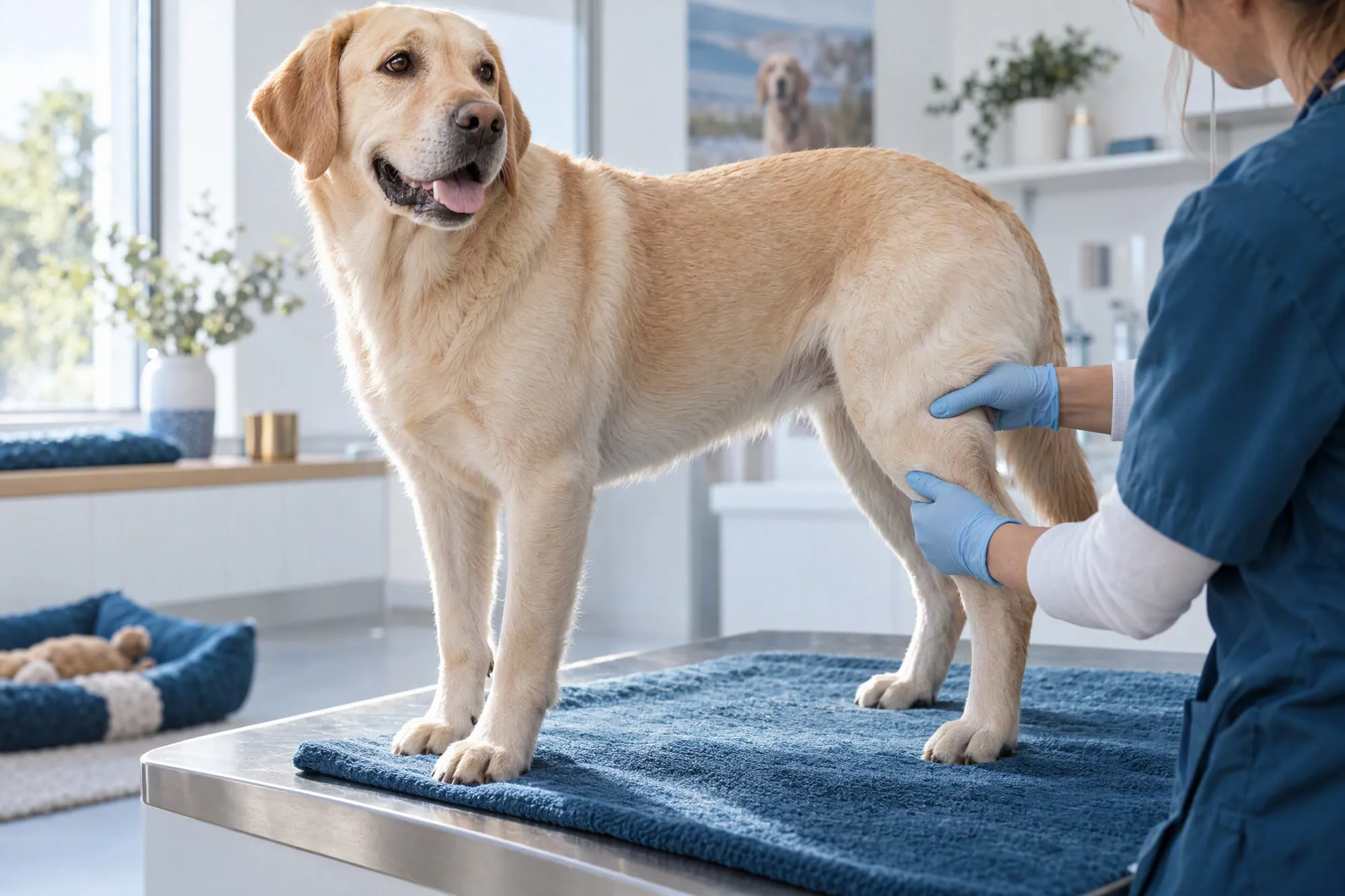
- Feeling the knee for a drawer sign (the tibia slides forwards when pushed) or tibial thrust when the ankle (hock) is flexed. In a muscular or tense dog, light sedation is often needed for the test to be reliable.
- X-rays: the ligament itself doesn’t show up, but the vet can see fluid in the knee and osteoarthritis, and plan any surgery (by measuring the slope of the top of the tibia).
- Sometimes ultrasound, a CT scan or arthroscopy, particularly for partial tears or to assess the meniscus.
- Blood tests before an anaesthetic or before prescribing anti-inflammatories.
Cruciate ligament rupture in dogs: surgery or not?
This is THE question every owner asks. The ACVS (American College of Veterinary Surgeons) considers surgery the best treatment in most cases, because it is the only way to control knee instability in the long term. But it is not an absolute requirement: the decision takes several factors into account.
Factors that guide the decision
| Factor | Tends to favour surgery | May suit conservative management |
|---|---|---|
| Weight and size | Dog over roughly 15 kg | Small, light dog at a healthy weight |
| Activity | Young, sporty or working dog | Calm, fairly inactive dog |
| Type of rupture | Complete rupture, or a partial tear that is getting worse | Stable partial tear, causing little pain |
| Meniscus | Suspected meniscal tear (click, sharp pain) | Meniscus apparently intact |
| General health | Good candidate for anaesthesia | Serious concurrent illness, high anaesthetic risk |
| Practicalities | Able to provide 8 weeks of supervised rest | Circumstances that make convalescence very difficult |
Age alone is not a reason to rule out surgery: a healthy 10-year-old dog can certainly have an operation and benefit from it.
What the research says
In a randomised trial of 40 overweight dogs with a rupture on one side, all received a weight-loss diet, physiotherapy and anti-inflammatories; half also had TPLO surgery (Wucherer et al., 2013). At one year, the rate of good outcomes was 75% in the surgical group compared with about 64% in the non-surgical group, and the dogs that had surgery put noticeably more weight on the leg. In other words, surgery gives better results on average, but nearly two-thirds of the dogs managed without surgery were doing well at one year thanks to committed care.
Conservative management in practice
If you and your vet decide against surgery, treatment is based on:
- 6 to 8 weeks of very restricted activity: short-lead walks only, no free play, no jumping and no stairs. This is the most important part, because rest allows the body to form scar tissue around the knee.
- Weight loss if needed: this is often what makes the difference. See our guide to the overweight dog and joint health.
- Pain relief prescribed by your vet, for as long as they consider useful.
- Rehabilitation with a veterinary physiotherapist, followed by a very gradual return to exercise.
- Sometimes a custom-made knee brace: evidence of its effectiveness is still limited, and it can cause skin irritation if poorly tolerated.
Bear in mind that the knee remains unstable: osteoarthritis progresses faster than after surgery, and a meniscal tear may occur later and lead to surgery after all.
TPLO, TTA and lateral suture: the techniques explained simply
A dog’s ligament is not replaced as it would be in a person. Surgeons use two main strategies: change the shape of the tibia so that the knee becomes stable without a ligament, or place an artificial ligament outside the joint. In every case, the meniscus is checked during the operation and any damaged part is removed.
TPLO (tibial plateau levelling osteotomy)
The surgeon makes a curved cut at the top of the tibia, rotates this section to make the tibial plateau almost level, then fixes it with a plate and screws. As a result, the tibia is no longer pushed forwards with each step, and the knee stays stable without the ligament. It is the most widely used technique in medium to large, active dogs. The plate usually stays in place for life.
TTA (tibial tuberosity advancement)
Here, the front of the tibia, where the kneecap tendon attaches, is cut and moved forwards using a spacer (or cage) and a plate. Changing the angle of this tendon neutralises the force that pushes the tibia forwards. A review of 72 studies published in 2022 could not name a clear winner between TPLO and TTA: both give good results, with minor differences (Wemmers et al., 2022).
Lateral (extracapsular) suture and its variants
A very strong suture is passed around the outside of the knee, from the back of the femur to the front of the tibia, to do the ligament’s job while the body forms stabilising fibrous tissue. Less expensive and with no bone cutting, it mainly suits small and light dogs. In heavy, very active dogs, the suture may stretch or break. Variants such as TightRope use a special suture anchored in the bone.
| Technique | How it works | Suitable dogs | Advantages | Limitations |
|---|---|---|---|---|
| TPLO | Rotation of the tibial plateau, fixed with a plate and screws | Medium to large, active dogs, and some small dogs | Consistent results, frequent return to an active, sporting life | Bone cut, higher cost, about 8 weeks for the bone to heal |
| TTA | Front of the tibia moved forwards with a spacer | Medium to large dogs, depending on knee shape | Results comparable to TPLO | Bone cut, a few weeks of strict rest |
| Lateral suture | Strong suture placed outside the joint | Small, light and calm dogs | No bone cut, lower cost | Suture can fail, less suited to heavy dogs |
According to the ACVS, 85 to 90% of dogs show a clear improvement after surgery. Complications do occur (infection, implant problems, a later meniscal tear) but they are in the minority, especially when rest instructions are followed carefully.
After surgery: a recovery timeline
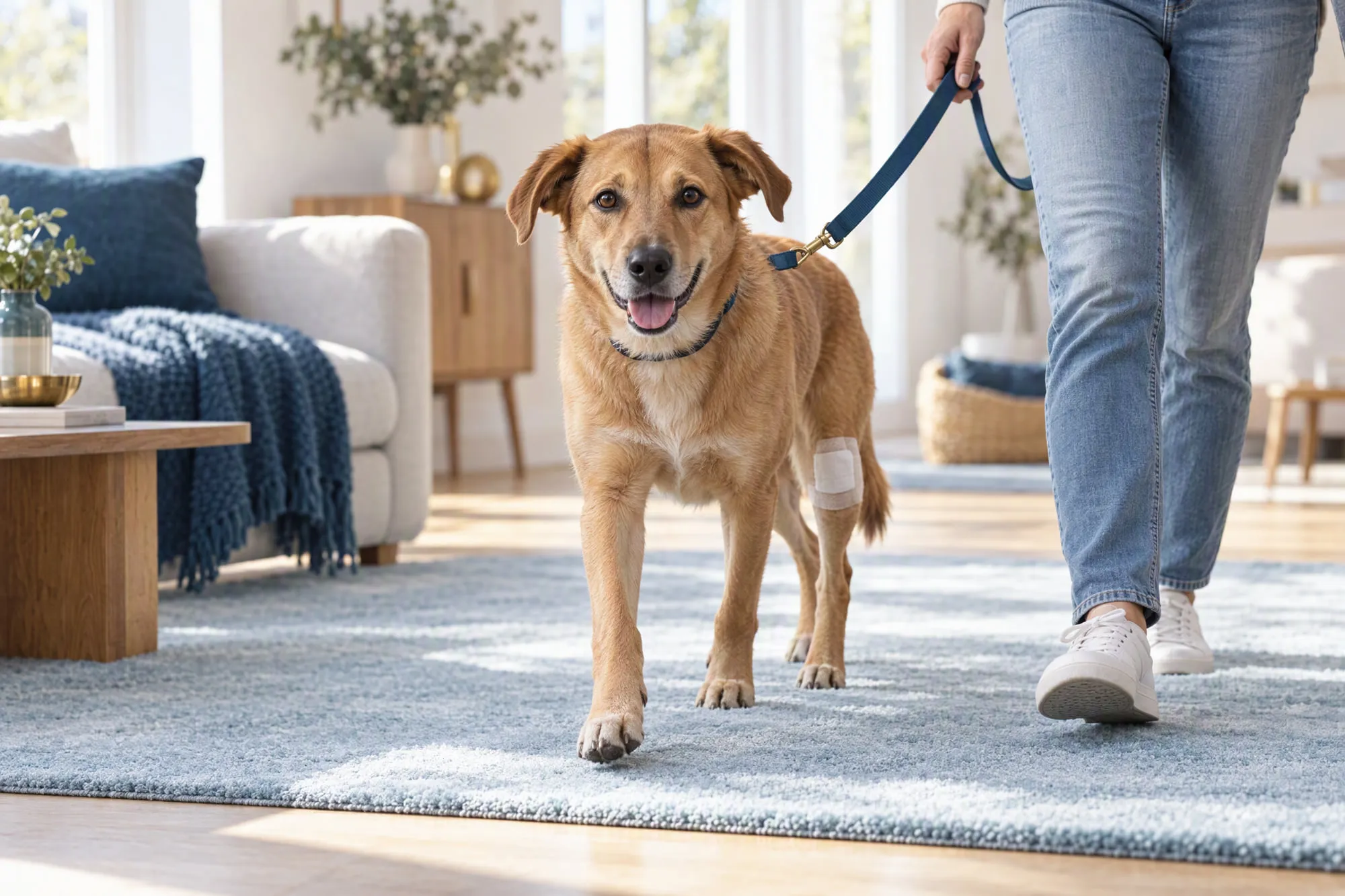
The period after the operation matters as much as the operation itself. Here is an approximate timeline after TPLO or TTA; it varies with the dog, the technique and your surgeon, whose instructions always come first.
| Period | What happens | Activity usually allowed |
|---|---|---|
| Days 1 to 3 | Home the same day or the next; pain controlled with the prescribed medication; cold packs on the knee if advised | Toilet trips of a few minutes on a short lead; rest in a confined space |
| Days 3 to 14 | Wound healing, buster collar (cone), stitches out at around 10 to 14 days; the dog starts to use the leg | 3 to 4 walks of 5 to 10 minutes a day on the lead; passive exercises if your vet has shown you how |
| Weeks 2 to 6 | Increasingly confident weight-bearing | Lead walks gradually lengthened, by about 5 minutes a week; first strengthening exercises |
| Weeks 6 to 8 | Check-up X-ray to confirm bone healing | If healing is complete: longer walks, gentle slopes, hydrotherapy possible |
| Months 2 to 4 | Thigh muscle rebuilds | Long lead walks on varied ground, then short off-lead periods in a quiet area |
| Months 4 to 6 | Back to normal life | Free play, running, then a return to sport (agility, canicross) at around 6 months if the surgeon agrees |
After a lateral suture, the timeline is similar, often with equally strict restrictions for the first 8 weeks while the fibrous tissue forms.
Rehabilitation exercises at home
A systematic review of studies on rehabilitation after cruciate ligament surgery supports therapeutic exercise and cold compression therapy (Alvarez et al., 2022). A programme supervised by a physiotherapist or hydrotherapist often speeds up recovery. Here are two classic exercises, to start only when your vet gives the go-ahead.
Standing weight shifts
- Stand your dog on a non-slip mat, with all four feet squarely placed.
- Rest your hands gently on their pelvis and push very slightly to one side, then the other, for a few seconds each time.
- Your dog rebalances by tightening their muscles, including those of the operated leg.
- Do 10 small pushes, always gently.
Good to know: if your dog lifts the operated leg or refuses the exercise, stop and talk to your vet.
Square sit-to-stands
- Position your dog with their back to a wall or in a corner, operated side against the wall, so they cannot stick the leg out to the side.
- Ask for a slow ‘sit’: the operated leg should fold underneath like the other one.
- Encourage them to stand up with a treat held in front of their nose.
- Start with 5 repetitions and add 1 or 2 each week.
Good to know: an increasingly square, symmetrical sit is an excellent sign of progress. Find more ideas in our exercises for dogs with arthritis.
Setting up your home during recovery
- A small rest area: a pen, a small room or a large crate, with a thick bed. Your dog must not be able to run around when you are not there.
- Non-slip floors: rugs or runners of yoga mats where your dog walks.
- No stairs, no sofa, no bed: baby gates, a ramp for the car, or carrying a small dog.
- A towel or support harness under the belly to help them get up and walk in the first few days.
- The buster collar until the stitches come out, even if your dog protests.
- Things to do without moving much: snuffle mats, stuffed food toys, permitted chews and short, calm training sessions to beat boredom.
Many of these changes will remain useful later on: our guide to home adaptations for a senior dog offers more practical ideas.
Preventing cruciate ligament rupture and protecting the other knee
Not everything can be prevented, particularly genetic predisposition, but several measures reduce the risk:
- A healthy weight: you should be able to feel the ribs easily. Being overweight is a recognised risk factor.
- Regular activity rather than occasional bursts of intense effort: good muscle protects the ligaments.
- A warm-up of 5 to 10 minutes’ walking before running or playing ball.
- Avoid sudden starts and sharp turns on slippery floors, and repeated ball throwing.
- Keep an eye on the other knee in the following months: up to half of dogs affected on one side will be affected on the other. At the first sign of a crooked sit or a limp, see your vet.
- Think long term: an operated knee can develop arthritis over the years. Good weight and exercise habits remain the best insurance.
Cruciate ligament rupture in dogs: the key points
Cruciate ligament rupture is common, often linked to gradual wear, and it responds well to treatment. Surgery is generally the best option for medium to large, active dogs; carefully followed conservative management may suit some small dogs or particular situations. Either way, your role is central: stick to the rest, do the exercises and keep your dog lean. With patience, most dogs get back to the joy of running.
Frequently asked questions
Can a dog live with a ruptured cruciate ligament without surgery?
Yes, some dogs, especially small ones, become reasonably comfortable with strict rest, weight loss, rehabilitation and prescribed pain relief. The knee remains unstable, however, osteoarthritis progresses faster and the risk of meniscal damage persists. In heavy or active dogs, surgery generally gives better results.
How long is TPLO recovery in dogs?
The bone takes about 6 to 8 weeks to heal, during which activity is strictly controlled on the lead. Exercise then builds up gradually over 2 to 3 months, with a return to normal activity at around 4 months and to sport at around 6 months, provided the check-up X-rays and examination are satisfactory.
Is a cruciate ligament rupture in a dog an emergency?
It is not life-threatening, but a vet appointment within 24 to 48 hours is recommended if your dog won’t put weight on the leg or is in pain. The vet can control the pain and confirm the diagnosis. A dangling leg, major swelling or a wound needs to be seen the same day.
What is the difference between TPLO and TTA?
Both techniques change the shape of the tibia so the knee stays stable without the ligament. TPLO rotates the top of the tibia, while TTA moves the front of the tibia forwards. A 2022 review of the evidence could not name a clear winner: the choice depends on the shape of the knee and the surgeon’s experience.
Can my dog rupture the cruciate ligament in the other leg?
Yes, it is common: according to the ACVS, 40 to 60% of dogs affected on one side eventually develop the same problem on the other side, often within 12 to 18 months. Keeping a healthy weight, strengthening muscles regularly and avoiding sudden efforts on slippery floors help protect the remaining knee.
This article is for information only and does not replace a veterinary consultation. If in doubt, or if your dog is in pain or changes suddenly, contact your vet.
Sources and references
- Cranial Cruciate Ligament Disease
- Cruciate Ligament Rupture in Dogs
- Surgical treatment of cranial cruciate ligament disease in dogs using TPLO or TTA: a systematic review with a meta-analytic approach (Wemmers et al.)
- Short-term and long-term outcomes for overweight dogs with cranial cruciate ligament rupture treated surgically or nonsurgically (Wucherer et al.)
- Systematic review of postoperative rehabilitation interventions after cranial cruciate ligament surgery in dogs (Alvarez et al.)
- Long-term health effects of neutering dogs: comparison of Labrador Retrievers with Golden Retrievers (Hart et al.)