Joints & mobility Complete guide
Hip dysplasia in dogs: symptoms, diagnosis, treatment and everyday life
Swaying gait, bunny hopping, struggling to get up: how to spot hip dysplasia in dogs, understand hip scoring, weigh up treatment and manage daily life.
Key takeaways
- Hip dysplasia is a developmental defect of the hip joint, largely genetic, that makes the hip unstable and eventually leads to osteoarthritis.
- In puppies it shows as a swaying gait, ’bunny hopping' or tiring quickly; in adult dogs, as stiffness when getting up and loss of muscle over the thighs.
- Diagnosis relies on a clinical examination and X-rays; official screening grades hips from A (normal) to E (severe dysplasia) on the FCI scale in much of Europe, while the UK uses the BVA/KC hip score (0 to 106, lower is better).
- Depending on age and severity, vets combine medical management (weight, suitable exercise, veterinary pain relief) and sometimes surgery: JPS, TPO/DPO, total hip replacement or femoral head excision.
- Keeping your dog lean for life is the most effective and least expensive way to delay osteoarthritis and protect their comfort.
Contents
Hip dysplasia in dogs is a malformation of the hip joint that develops as the puppy grows: the head of the thigh bone does not sit snugly in its socket, so the joint is loose, wears out too quickly and eventually becomes arthritic. It mainly affects large dogs, it is largely inherited and, strictly speaking, it cannot be cured. The good news is that, well managed, it usually still allows an active and comfortable life. Here is how to recognise it at every age, what official hip screening means, what the treatment options are and, above all, what you can do at home every day.
Hip dysplasia in dogs: what is it?
A joint that ‘floats’ from puppyhood
The hip is a ball-and-socket joint: a ball (the head of the femur, or thigh bone) turns inside a cup (the acetabulum, on the pelvis). In a healthy dog, the ball is well covered by the cup and held in place by a strong joint capsule and ligaments.
In a dog with hip dysplasia, the joint is too loose, which vets call laxity. With every step, the head of the femur slips slightly out of its socket and back again. These repeated small movements damage the rim of the cup, flatten the femoral head and wear away the cartilage. The body responds by thickening the joint capsule and building bony outgrowths (osteophytes): this is arthritis in dogs, an almost inevitable consequence of marked dysplasia.
Hip dysplasia usually affects both sides, sometimes unevenly. It is not present at birth: puppies’ hips look normal when they are born and become misshapen as they grow, which is why the first months matter so much.
Genes and environment: what does what?
Hip dysplasia is described as multifactorial:
- Genetics is the leading risk factor. Several genes are involved, which explains why a puppy can be affected even when its parents seem healthy, and why nobody can ‘guarantee’ perfect hips.
- Growth and diet also count: gaining weight too fast, or a diet too rich in energy or calcium, makes the condition worse in a predisposed puppy.
- Body weight throughout life strongly influences the osteoarthritis that follows. In a landmark study of 48 Labradors followed for their whole lives, the dogs fed 25% less food stayed leaner and developed X-ray signs of hip osteoarthritis much later: at a median age of around 12 years, compared with 6 years for their littermates fed freely (Smith et al., 2006).
- A puppy’s lifestyle: in a Norwegian study of four large breeds, puppies that climbed stairs before 3 months of age had a higher risk of hip dysplasia, whereas those that could exercise freely on soft, slightly uneven ground had a lower risk (Krontveit et al., 2012).
Dog breeds at risk of hip dysplasia
Hip dysplasia can affect any dog, including crossbreeds, but it is far more common in medium to giant breeds that grow quickly:
| Type of dog | Examples of breeds often affected |
|---|---|
| Herding and working dogs | German Shepherd, Belgian Shepherd, Rottweiler, Bernese Mountain Dog |
| Retrievers and gundogs | Labrador, Golden Retriever, setters, pointers |
| Mastiff types and giant breeds | Newfoundland, St Bernard, Leonberger, Dogue de Bordeaux, Cane Corso, Great Dane |
| Flat-faced (brachycephalic) breeds | Bulldog, Pug (signs are often subtle) |
If your dog belongs to one of these breeds, it is not a foregone conclusion: it is a reason to choose a breeder who screens their breeding dogs, to keep an eye on growth and to talk to your vet early.
What about small dogs? They can have hip dysplasia too, but their low body weight puts less strain on the joint, so signs are often milder and sometimes go unnoticed. In small dogs, a hind-leg limp first suggests a luxating patella.
Hip dysplasia symptoms in dogs by age
The signs often come in two stages: a first painful phase in the young dog, linked to the loose joint, then a sometimes quiet period, and finally the onset of osteoarthritis in adulthood.
In puppies and young dogs (4 to 12 months)
- A swaying gait: the hindquarters roll from side to side, a bit like a swagger.
- ‘Bunny hopping’ when running: both back legs push off together instead of alternating.
- Difficulty getting up, especially after a nap or a long play session.
- Sitting ‘crookedly’, with the back legs splayed out to one side.
- Tiring quickly on walks: the puppy sits, lies down or refuses to go on.
- Reluctance to jump into the car, onto the sofa or to climb stairs.
- Sometimes a small ‘clunk’ from the hip, or pain when the leg is stretched backwards.
An important point: at around 12 to 18 months, these signs may fade because the joint capsule thickens and steadies the joint a little. This improvement is misleading: the hip is still abnormal and osteoarthritis keeps progressing.
In adult and older dogs
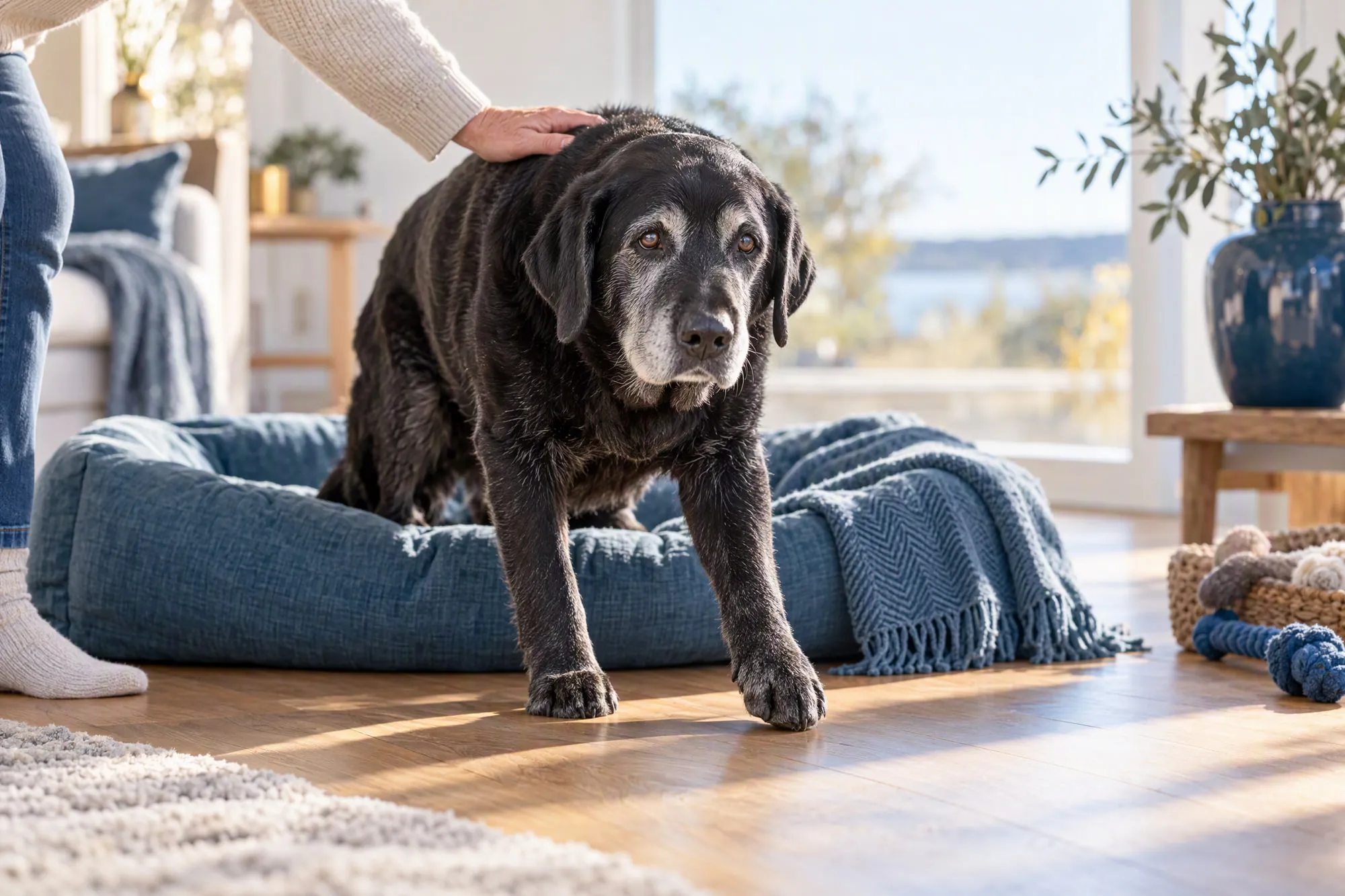
- Stiffness when getting up, which wears off after a few minutes of walking.
- Lameness in one or both back legs, especially after exercise or the day after a long walk.
- Muscle loss over the thighs and hindquarters, while the shoulders look more developed (the dog shifts its weight forwards).
- Shorter steps, reduced hip movement, difficulty sitting down or climbing steps.
- Licking or nibbling at the hip area, a change in temperament, or grumpiness when touched around the back end.
Why some dogs with hip dysplasia don’t limp
There is no direct link between how the X-rays look and how much pain the dog feels. Some dogs with badly deformed hips stay surprisingly active, while others with moderate dysplasia are clearly uncomfortable. Dogs are also very good at hiding pain: a dog that is ‘slowing down with age’ sometimes has a sore hip. If your dog is limping for no obvious reason, our guide to dog limping will help you work out what is going on.
Diagnosis and official hip screening
The examination at the vet practice
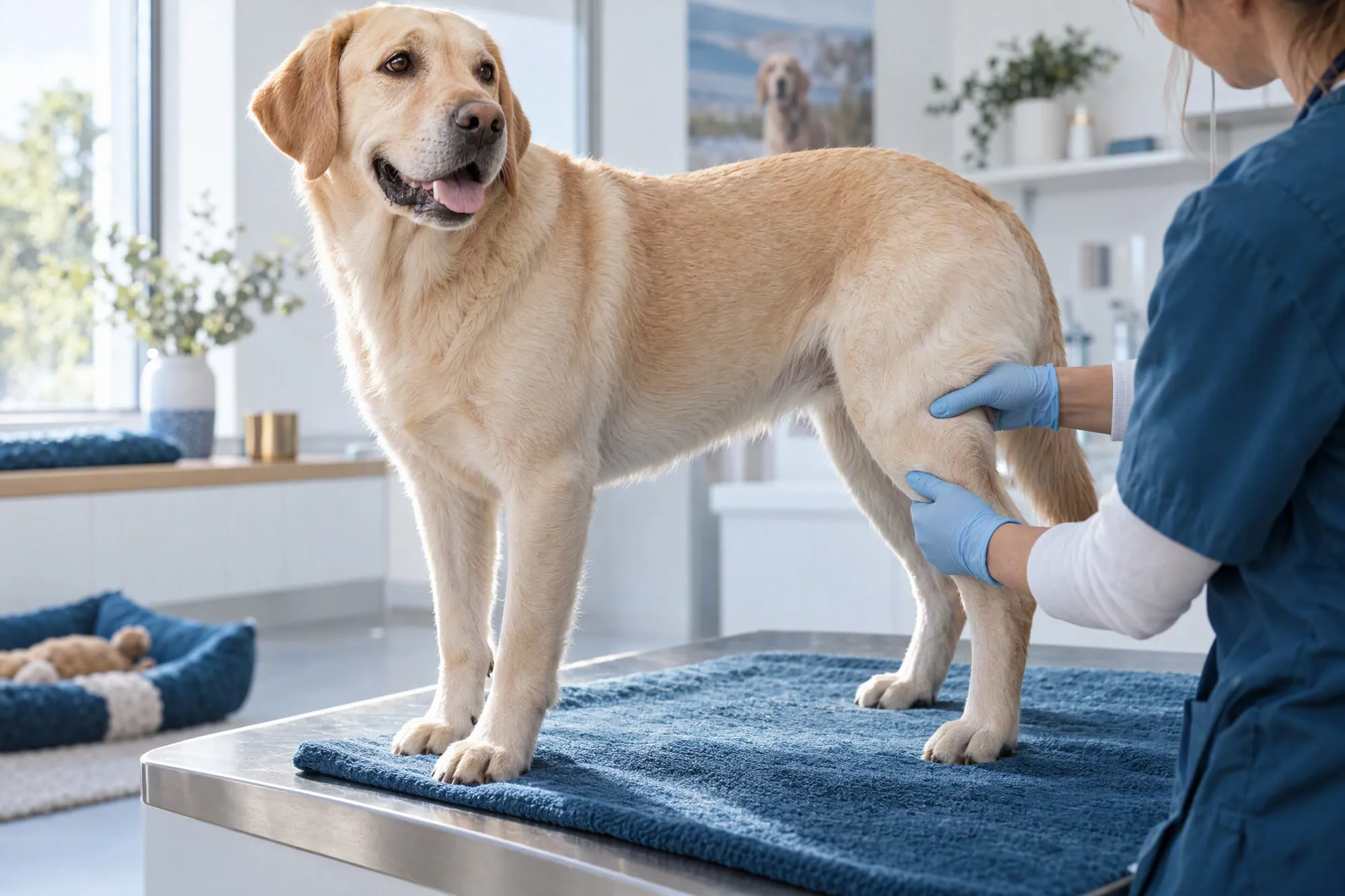
The vet watches your dog walk, feels the hips, measures the range of movement and checks for pain when the leg is extended. In a young dog, they may look under light sedation for an Ortolani sign: a noticeable clunk as the head of the femur, having slipped out of its socket, drops back into place. Its presence confirms abnormal laxity.
X-rays and PennHIP
- A standard X-ray of the pelvis, with the back legs stretched out, is the basic test. To be readable, the dog must lie perfectly straight, so sedation is usually needed.
- The PennHIP method measures hip laxity precisely using X-rays taken while the hips are gently distracted. It can be carried out from about 4 months of age and helps predict the risk of future osteoarthritis. It requires a trained and equipped vet.
- A CT scan is sometimes used to plan surgery.
Official screening: FCI grades and the BVA/KC hip score
In much of continental Europe, official screening follows the grading system of the Fédération Cynologique Internationale (FCI). In France, for example, X-rays are assessed by an approved official reader (under the Société Centrale Canine and the breed clubs), on an identified dog, from 12 months of age for most breeds and often later (15 to 18 months) for large and giant breeds, depending on each club’s rules.
| FCI grade | Meaning | What the X-ray shows |
|---|---|---|
| A | No signs of hip dysplasia | Femoral head well covered, congruent joint, Norberg angle of about 105° or more |
| B | Near-normal hips (borderline) | Slight incongruity, no signs of osteoarthritis |
| C | Mild dysplasia | Clear incongruity, less coverage of the femoral head, possible early signs of osteoarthritis |
| D | Moderate dysplasia | Subluxation, flattened socket, visible osteoarthritis |
| E | Severe dysplasia | Marked luxation or subluxation, significant deformity and osteoarthritis |
In the UK, the reference is the BVA/KC Hip Dysplasia Scheme, run by the British Veterinary Association, which uses a score rather than a letter. The dog must be at least a year old and microchipped, and the X-rays are taken under anaesthesia or heavy sedation. A pair of expert veterinary scrutineers scores each hip on nine features, from 0 to 53, giving a total of 0 to 106: the lower the score, the better the hips. Each breed has a published median score, and the scheme advises breeding only from dogs whose scores are below or close to that median.
Whatever the system, the result is used above all for selecting breeding dogs: it shows a dog’s likely genetic quality, not how much pain it is in. A dog graded D (or with a high hip score) may be perfectly comfortable, while one graded C may need help. For your own dog, it is the clinical examination that guides treatment.
Treating hip dysplasia in dogs: medical management or surgery?
There is no single treatment. The choice depends on your dog’s age, weight, degree of laxity, whether osteoarthritis is present, their lifestyle and your budget. In every case, an assessment with your vet, and sometimes an orthopaedic surgeon, is essential.
Conservative (medical) management
This is the most common option, particularly for adult and older dogs. It combines several pillars that reinforce one another:
- A strictly healthy weight. According to the ACVS (American College of Veterinary Surgeons), keeping a dog with hip dysplasia very lean is the most effective and least expensive way to protect their long-term comfort.
- Regular, controlled, low-impact activity: lead walks of a length your dog copes with comfortably, swimming and strengthening exercises.
- Pain relief prescribed by the vet: non-steroidal anti-inflammatory drugs licensed for dogs, with blood tests to monitor long-term use, or, more recently, monthly injections of monoclonal antibodies that target osteoarthritis pain. The choice of medicine, the dose and the duration are for your vet alone to decide.
- Rehabilitation: dog physiotherapy and hydrotherapy (underwater treadmill, guided exercises) help rebuild the muscle that stabilises the hip.
- Marine omega-3 fatty acids, which the ACVS lists among the measures of medical management, in the form of a joint diet or a supplement.
Joint supplements: what to expect
A supplement will not repair a dysplastic hip or rebuild cartilage. Its role is to contribute to supporting joint function, alongside a well-built routine (weight, exercise, veterinary follow-up), never instead of it. Marine omega-3s, which the ACVS mentions in medical management, and green-lipped mussel are the most studied ingredients, with encouraging trials in dogs with osteoarthritis. Glucosamine and chondroitin, natural components of cartilage, are widely used together; their results vary from one study to another. Give a supplement every day for at least 6 to 8 weeks before judging, then review things with your vet. To compare products, read our guide to joint supplements for dogs.
Surgical options explained simply
| Surgery | Which dog? | How it works | Good to know |
|---|---|---|---|
| JPS (juvenile pubic symphysiodesis) | Puppy screened very early, before about 18 weeks (just over 4 months) | A small growth plate under the pelvis is closed off: as the puppy grows, the hip socket tilts to cover the head of the femur better | A short, minimally invasive procedure, but the window is very narrow: hence the value of early screening |
| TPO / DPO (triple or double pelvic osteotomy) | Young dog, ideally under 8 to 10 months, with a loose hip but no osteoarthritis | The pelvis is cut in two or three places, then rotated and fixed with a plate so the socket covers the ball better | About 6 weeks of strict rest; unsuitable once osteoarthritis has set in |
| Total hip replacement | Dog that has finished growing (at least 1 year old), including large, sporty dogs | The damaged ball and socket are replaced with implants, as in people | Best possible return of function; specialist, expensive surgery; complications are rare but serious (dislocation, infection) |
| Femoral head and neck excision (FHO) | Any age, especially lighter dogs (under roughly 25 to 30 kg) or when a replacement is not an option | The head of the femur is removed: a fibrous ‘false joint’ forms, supported by the muscles | Removes painful bone-on-bone contact; needs active rehabilitation and a low body weight for life; function is not that of a normal hip |
How to choose
- Puppy aged 4 months or under with detected laxity: JPS should be discussed quickly.
- Young dog of roughly 5 to 10 months, with loose hips but no osteoarthritis: TPO or DPO may be offered.
- Adult with established osteoarthritis: medical management is the starting point; a total hip replacement is considered if pain remains poorly controlled or if the dog is young and active.
- Lighter dog, or limited budget, with persistent pain: femoral head excision is an option that often gives good comfort.
Severe dysplasia on an X-ray does not automatically mean surgery: your dog’s quality of life guides the decision.
Living with a dog with hip dysplasia day to day
This is where you have the most influence. Everyday habits often do more than any product.
Weight comes first
Every extra kilo increases the load on fragile hips. You should be able to feel your dog’s ribs under your fingers without pressing, and see a defined waist from above. Weigh your dog once a month, weigh their food on kitchen scales and count treats as part of the daily ration. Our guide to the overweight dog and joint health explains how to get back to a healthy weight.
Exercise: move better, not less
Muscle is the hip’s best stabiliser. A dog with hip dysplasia that stops moving loses muscle mass, and the hip becomes even more unstable.
- Choose three or four walks of 15 to 30 minutes rather than one very long outing at the weekend.
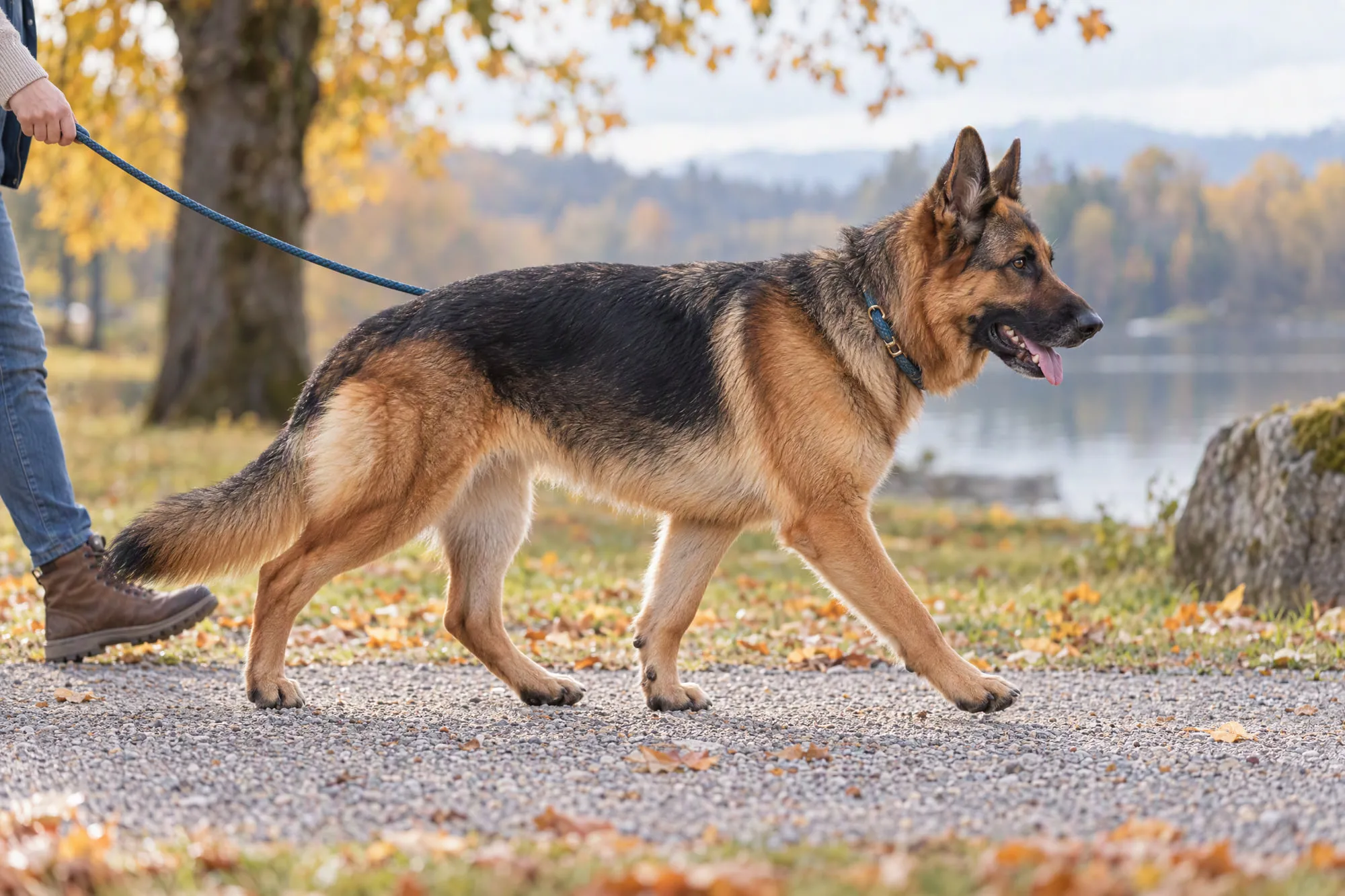
- Walk on the lead at a steady pace on soft ground (grass, woodland paths).
- Swimming is ideal: it builds muscle without impact. Dry your dog thoroughly afterwards.
- Avoid repeated ball throwing, sudden starts and stops, jumping and rough play with young dogs.
- Adjust from day to day: if your dog limps the day after an outing, it was too long.
Two simple exercises, only when your dog is not in a painful phase and with your vet’s agreement:
Slow sit-to-stands
- Stand your dog facing you on a non-slip surface.
- Ask them to sit up straight, with the back legs tucked underneath (not out to the side).
- Holding a treat at nose height, encourage them to stand up slowly while moving forwards slightly.
- Do 5 repetitions, take a break, then another 5 if all is well.
Good to know: going slowly is what makes it work. If your dog ‘catapults’ up or sits crookedly, reduce the number of repetitions.
Slow uphill walking
- Choose a gentle, even slope (a grassy bank, a gently rising path).
- Walk up at a slow pace on a short lead, so your dog pushes with the back legs instead of bounding.
- Come back down in a zigzag to reduce braking.
- Start with 2 or 3 climbs and increase gradually.
Good to know: you will find more ideas in our exercises for dogs with arthritis.
Adapting your home
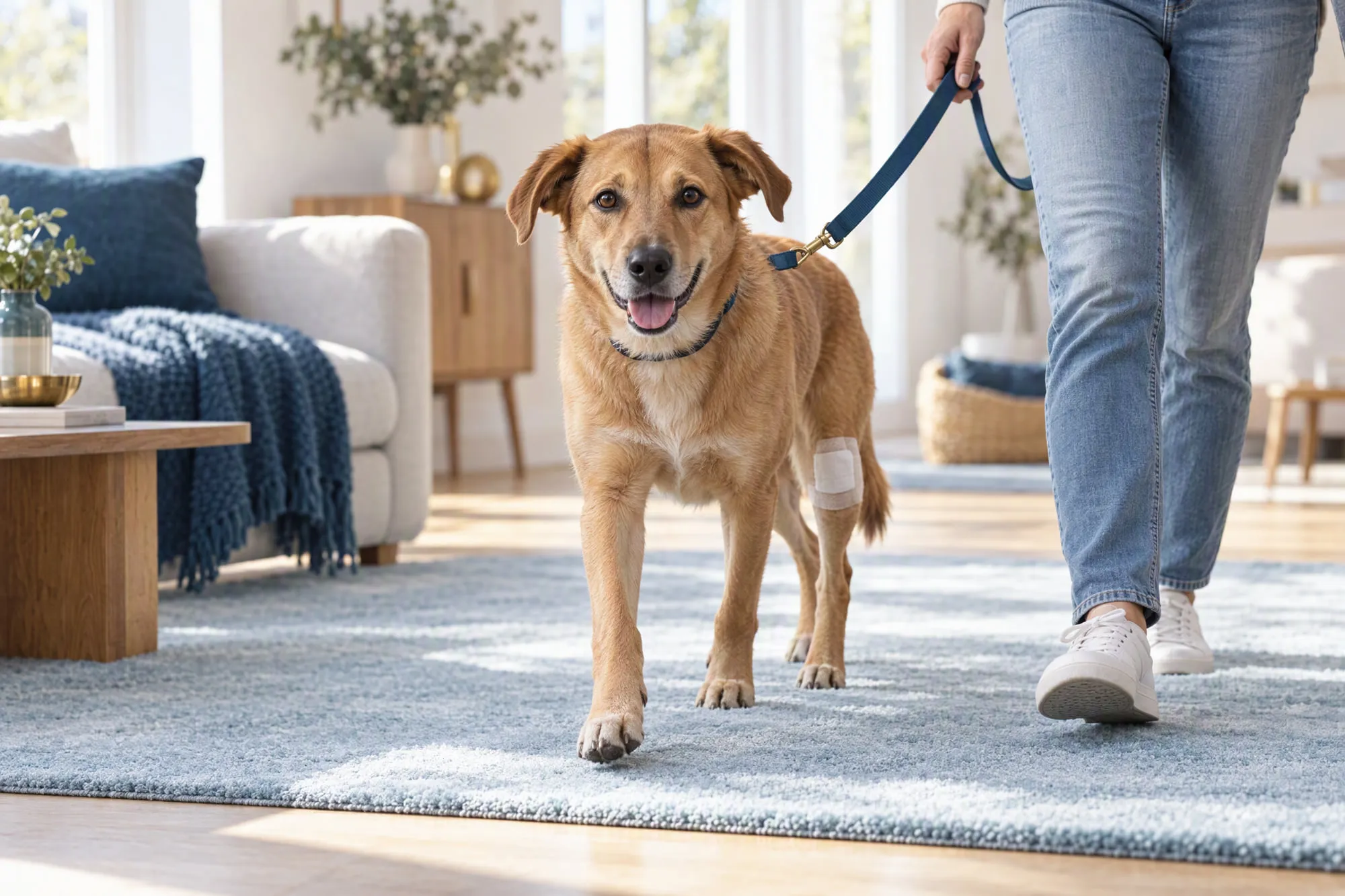
- Slippery floors: put non-slip rugs or runners where your dog walks; trim the fur between the paw pads and keep the nails short.
- Car and sofa: a ramp saves jumping. For stairs, a baby gate or a harness with a handle lets you help your dog.
- Bed: a thick-foam orthopaedic bed, away from cold and draughts, makes getting up easier.
- Cold and damp: many dogs with hip dysplasia are stiffer in winter; a coat for short-haired dogs and a few minutes of walking to warm up before play both help.
Hip dysplasia in puppies: prevention from the first months
You cannot change a puppy’s genes, but you can avoid making things worse:
- Choose the breeder carefully: ask for the official hip screening results of both parents (ideally FCI grade A or B, or BVA/KC hip scores below or close to the breed median) and, if possible, of the grandparents.
- Feed for steady growth: a complete large-breed puppy food, measured portions, no free feeding and no added calcium. A slightly slim puppy grows better than a chubby one.
- No stairs before 3 months, little jumping, but plenty of free play on soft, varied ground.
- No forced, repetitive exercise (running alongside a bike, canicross, agility jumps) until growth is complete.
- Early hip checks in at-risk breeds, from the puppy vaccination appointments, so the JPS window is not missed.
- Discuss the timing of neutering with your vet for large breeds, as some studies link very early neutering with more joint problems.
All of this advice is explained in detail in our article on large breed puppy joints.
Hip dysplasia in dogs: the key points
Hip dysplasia is a developmental condition, largely genetic, that leads to osteoarthritis. Picked up early in a puppy, it can sometimes be corrected with relatively simple surgery; discovered later, it can be managed very well in most cases thanks to a winning trio: a lean dog, regular gentle exercise, and veterinary follow-up with appropriate pain relief when needed. Watch your dog, note what changes and talk to your vet: you are the person best placed to keep them enjoying life on the move.
Frequently asked questions
Can a dog with hip dysplasia live a normal life?
Yes, in the vast majority of cases. With a healthy weight, regular and appropriate exercise, veterinary follow-up and, where needed, pain relief or surgery, many dogs with hip dysplasia enjoy a long, active and comfortable life. Hip dysplasia itself does not usually shorten life expectancy.
At what age do the signs of hip dysplasia appear in dogs?
There are often two peaks. The first is between 4 and 12 months, when the loose hip is painful during growth. The second comes later, often from 5 or 6 years of age, once osteoarthritis has set in. Some dogs show no signs for years despite poor X-rays.
How much does hip dysplasia surgery cost for a dog?
Costs vary widely with the technique, the size of the dog and the practice. Femoral head excision is usually the least expensive option, whereas a total hip replacement by a specialist surgeon is the most costly: in France, for example, it often runs to several thousand euros per hip. Ask for a detailed estimate that includes follow-up X-rays and rehabilitation, and check what your pet insurance covers.
Is hip dysplasia in dogs hereditary?
Yes, genetics is the main risk factor, but it does not explain everything: growing too fast, too much food or calcium and some aspects of a puppy’s environment also influence how the condition develops. That is why responsible breeders have their breeding dogs X-rayed and why a puppy’s diet matters so much.
Is my puppy too young to be screened for hip dysplasia?
No. Official screening is done from around 12 months of age, but a vet can look for abnormal looseness much earlier, from 3 to 4 months, by palpation under sedation or with the PennHIP method. This matters because some preventive surgery is only possible in very young puppies.
This article is for information only and does not replace a veterinary consultation. If in doubt, or if your dog is in pain or changes suddenly, contact your vet.
Transparency: Novalia develops and sells a complementary feed for dogs. Our articles stay independent: the product is only mentioned where relevant, always clearly labelled, and never in place of veterinary advice.
Sources and references
- Canine Hip Dysplasia
- Hip Dysplasia in Dogs
- Diagnosis, prevention, and management of canine hip dysplasia: a review (Schachner & Lopez)
- Characterization of FCI (Fédération Cynologique Internationale) Grades for Hip Dysplasia in Five Dog Breeds (Pinna et al.)
- Lifelong diet restriction and radiographic evidence of osteoarthritis of the hip joint in dogs (Smith et al.)
- Housing- and exercise-related risk factors associated with the development of hip dysplasia (Krontveit et al.)
- Hip Dysplasia Scheme