Puppies & growth Practical tips
Large breed puppy joints: how to protect them while your puppy grows
Stairs, exercise, feeding and screening: practical advice to protect your large breed puppy’s joints throughout growth, from 8 weeks to adulthood.
Key takeaways
- A large breed puppy grows very fast and for a long time, often 12 to 18 months and up to 24 months in giant breeds: the joints remain vulnerable throughout that period.
- Slow, steady growth is the goal: a complete ’large breed puppy' food, measured meals, no added calcium, and a lean puppy rather than a chubby one.
- Free play on soft ground is beneficial; stairs before 3 months, repeated jumping and forced exercise (running, cycling, canicross) are best avoided until growth is complete.
- A swaying gait, bunny hopping, lameness or unusual tiredness should prompt an early vet visit: some preventive procedures for hip dysplasia are only possible in very young puppies.
- Screening starts before you buy (the parents' results) and continues at the vet practice, up to official hip and elbow screening from around 12 to 18 months.
Contents
To protect your large breed puppy’s joints, three things matter more than anything else: slow, steady growth thanks to a suitable, carefully measured diet; plenty of free movement but no forced exercise and no stairs too early; and early screening for hip and elbow problems. Labradors, German Shepherds, Golden Retrievers, Bernese Mountain Dogs, Great Danes, Newfoundlands… these puppies grow fast and for a long time, and the choices you make during their first 12 to 18 months shape their joint health for life. Here are the practical rules, month by month.
Why large breed puppy joints are vulnerable
Spectacular growth
A dog is generally described as a large breed when it weighs more than about 25 kg as an adult, and as a giant breed above 45 kg. A giant breed puppy can multiply its birth weight by almost 100 in eighteen months. To keep up, its bones lengthen from growth plates (areas of growth cartilage) located near the joints. Until they close, these areas are softer than adult bone and sensitive to repeated impact, dietary excess and excess weight.
| Adult size | Examples | Approximate end of growth |
|---|---|---|
| Medium (10 to 25 kg) | Border Collie, Brittany | 10 to 12 months |
| Large (25 to 45 kg) | Labrador, German Shepherd, Golden Retriever | 12 to 18 months |
| Giant (over 45 kg) | Great Dane, Newfoundland, Leonberger, St Bernard | 18 to 24 months |
These timings are a guide only: your vet can confirm that growth has finished at a check-up and, if needed, with an X-ray.
Developmental joint diseases
Vets group several conditions that mainly affect large breeds under the heading of developmental orthopaedic diseases:
- Hip dysplasia: the hip is too loose and wears out prematurely. See our complete guide to hip dysplasia in dogs.
- Elbow dysplasia: a group of elbow abnormalities, often behind front-leg lameness in young dogs.
- Osteochondrosis: a fault in the way cartilage turns into bone, which can cause a flap of cartilage to come loose (shoulder, elbow, knee, hock).
- Panosteitis: inflammation of the long bones causing a lameness that shifts from leg to leg, usually temporary but painful.
All of them have a genetic component. Environment (diet, weight, type of exercise) does not cause the disease on its own, but it can make it noticeably worse or milder in a predisposed puppy.
Feeding a large breed puppy: the foundation of joint health
A complete ‘large breed puppy’ food
Choose a complete food formulated specifically for large breed puppies. These foods have a moderate energy density and adjusted levels of calcium and phosphorus to support steadier growth. The WSAVA (World Small Animal Veterinary Association) recommends choosing manufacturers who can show that their foods are formulated by qualified nutrition experts. A home-made diet is possible, but only if it has been worked out by a veterinary nutritionist: calcium mistakes are common in home-prepared diets.
Calcium: no more, no less
This is the classic trap, usually set with the best of intentions. A young puppy absorbs a large share of the calcium it eats and is poor at protecting itself from an excess. Yet too much calcium disturbs normal skeletal development in large breed puppies; nutrition researchers stress that intake recommendations must take these potentially harmful effects into account (Böswald et al., 2019). In practice:
- Never add calcium, bone meal, vitamin D or a ‘growth supplement’ to a complete food unless your vet has prescribed it.
- Don’t mix puppy and adult food at random, or commercial food and home-made meals.
- Treats should make up no more than 10% of the day’s intake.
Slow, steady growth
A large breed puppy should grow at its own pace, not faster. Its adult weight will be the same; it will simply reach it a little later, and that is a good thing. In a study of 48 Labradors followed for life from 8 weeks of age, dogs fed 25% less than their littermates fed freely developed hip osteoarthritis much later, at a median age of 12 years compared with 6 years (Smith et al., 2006).
- No free feeding: weigh each meal on the kitchen scales.
- Weigh your puppy every 2 weeks and adjust the ration according to body condition, not just the chart on the bag, which is only a starting point.
- Aim for a lean puppy: you should feel the ribs easily under your fingers and see a visible waist from above. A ‘nice round’ puppy is not a healthier puppy.
How many meals, and until when?
- Up to 4 to 6 months: 3 to 4 meals a day.
- From 6 months to the end of growth: 2 to 3 meals a day.
- Switching to adult food: usually between 12 and 18 months for large breeds, sometimes as late as 18 to 24 months for giant breeds, on your vet’s advice.
Looking ahead, our guide to overweight dogs and joint health explains how to assess body condition and keep your dog slim once adult, and our dog nutrition section brings together our other feeding advice.
Large breed puppy exercise: the right rules
What helps
A puppy needs to move to build muscle, coordination and strong joints. In a Norwegian study that followed 501 puppies of four large breeds (Newfoundland, Labrador, Leonberger and Irish Wolfhound), those that could exercise freely outdoors up to 3 months of age, on soft, moderately uneven ground, had a lower risk of hip dysplasia (Krontveit et al., 2012).
- Free play on grass, firm sand or woodland paths, at the puppy’s own pace: it stops when it is tired.
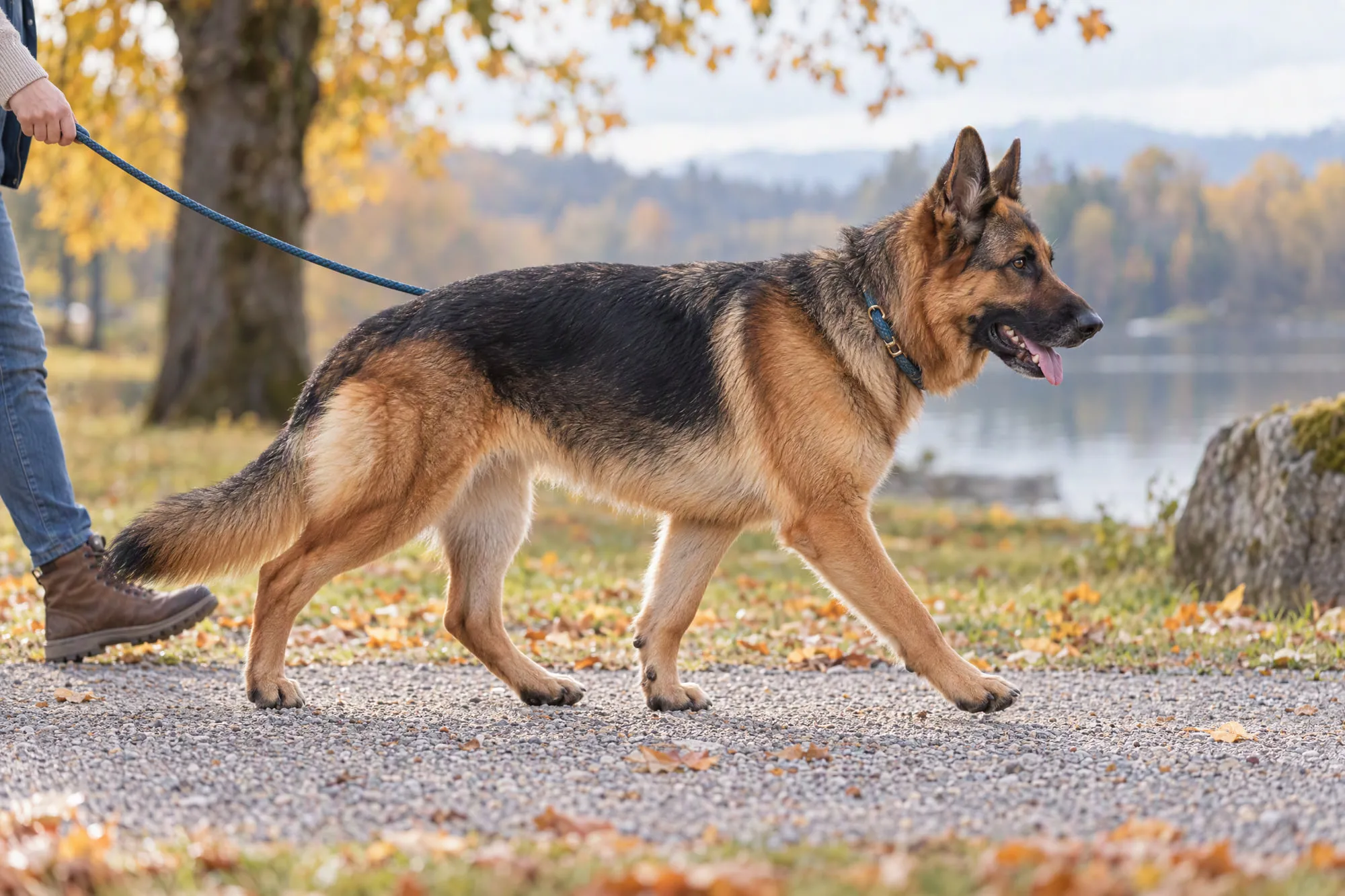
- Short exploration walks on the lead, varied, with lots of sniffing breaks.
- Simple balance and training games, which tire the brain as well.
- Calm paddling in shallow water, introduced gradually and under supervision.
What to avoid until growth is complete
- Forced, repetitive exercise: jogging, running alongside a bike, canicross, long hikes.
- Repeated jumping: jumping out of the car boot or off the sofa, agility jumps.
- Endless ball throwing, which strings together sprints, sudden stops and sharp turns.
- Rough play with big adult dogs that knock the puppy over and roll it around.
- Slippery floors, where the puppy skids and strains its hips.
The 5-minute rule: a guide, not a law
You will often read that a puppy needs ‘5 minutes of walking per month of age, once or twice a day’ (around 20 minutes at 4 months, 30 minutes at 6 months). This popular rule of thumb has no solid scientific basis, but it is a useful reminder that a puppy should not be walked like an adult dog. It applies to structured lead walking, not to free play. Your puppy remains the best guide: it should come home happy, not worn out, and never be lame or dragging its feet the next day.
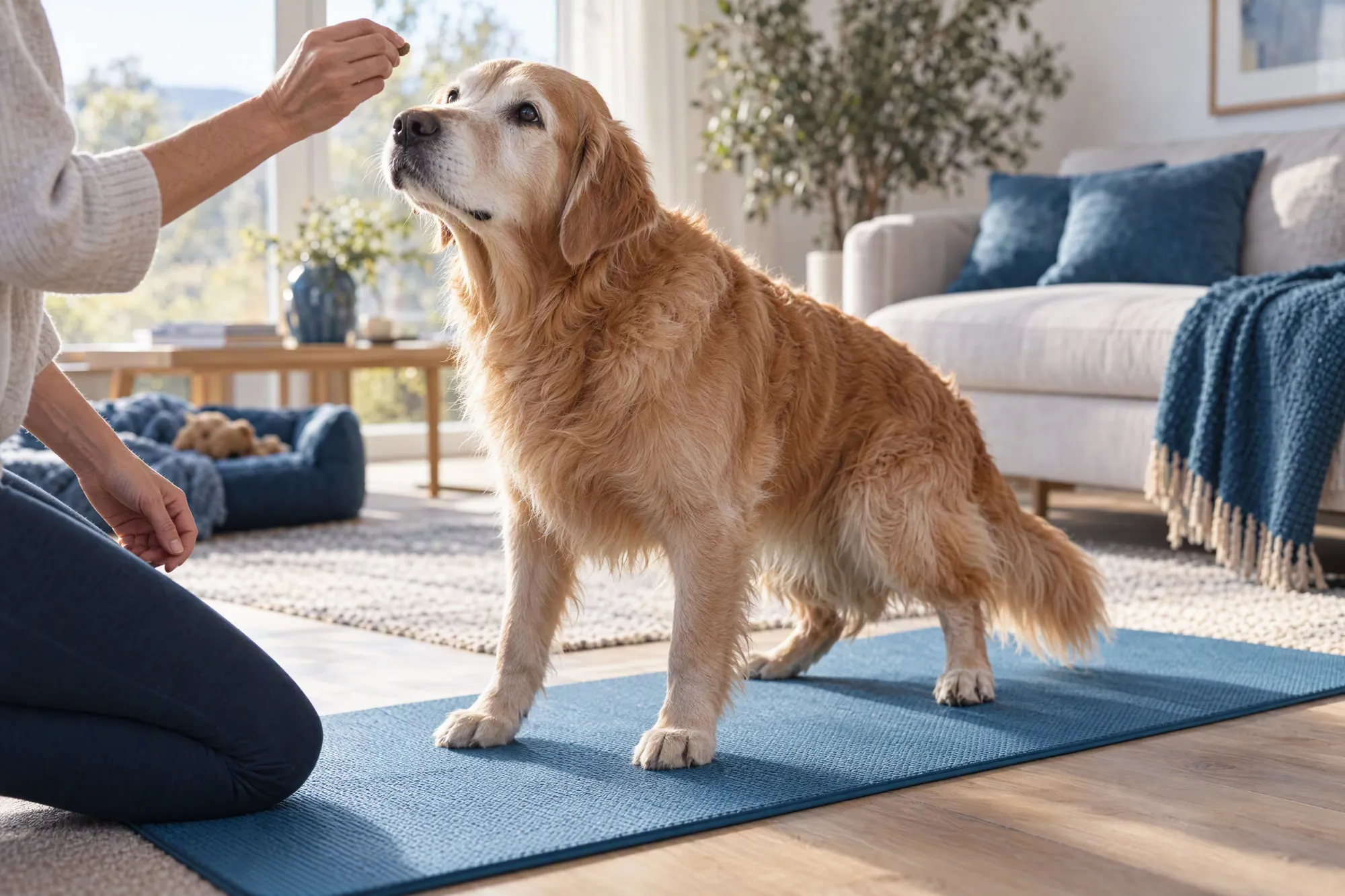
Two gentle exercises suitable for puppies, to build coordination and muscle without excessive strain:
The texture trail
- Lay out a few different surfaces on the floor: a rug, a flat firm cushion, a flattened cardboard box, a folded towel, a square of turf.
- Guide your puppy at a walk from one surface to the next with a treat, without rushing.
- Praise every crossing; change the order of the surfaces from one session to the next.
- Stop as soon as your puppy loses interest.
Good to know: everything stays at floor level, with no height: the aim is for your puppy to feel where it puts its paws, not to climb or jump.
Stepping over poles on the ground
- Lay 4 or 5 sticks or broom handles flat on the ground, about one puppy body length apart.
- Walk your puppy over the poles on the lead, in a straight line.
- Do 3 to 5 passes, in one direction and then the other.
- Keep the poles flat on the ground, never raised, while your puppy is still growing.
Good to know: walking slowly makes your puppy lift each paw in turn, which builds coordination with no impact at all.
Puppy stairs, jumping and the car: what to avoid
In the same Norwegian study, puppies that climbed stairs before 3 months of age had a higher risk of hip dysplasia (Krontveit et al., 2012). Here are the practical guidelines we recommend:
| Age | Stairs | Sofa, bed, car | Floors |
|---|---|---|---|
| Up to 3 months | Avoid completely: stair gate, carry your puppy | Lift up and down | Non-slip rugs in living areas |
| 3 to 6 months | A few steps now and then, slowly and on the lead | Lift or use a ramp; no jumping down | Non-slip rugs, short nails |
| 6 months to end of growth | Stairs at a walk are fine, no racing up or down | Ramp for the car, especially for getting out | Avoid play on tiles or wooden floors |
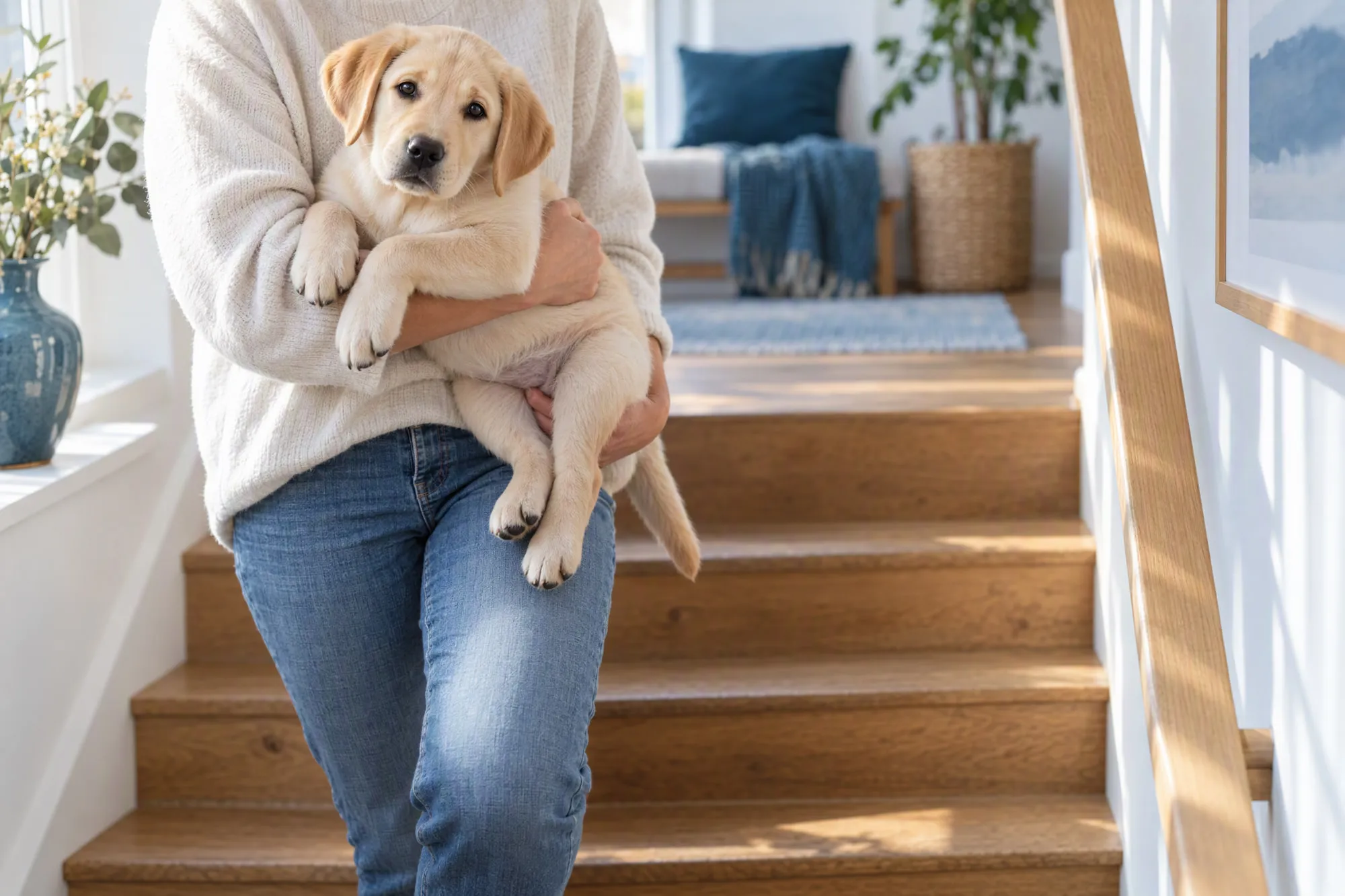
When you carry a puppy, support both the chest and the hindquarters: never lift a puppy by its front legs or just under the armpits. Once your puppy becomes too heavy to carry, a car ramp quickly becomes essential.
Hip dysplasia in puppies: warning signs
Dysplasia and other developmental conditions often show between 4 and 12 months. Don’t put a limp down to ‘growing pains’ without asking your vet.
- A swaying walk, with the hindquarters rolling from side to side.
- Bunny hopping when running, both back legs moving together.
- Sitting lopsided, with the back legs splayed out to one side.
- Lameness in one leg, or a limp that moves from leg to leg from one week to the next.
- An elbow that sticks out from the body, or a front paw turned outwards.
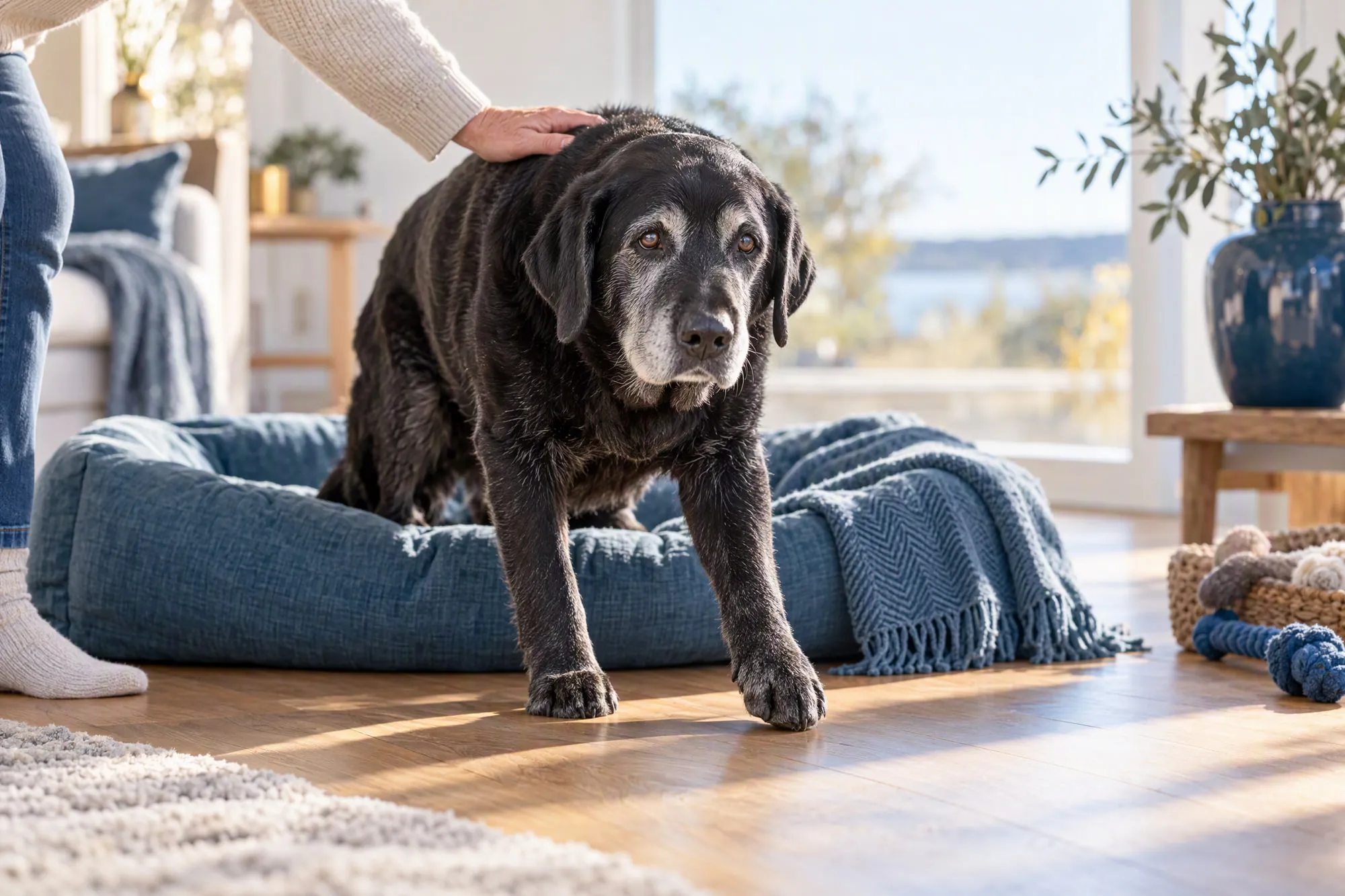
- Tiring quickly, not wanting to play, difficulty getting up after a nap.
If your puppy is limping, our guide to dog limping: what to do will help you describe the problem to your vet.
Screening: the right times
- Before you buy: ask to see the official hip screening results (and elbow results for breeds at risk) for both parents. In the UK, these come from the BVA/Kennel Club schemes. Each hip is scored, giving a total from 0 to 106: the lower the score, the better, and the BVA recommends breeding only from dogs with scores below or close to the breed median. Elbows are graded, 0 meaning normal, and the BVA recommends breeding only from dogs graded 0. If the parents were screened in an FCI country (much of mainland Europe), hips are graded from A (normal) to E (severe dysplasia): look for parents graded A or B.
- From the vaccination visits (8 to 16 weeks): ask your vet to feel the hips and elbows, especially in an at-risk breed. An abnormally loose hip can be checked for under light sedation.
- At around 4 months: in puppies that are at risk or show suspicious signs, the PennHIP method gives a precise measurement of hip laxity. According to the ACVS, this is the age at which a short, minimally invasive procedure (juvenile pubic symphysiodesis, or JPS) can still influence how the pelvis grows.
- At around 6 to 10 months: if there are signs, an X-ray can point towards other preventive surgical options, which are only possible before osteoarthritis sets in.
- From 12 months (often 15 to 18 months for giant breeds): official hip and elbow screening, essential if you are thinking of breeding and useful for tailoring your dog’s lifestyle. Under the BVA schemes, dogs must be at least 1 year old.
Neutering and joints: talk it through with your vet
Sex hormones play a part in closing the growth plates. In some large breeds, very early neutering has been linked to more joint problems. In a study of Labradors and Golden Retrievers, neutering before 6 months doubled the rate of at least one joint disorder (hip or elbow dysplasia, cruciate ligament rupture) in Labradors, and multiplied it by 4 to 5 in Golden Retrievers (Hart et al., 2014). These results vary between breeds and are only one part of the decision, which also takes other health risks and your lifestyle into account. The right age is decided case by case with your vet.
Key points for your large breed puppy’s joints
A large breed puppy doesn’t need to be wrapped in cotton wool, but it does need guidance: a suitable, measured diet so it grows slowly, lots of free play on soft ground, no stairs or repeated jumping too early, no forced exercise before growth is complete, and a watchful eye on how it moves. Add a breeder who health-tests their dogs and a vet you consult at the slightest doubt, and you give your puppy the best chance of strong joints for life. You will find all our advice in our puppy health section.
Frequently asked questions
How long should I walk my large breed puppy?
A rule of thumb you will often see is about 5 minutes of lead walking per month of age, once or twice a day, on top of free play. It is not a scientific rule: watch your puppy, who should come home happy rather than exhausted, and split outings into shorter ones. Free play on soft ground, where your puppy can stop whenever it likes, matters more than the distance covered.
When can a large breed puppy go up and down stairs?
Avoid stairs completely before 3 months: a Norwegian study of four large breeds linked stair use at that age to a higher risk of hip dysplasia. After that, a few steps now and then, taken slowly and on the lead, are acceptable; daily, repeated use of stairs is best limited until your puppy has finished growing.
When should I switch my large breed puppy to adult food?
Usually between 12 and 18 months for large breeds, and sometimes as late as 18 to 24 months for giant breeds, once growth has clearly slowed. The right time depends on your dog’s breed and size: ask your vet, who can use the weight chart to guide you.
Should I give my large breed puppy calcium or a joint supplement?
No to calcium: a complete large breed puppy food already contains the right amount, and too much can disturb skeletal development. Joint supplements have mainly been studied in adult dogs; in a healthy puppy, the priority remains controlled growth and a suitable food, which no supplement can replace. Talk to your vet before adding anything.
Can hip dysplasia show up in a puppy before 1 year?
Yes. The first signs often appear between 4 and 12 months, and a vet can detect an overly loose hip from 3 to 4 months by palpation under sedation or with the PennHIP method. Official screening starts from around 12 months, but it should never delay a vet visit if your puppy shows signs.
This article is for information only and does not replace a veterinary consultation. If in doubt, or if your dog is in pain or changes suddenly, contact your vet.
Sources and references
- Housing- and exercise-related risk factors associated with the development of hip dysplasia in Newfoundlands, Labrador Retrievers, Leonbergers, and Irish Wolfhounds (Krontveit et al.)
- Lifelong diet restriction and radiographic evidence of osteoarthritis of the hip joint in dogs (Smith et al.)
- Factorial calculation of calcium and phosphorus requirements of growing dogs (Böswald et al.)
- Long-term health effects of neutering dogs: comparison of Labrador Retrievers with Golden Retrievers (Hart et al.)
- Canine Hip Dysplasia
- Global Nutrition Guidelines
- Hip scheme
- Elbow scheme