Joints & mobility Symptom
Dog limping on back leg: common causes and what to do
Dog limping on back leg, suddenly or after resting? Cruciate ligament, kneecap, hip: the common causes, what to do at home and when to see the vet.
Key takeaways
- In adult dogs, cruciate ligament rupture is one of the most common causes of back leg lameness; in small dogs, a luxating patella is another suspect, and in young large dogs, hip dysplasia.
- A limp on getting up that eases with walking suggests osteoarthritis or a cruciate ligament problem; a sudden limp after running or jumping suggests a ligament, a paw injury or a fracture.
- A dog that won’t put weight on the leg, drags its back legs, scuffs the tops of its toes or staggers needs to be seen urgently: the cause may be neurological.
- While you wait for the appointment: check the leg, keep your dog on strict lead-only rest for 24 to 48 hours, no stairs or jumping, and no human painkillers.
- The sit test is a useful clue: a dog that sits crookedly, with the leg stuck out to the side, often has a sore knee.
Contents
A dog limping on a back leg is most often sore in the knee (cruciate ligament, kneecap), the hip (dysplasia, osteoarthritis) or the paw itself (grass seed, nail). If your dog won’t put any weight on the leg, is dragging its hindquarters or staggering, see a vet urgently. If they are using the leg and are otherwise well, check it, give 24 to 48 hours of lead-only rest and book an appointment if the limp persists. Here is how to recognise the likely causes and how to respond.
Dog limping on back leg: should you be worried?
Hind leg lameness is always a sign of discomfort or pain. How serious it is depends on whether your dog bears weight on the leg, how the limp started and your dog’s general condition.
| Situation | Main possibilities | What to do |
|---|---|---|
| Suddenly won’t put any weight on the leg | Cruciate ligament rupture, dislocation, fracture | See the vet the same day |
| Dragging one or both legs, scuffing the tops of the toes, staggering | Spinal cord problem (slipped disc and so on) | Emergency, straight away |
| Limp after an accident or a fall | Fracture, hip dislocation | See the vet the same day, even if your dog seems fine |
| Using the leg, clearly limping, happy dog | Paw injury, sprain, partial ligament tear | Rest for 24 to 48 hours, vet visit if no improvement |
| Hops on three legs for a few strides, then carries on | Luxating patella | Routine appointment |
| Stiff on getting up, easing with walking | Osteoarthritis, hip dysplasia, worn cruciate ligament | Appointment within the week |
How to recognise a back leg limp
A hind leg limp is often more subtle than a front leg one. Film your dog at a walk and a gentle trot, from behind and from the side, in a straight line.
- The ‘hip hike’: seen from behind, the pelvis on the sore side rises higher as the leg lands, or tilts unevenly.
- The head: it dips slightly as the sore leg lands, because the dog shifts its weight forwards.
- A shorter stride on the affected side.
- The sit test: a dog with a sore knee often sits crookedly, with the painful leg stuck out to the side instead of tucked underneath.
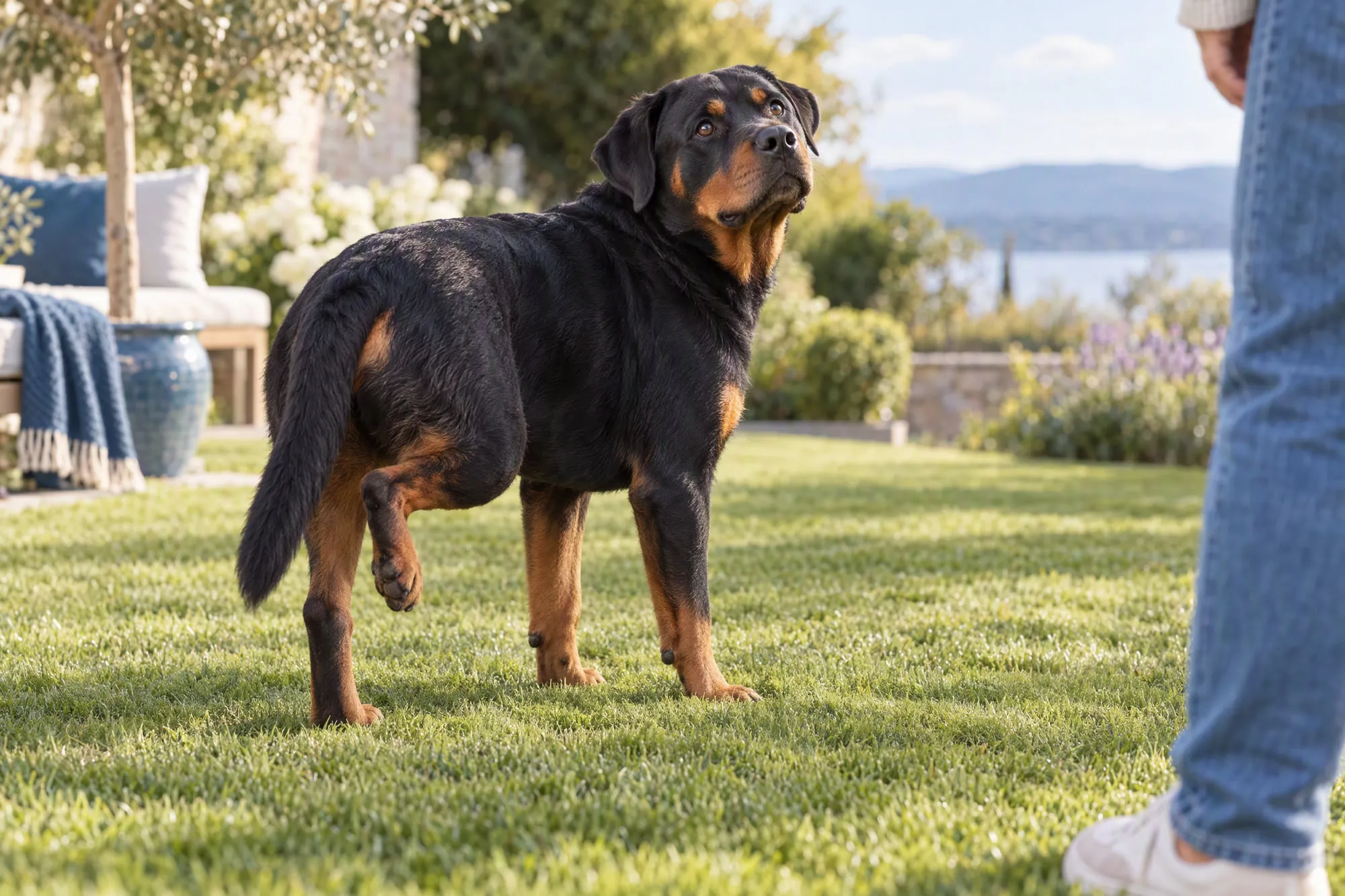
- Standing still, the dog rests only its toes on the ground or keeps the leg slightly raised.
- The thighs: over time, the thigh of the lame leg loses muscle, which you can feel by comparing both sides.
- Both back legs: a stiff or swaying gait, bunny hopping, difficulty getting up or into the car. Think of both hips, both knees or the back.
Common causes of hind leg lameness in dogs
Cruciate ligament rupture
This is one of the most common causes of back leg lameness in adult dogs. This ligament stabilises the knee. In dogs, it almost never snaps cleanly in a healthy knee: it wears down gradually (ageing, excess weight, lack of fitness, genetic predisposition) and finally gives way, often during a sudden start, a turn or a jump. The dog then suddenly lifts the leg.
Possible signs: variable lameness, sometimes only after a long rest; difficulty sitting or getting up; sitting crookedly; refusing to jump into the car; loss of thigh muscle; sometimes a ‘click’ in the knee (meniscal tear). Partial tears are common and almost always progress to a complete rupture. Rottweilers, Newfoundlands, Labradors, Staffordshire terriers, Akitas and St Bernards are among the most affected breeds, but any dog can be affected. Our guide explains cruciate ligament rupture in dogs and the treatment options in detail.
Luxating patella
The kneecap slips off its track, usually towards the inside of the knee. It is one of the most common orthopaedic conditions in dogs, particularly in small breeds: Yorkshire Terrier, Chihuahua, Pomeranian, Miniature Poodle. The tell-tale sign: the dog runs on three legs for a few strides with the back leg tucked up, then carries on normally. Both knees are affected in about half of cases. To understand the grades, read our article on luxating patella in dogs.
Hip dysplasia and osteoarthritis
Hip dysplasia is a developmental defect that makes the joint unstable, then arthritic. It causes hind leg lameness, reluctance to get up or jump, shifting of weight onto the front legs and loss of thigh muscle. It mainly affects large breeds, often in both hips. If your dog seems to be limping from the hip, our guide to hip dysplasia in dogs explains the steps to diagnosis.
Osteoarthritis can affect the hip, knee or hock of adult and older dogs, often following hip dysplasia or an old ligament injury.
Paw injuries
A grass seed between the toes, a cut pad, a broken or torn nail, a sting, a foreign body: these are the most common causes of a sudden limp, at any age. They are often visible when you check the paw.
Neurological causes
A slipped disc or another spinal cord problem rarely causes lameness in a single leg. Instead, it causes a wobbly, drunken gait, legs that cross over, a dog that walks on the tops of its toes, back pain or even paralysis. Long-backed breeds (Dachshund, French Bulldog and others) are particularly at risk: see our guide to IVDD in dogs.
Other causes to know about
- Panosteitis in young large-breed dogs: lameness that shifts from leg to leg, painful bones.
- Femoral head necrosis (Legg-Calvé-Perthes disease) in young small-breed dogs: gradual lameness in one back leg, hip pain.
- Iliopsoas strain (a groin muscle) in active, sporting dogs.
- Achilles tendon injury: the hock sinks towards the ground.
- A bone tumour in large adult or older dogs: lameness that worsens despite rest, a hard swelling, often near the knee.
Causes by your dog’s age and size
| Profile | Causes to consider first |
|---|---|
| Large-breed puppy or young dog | Hip dysplasia, panosteitis, osteochondrosis of the knee or hock, injury |
| Small-breed puppy or young dog | Luxating patella, femoral head necrosis |
| Medium to large adult | Cruciate ligament rupture, paw injury, luxating patella |
| Older dog | Osteoarthritis of the hip or knee, cruciate ligament, slipped disc, bone tumour |
Sudden limp or limp after resting: what it tells you
Dog suddenly limping on a back leg
A limp that appears all at once, during or just after a walk, points to:
- a paw injury, which you should look for first;
- a cruciate ligament rupture, especially if your dog set off or turned sharply and won’t put weight on the leg;
- a luxating patella, if the limp comes and goes;
- a fracture or a hip dislocation after an impact.
Dog limping on a back leg after resting
A limp or stiffness that is worse on getting up, after a nap or the day after a long walk, and eases within a few minutes of walking, suggests chronic joint pain: osteoarthritis, hip dysplasia, or a partial or long-standing cruciate ligament tear. For older dogs that struggle to get up, our article on the old dog struggling to stand up offers practical solutions.
What to do when your dog is limping on a back leg
If the situation is not urgent, here are the steps to follow.
- Stop the walk and head home slowly on the lead.
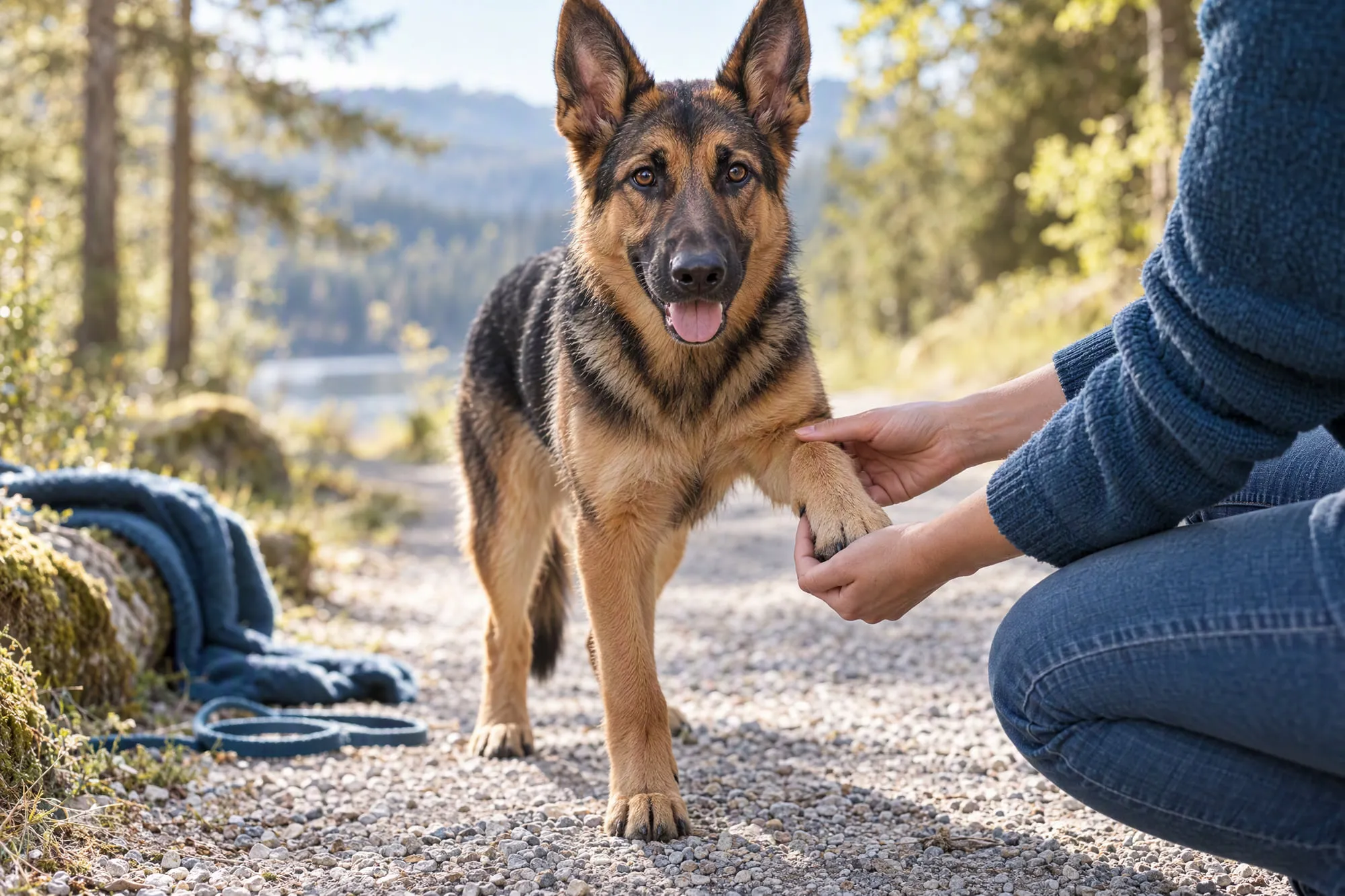
- Check the paw: spread the toes, look between the pads, check the nails and any dewclaw. Look for a grass seed, a wound or redness.
- Feel gently from the toes up to the hip, comparing with the other leg: heat, swelling, pain, a less muscular thigh. Never force a joint.
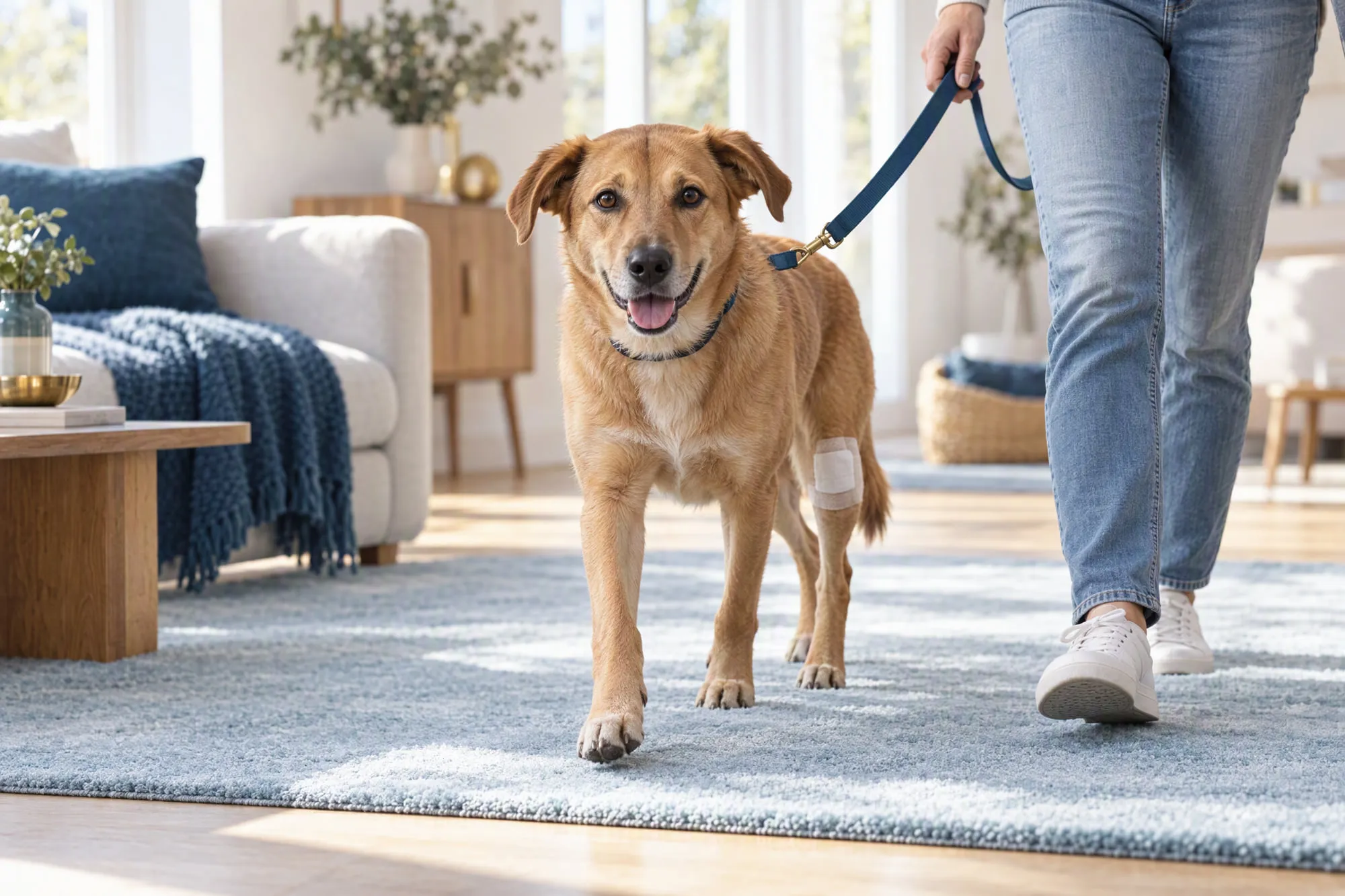
- Strict lead-only rest for 24 to 48 hours: short toilet trips, no stairs, no jumping, no play with other dogs. This is essential if the cruciate ligament is involved.
- Film the limp at a walk and a trot, from behind and from the side.
- Watch how your dog sits and note when the limp is most visible.
- Reassess after 24 to 48 hours and book an appointment if it hasn’t gone.
Small things that help
- A cold pack wrapped in a tea towel, for 10 minutes, two or three times a day, on a recent sprain or knock.
- Non-slip rugs on tiled and wooden floors, where your dog gets up.
- A harness with a handle, or a towel under the belly, to help them up a few steps or into the car.
- A thick, warm bed to limit morning stiffness.
At the vet practice: diagnosis and treatment
The vet watches your dog walk, then carries out a full orthopaedic examination: feeling the muscles and bones, moving the hip, knee and hock, checking for knee instability (drawer test, tibial thrust) and the position of the kneecap. In a tense dog, light sedation is sometimes needed for a reliable examination. A neurological examination is carried out if the gait is abnormal.
The most common further tests are X-rays of the hip or knee, sometimes a CT scan, an MRI of the spine, or arthroscopy of the knee.
Treatment depends on the cause: removing a grass seed and local wound care, rest and veterinary pain relief for a sprain, surgery for most cruciate ligament ruptures in medium to large dogs or for a high-grade luxating patella, and long-term management of osteoarthritis and hip dysplasia (weight, suitable exercise, veterinary treatment, rehabilitation). Physiotherapy speeds up recovery after knee or hip surgery.
Preventing hind leg lameness
- A healthy weight: excess weight is a recognised risk factor for cruciate ligament rupture, and it speeds up osteoarthritis.
- Regular activity rather than intense exercise only at weekends: a fit dog protects its knees better.
- A warm-up of a few minutes’ walking before ball games, frisbee or agility.
- Less jumping out of the car or off the bed or sofa: a ramp helps a lot.
- Non-slip floors at home.
- Controlled growth in large-breed puppies: a suitable diet and no repeated, forced exercise.
- An early vet visit as soon as a limp lingers: treating early limits the osteoarthritis that follows.
Dog limping on back leg: the key points
A back leg limp most often comes from the knee, the hip or the paw itself. If the leg no longer touches the ground, or your dog is staggering or dragging its legs, see the vet straight away. Otherwise: check the leg, give 24 to 48 hours of strict lead-only rest, film the limp, and book an appointment if it persists. To compare with front leg lameness, read our guide to the dog limping on front leg, and find all our advice in our dog joint health section.
Frequently asked questions
Why is my dog limping on a back leg after resting?
Marked lameness on getting up that improves after a few minutes of walking is typical of chronic joint pain: osteoarthritis of the hip or knee, hip dysplasia or a partial cruciate ligament tear. Rest lets the joint stiffen, then movement ’loosens it up'. It is not simply down to age: an examination can find the cause and help control the pain better.
My dog is suddenly limping on a back leg. Is it serious?
It depends on whether your dog is putting weight on the leg. If not at all, especially after running or a sudden start, a cruciate ligament rupture, a dislocation or a fracture are possible: see your vet the same day. If your dog is using the leg and is otherwise well, check the toes and pads, then give 24 to 48 hours of lead-only rest before reassessing.
My small dog hops on three legs, then carries on normally. What is it?
This ’skip' for a few strides, with the back leg tucked up, followed by a return to normal is highly suggestive of a luxating patella: the kneecap slips off its track, then back on. It is common in small breeds. A veterinary examination can establish the grade and decide whether surgery would help.
How can I tell if my dog has a sore hip or a sore knee?
It is difficult without an examination. Hip pain often causes a swaying gait, bunny hopping and difficulty getting up; knee pain shows more when the dog sits crookedly, with the leg stuck out to the side. The vet locates the pain by moving each joint and confirms it with X-rays.
How long should I wait before seeing the vet for a back leg limp?
For a mild limp, with no impact or wound, in a dog that is eating and cheerful, 24 to 48 hours of strict lead-only rest is enough to judge. If it doesn’t clearly improve, comes back or gets worse, book an appointment. A leg that no longer touches the ground or a dog that is staggering needs to be seen immediately.
This article is for information only and does not replace a veterinary consultation. If in doubt, or if your dog is in pain or changes suddenly, contact your vet.