Joints & mobility Symptom
Dog limping on front leg: causes, what to do and when to see the vet
Is your dog limping on a front leg? Toes, wrist, elbow or shoulder: the common causes of a dog limping on front leg, what helps and when to see the vet.
Key takeaways
- A dog limping on a front leg lifts its head as the sore leg touches the ground: this is the simplest way to tell which side is affected.
- From about 4 to 12 months in a large-breed puppy, elbow dysplasia, shoulder osteochondrosis and panosteitis come first to mind; in adults, toe and wrist injuries; in seniors, osteoarthritis, neck pain or a bone tumour.
- A leg that no longer touches the ground, a deformity, major swelling, a dog that is subdued or lameness after an impact all call for a vet visit the same day.
- Otherwise: check the leg carefully, give 24 to 48 hours of lead-only rest, film the limp, then book an appointment if it persists or comes back.
- Never give paracetamol, ibuprofen, aspirin or naproxen: these human medicines are dangerous for dogs.
Contents
A dog limping on a front leg is sore somewhere between the toes and the shoulder, and sometimes even in the neck. If the leg no longer touches the ground, looks deformed or very swollen, or the limp follows an impact, see your vet the same day. Otherwise, check the leg, give 24 to 48 hours of lead-only rest and book an appointment if the limp persists. Here is how to tell which leg is affected, understand the likely causes at each age and know what to do.
Dog limping on front leg: is it an emergency?
Front leg lameness is not a disease, it is a symptom: your dog is shifting its weight to protect a sore area. Before looking for the cause, assess how serious it is with three questions: is your dog putting weight on the leg? Did the limp come on suddenly or gradually? Is your dog otherwise well?
| What you notice | What it may mean | How soon to act |
|---|---|---|
| Leg no longer touching the ground, dangling or at an abnormal angle | Fracture, dislocation, serious injury | Emergency, straight away |
| Limp after a fall, an accident or a fight | Trauma, bite wound, severe sprain | The same day |
| Wrist sinking towards the ground as the dog walks | Wrist ligament injury | The same day |
| Hot swelling, fever, low mood, loss of appetite | Infection, abscess, inflammatory disease | The same day |
| Leg held up, stiff neck, yelping for no obvious reason | Neck or nerve pain | The same day |
| Putting weight on the leg, slight limp, happy dog | Thorn, small cut, mild sprain | Rest for 24 to 48 hours, then a vet visit if no improvement |
| Limp that keeps coming back, worse after exercise or on getting up | Elbow dysplasia, osteoarthritis, tendinitis | Appointment within the week |
How to tell which front leg your dog is limping on
It is not always obvious, especially when the limp is mild. Watch your dog walk, then trot gently, on flat ground in a straight line. The most useful thing is to film them from the front, from behind and from the side.
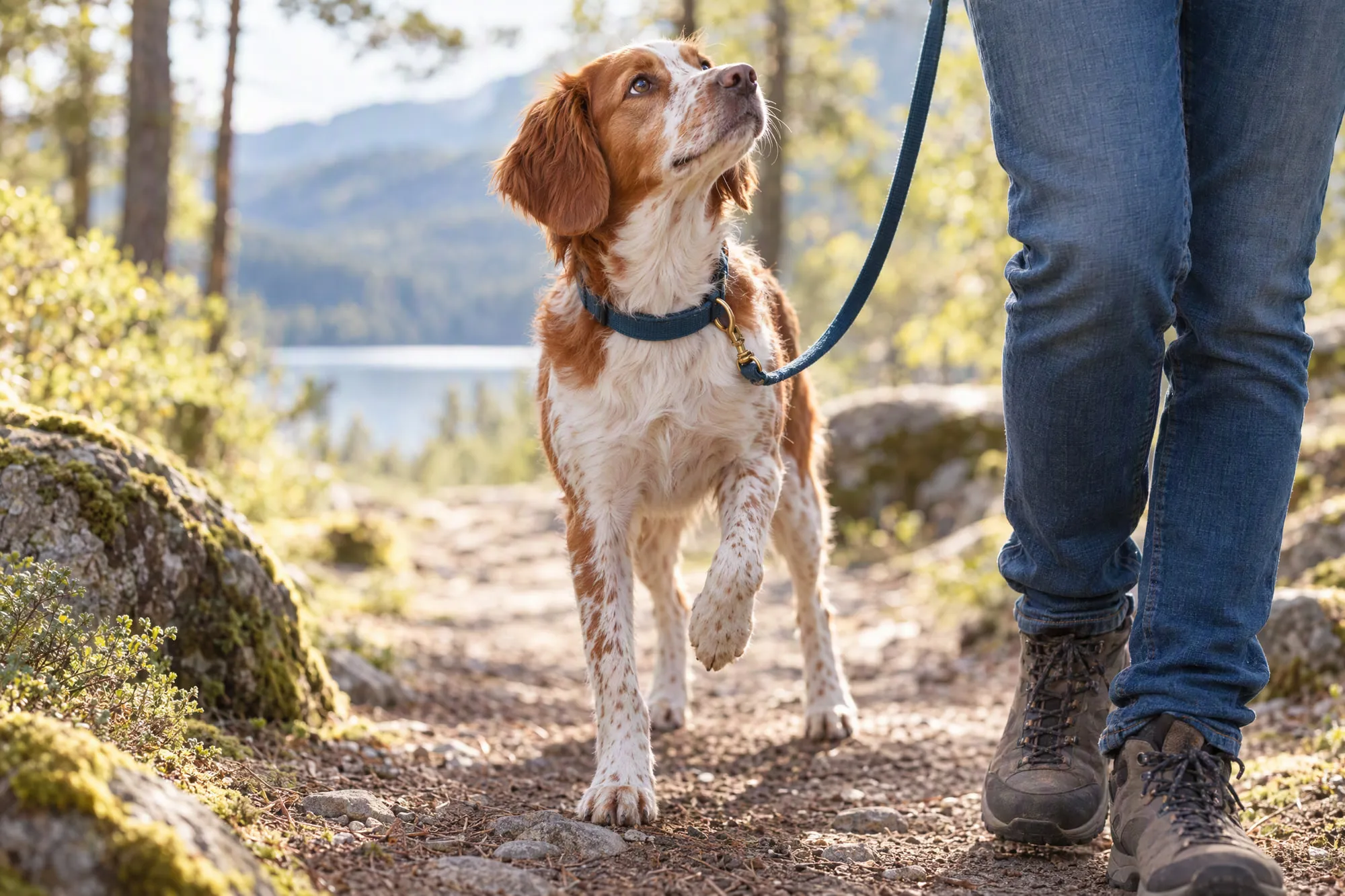
- The head nod: when the sore leg touches the ground, the dog lifts its head to take weight off it; the head drops when the sound leg lands. Remember: ‘the head goes up on the bad leg’.
- The stride: the step is shorter on the sore side, and the dog spends less time bearing weight on that leg.
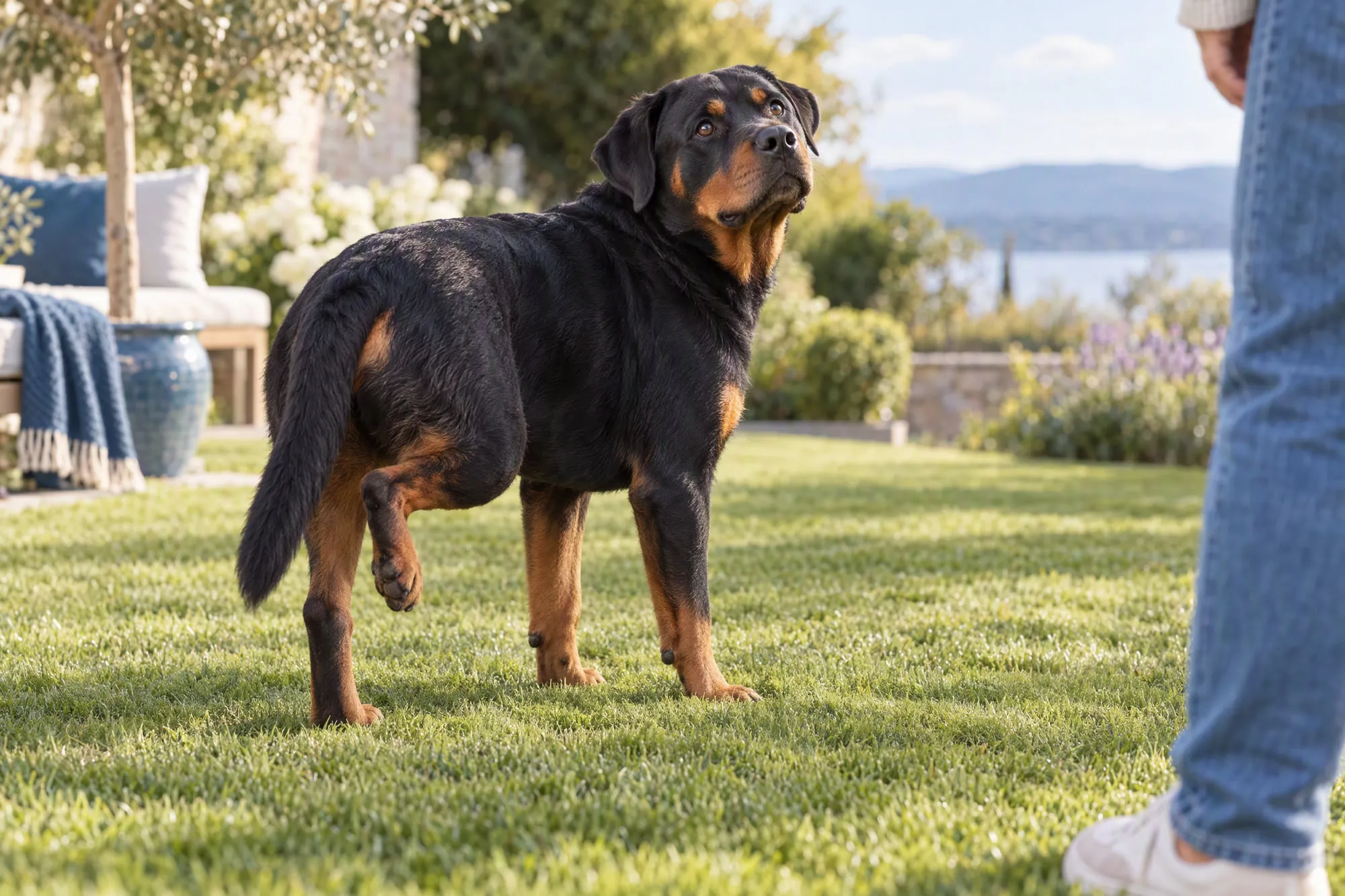
- Standing still: the dog takes weight off the leg, rests only its toes on the ground or holds it slightly forward.
- At rest: the dog always lies on the same side or keeps licking one particular spot.
- Both front legs: when both elbows or both shoulders are affected, the limp may almost disappear because it is symmetrical. The dog then has a stiff, short stride, tires quickly and sometimes refuses to finish the walk.
Causes of front leg lameness, from toes to shoulder
Vets work from the bottom up. Here are the most common causes for each part of the front leg.
Toes, pads and nails
This is the first area to check, as it is the most frequent culprit in a sudden limp: a grass seed lodged between the toes (very common from May to September), a cut pad, a broken or torn nail, a thorn, an insect sting, a burn from hot tarmac or an abscess. The dog often licks the paw persistently.
The wrist (carpus)
A wrist sprain happens after landing from a jump, a misstep or a slip. A more serious ligament injury gives a very recognisable sign: as the dog walks, the wrist sinks towards the ground. In older dogs, the wrist can also become arthritic, thickened and stiff.
The forearm (radius and ulna)
- Panosteitis, sometimes called ‘growing pains’, affects young large-breed dogs, usually between 6 and 18 months of age. The limp comes on suddenly, with no injury, and may shift from leg to leg between episodes. The bone is painful when pressed. It resolves on its own with age, but the episodes are painful and warrant veterinary pain relief.
- A fracture after an impact.
- Osteosarcoma, an aggressive bone tumour, mainly affects large adult or older dogs. It often develops in the long bones of the legs, particularly just above the wrist. The limp gets worse despite rest, with a hard, painful swelling.
The elbow
The elbow is one of the joints most often responsible for front leg lameness in large-breed dogs.
- Elbow dysplasia covers several developmental abnormalities of the joint (a loose fragment of cartilage or bone, a poor fit). Signs often start at around 5 months, but some dogs are not diagnosed until they are 4 to 6 years old. The limp worsens after exercise and does not disappear completely with rest. According to the American College of Veterinary Surgeons (ACVS), both elbows are affected in up to 80% of cases, which can mask the limp.
- Elbow osteoarthritis, often a consequence of dysplasia, in adult and senior dogs.
The shoulder
- Shoulder osteochondrosis: a developmental defect of the cartilage on the head of the humerus, in young large- or giant-breed dogs. Signs often appear between 4 and 8 months: a gradual limp that improves with rest and worsens with exercise. It can affect both shoulders.
- Shoulder tendinitis and instability (biceps tendon, medial ligaments), mainly in active adult dogs: agility dogs, gundogs and herding dogs.
- Shoulder osteoarthritis in older dogs.
The neck and nerves
Sometimes the leg itself is not the problem. A slipped disc in the neck or a trapped nerve root can make pain radiate down the front leg: the dog holds the leg up, keeps its neck stiff and struggles to lower its head to the bowl. More rarely, a tumour of the nerves in the armpit causes gradual lameness with muscle wasting over the shoulder. To find out more, read our guide to IVDD in dogs.
Likely causes by your dog’s age
Age is the best clue for narrowing down the possibilities, even before the examination.
| Age | Most common causes of front leg lameness |
|---|---|
| Puppy and young dog (about 4 to 18 months) | Elbow dysplasia, shoulder osteochondrosis, panosteitis, injury during play |
| Active adult | Grass seed, cut pad, broken nail, wrist sprain, shoulder tendinitis or instability |
| Older dog | Osteoarthritis of the elbow, shoulder or wrist, neck pain, bone tumour in large breeds |
In large-breed puppies, these growth disorders are a good reason to keep an eye on diet and activity during the first months: our guide to large breed puppy joints explains the right habits.
Dog limping on a front leg with no obvious pain
It is a common question: ‘He’s limping, but he isn’t complaining and he plays normally.’ In reality, a dog that limps is almost always in pain. It doesn’t whimper, because dogs are wired to hide pain, but it protects the leg. The excitement of a walk or a game of ball often makes the limp disappear, only for it to return once the dog is calm.
The rare truly painless limps are called ‘mechanical’: an old fracture that healed badly, a stiffened joint, a shortened tendon. Even then, only a vet can tell the difference. If the limp lasts more than 48 hours or keeps coming back, book an appointment, even if your dog seems fine.
My dog is limping on his front leg: what should I do right now?
If the situation is not an emergency, here is what to do.
- Stop the activity and walk home slowly on the lead.
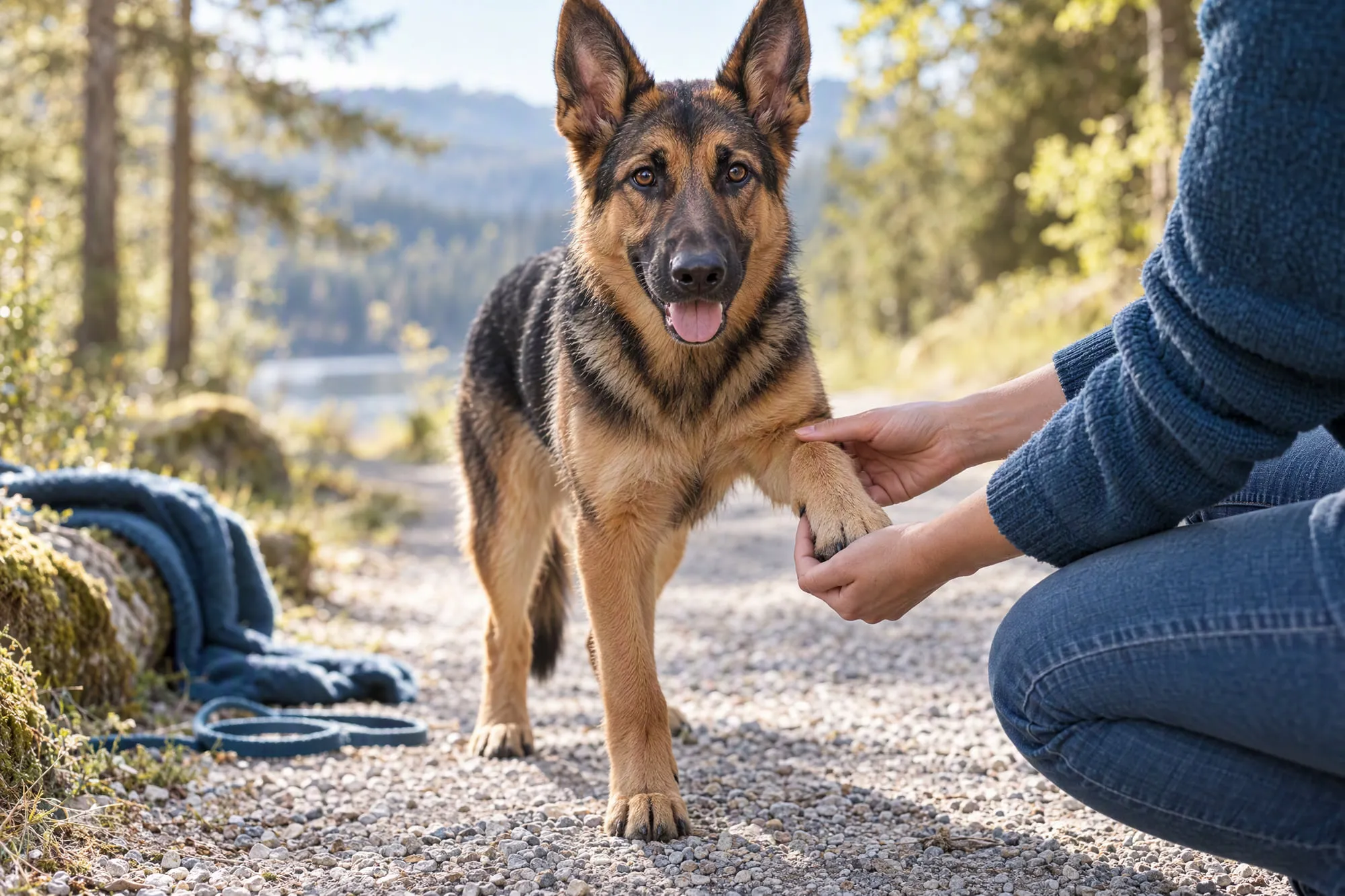
- Check the leg in good light: gently spread the toes, look between the pads and check every nail, including the dewclaw on the inside of the leg. Look for a grass seed, a thorn, a wound, or a red or swollen area.
- Feel gently, from the toes up to the shoulder, comparing with the other leg: heat, swelling, a pain reaction. Don’t force a joint to bend. Stop if your dog tenses or growls: a dog in pain may bite.
- Keep your dog on strict lead-only rest for 24 to 48 hours: short toilet trips, no stairs, no jumping off the sofa or out of the car, no play with other dogs.
- Film the limp at a walk and a trot: at the vet practice, stress often makes it disappear.
- Note the circumstances: since when, after what kind of exercise, whether it is worse on getting up or after a walk.
- Reassess after 24 to 48 hours. If there is no clear improvement, book an appointment.
Simple measures that help
- Cold on a recent sprain or knock: an ice pack wrapped in a tea towel, for 10 minutes, two or three times a day, if your dog accepts it.
- Floors that don’t slip: non-slip rugs where your dog gets up and lies down.
- A small cut on a pad can be rinsed with sterile saline; a deep or bleeding wound needs to be seen.
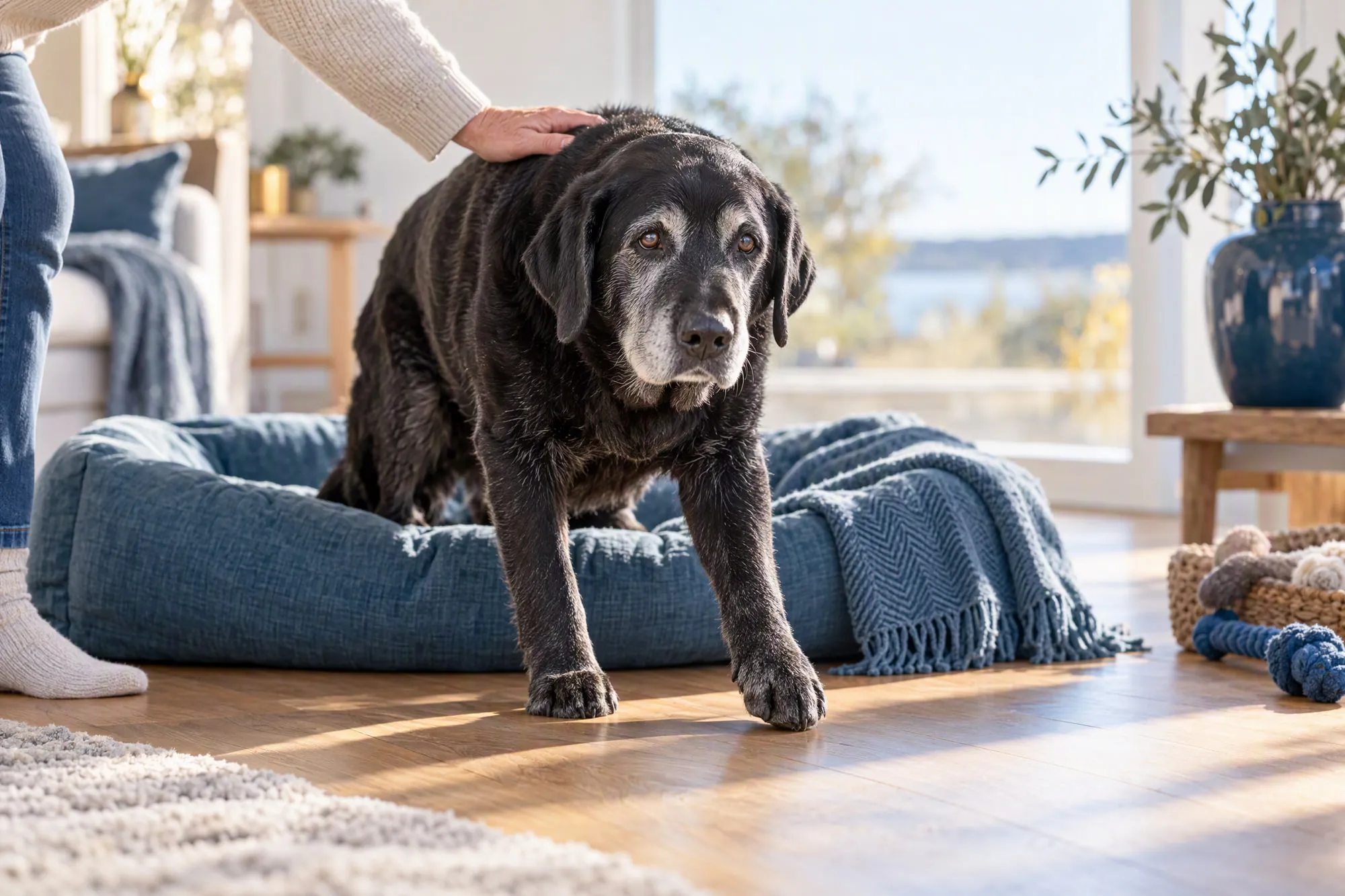
- A thick bed away from draughts for a stiff older dog.
At the vet practice: examination, diagnosis and treatment
The vet starts with the history, then watches your dog walk and trot. The orthopaedic examination involves feeling each bone and flexing and extending each joint, from the toes to the shoulder, to find the sore area, any swelling, instability or reduced range of movement. A neurological examination often completes the assessment, as some front leg lameness comes from the neck.
Depending on the case, the vet may suggest:
- X-rays, often under sedation, comparing both legs (growth disorders of the elbow and shoulder often affect both sides);
- a CT scan, which is very useful for the elbow;
- an ultrasound or MRI scan for the shoulder tendons or the neck;
- arthroscopy (keyhole surgery), which allows the vet both to see inside the joint and to treat some lesions.
Treatment depends entirely on the cause: removing a grass seed, wound care, rest and veterinary pain relief for a sprain or panosteitis, surgery (often by arthroscopy) for a fragment in the elbow or a flap of cartilage in the shoulder, and long-term management for osteoarthritis. Rehabilitation plays an important role after surgery or tendinitis: find out how dog physiotherapy and hydrotherapy can help.
If your dog has been limping on and off for a long time, our guide to arthritis in dogs will help you understand day-to-day management.
Protecting your dog’s front legs every day
The front legs carry most of a dog’s weight: they absorb every landing and every sudden stop. A few habits limit injuries.
- Keep your dog slim. Every extra kilo overloads the elbows, shoulders and wrists. Our guide to the overweight dog and joint health helps you assess their body shape.
- Limit jumping down: out of the car, off the sofa or bed, down big flights of stairs, especially for puppies and seniors. A ramp or a step makes all the difference.
- Warm your dog up with a few minutes of walking before intense play, ball games or agility.
- Avoid repeated ball throwing, which means lots of sudden stops and twisting of the shoulder.
- Check the paws after every walk in the warmer months and trim the fur between the pads.
- Keep the nails short so your dog stands correctly.
- Take care with large-breed puppies’ growth: no forced, repetitive exercise until growth is complete, a suitable diet and a lean body weight.
Dog limping on front leg: the key points
First identify the affected side using the head nod, then assess the urgency: if the leg no longer touches the ground, is deformed, if there has been an impact, the wrist is sinking or your dog is subdued, see the vet the same day. Otherwise, check the leg, give 24 to 48 hours of lead-only rest, with no human medicines, and have your dog examined if the limp persists. In a young large-breed dog, think of the elbow and shoulder; in a senior, of osteoarthritis and the neck. For an overview of all types of lameness, see our guide to dog limping: causes and what to do and our dog joint health section.
Frequently asked questions
My dog is limping on a front leg but doesn’t seem to be in pain. Is that possible?
Rarely: a dog almost always limps because it is protecting a sore area, even if it doesn’t whimper and carries on playing. Dogs are very good at hiding pain. A ’painless' limp that lasts more than 48 hours, or keeps coming back, should therefore be examined by a vet.
How can I tell if my dog has a sore shoulder or elbow?
It is hard to tell at home, and you should never force a joint to test it. A painful elbow is often held away from the body, with lameness that worsens after exercise; shoulder pain tends to show as a shortened forward stride. Only an orthopaedic examination, backed up by X-rays, can pinpoint the source of the pain.
My puppy is limping on a front leg. Should I be worried?
A slight limp after some rough play may pass with a day or two of calm. In a large-breed puppy, however, a limp that keeps coming back, moves from leg to leg or worsens after exercise needs a vet visit: elbow dysplasia, shoulder osteochondrosis and panosteitis typically appear during growth, and some are easier to treat when caught early.
My dog suddenly started limping on a front leg after running. What should I do?
Stop the activity, walk home slowly on the lead and check the toes, pads and nails. If you find nothing and your dog is putting weight on the leg, keep them on strict rest for 24 to 48 hours. If they won’t use the leg at all, the wrist is collapsing or the area is swelling fast, see your vet the same day.
Can a front leg limp come from the neck?
Yes. A slipped disc or a trapped nerve in the neck can cause pain that radiates down a front leg: the dog then often holds the leg up, is reluctant to lower its head to eat or drink and may yelp for no obvious reason. This kind of lameness needs a prompt neurological examination.
This article is for information only and does not replace a veterinary consultation. If in doubt, or if your dog is in pain or changes suddenly, contact your vet.