Senior dogs Symptom
Old dog struggling to stand up: causes, practical help and solutions
Is your old dog struggling to stand up, especially in the morning? Arthritis, muscle loss, nerve problems: how to help day to day and when to see your vet.
Key takeaways
- An old dog struggling to get up isn’t ‘just old’: in the vast majority of cases it is in pain, most often because of arthritis.
- Muscle loss, slippery floors, overlong claws and some nerve or hormonal diseases can also be to blame, alone or in combination.
- A dog that suddenly can’t get up, drags its back legs or loses its balance needs to be seen urgently.
- At home, non-slip flooring, a firm bed, a support harness and a gentle wake-up routine really make getting up easier.
- Managing pain with your vet often gives an old dog a surprising amount of mobility and joie de vivre back.
Contents
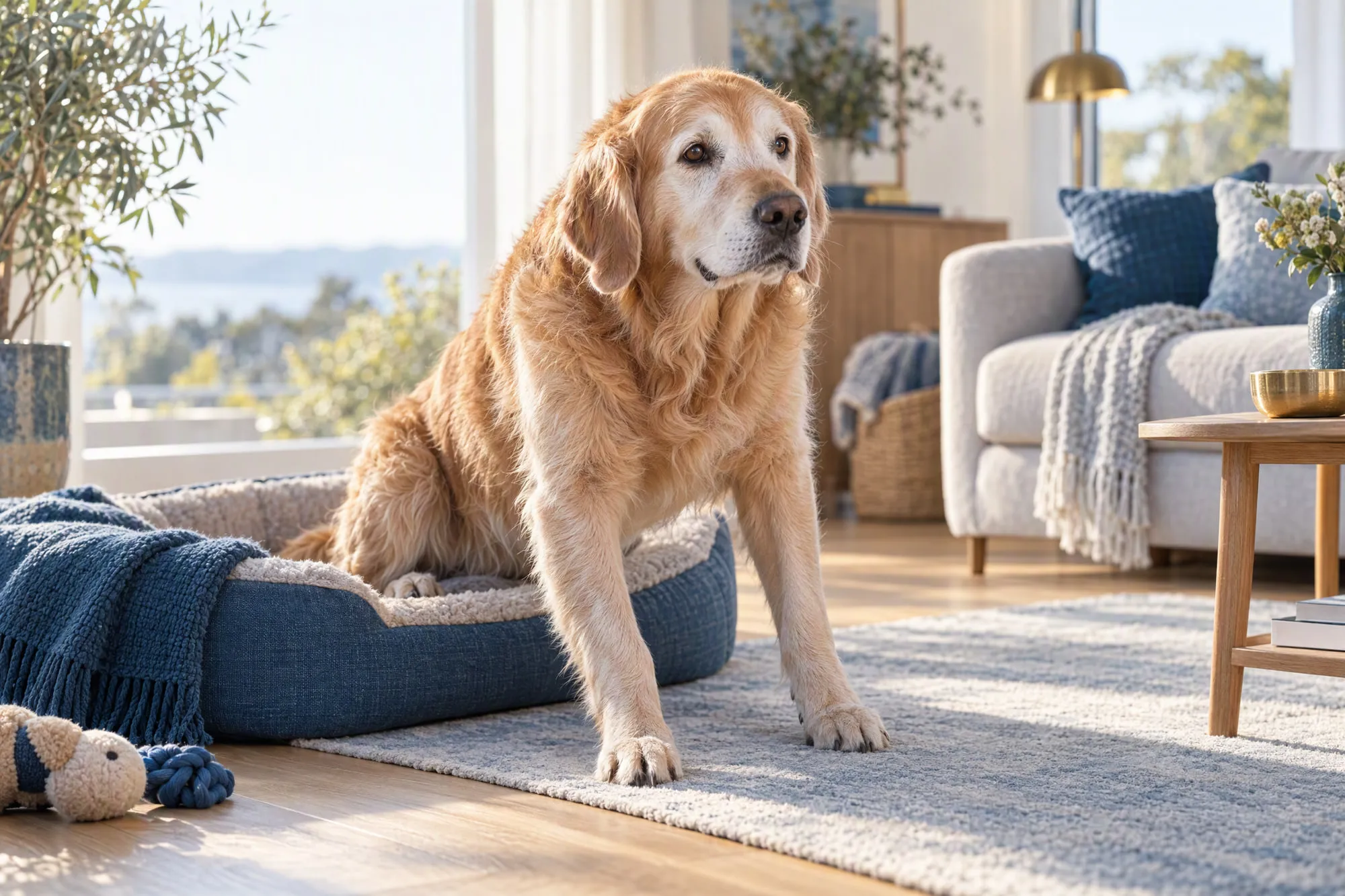
When an old dog is struggling to stand up, the most common cause is arthritis: its joints are stiff and painful, especially after rest. But it isn’t the only one. Muscle loss, a slippery floor or a nerve disease can also stop it getting up. Whatever the cause, it isn’t ‘just old age’: a vet visit will identify what’s going on, and a few simple changes at home can help your dog from today.
Why is my old dog struggling to stand up?
Getting up is more complicated than it looks: it takes supple, pain-free joints, muscles strong enough to push, nerves that pass on signals properly and a floor that gives grip. In a senior dog, one or more of these links weakens.
Arthritis, the number one cause
Arthritis is very common in older dogs, to varying degrees. The hips, knees, elbows and back are often affected. The typical sign: your old dog is stiff in the morning or after a nap, takes several attempts to get up, then walks better and better after a few minutes. It may also hesitate at the stairs or the car and cut walks short. Our complete guide to arthritis in dogs covers the symptoms and treatment in detail.
Muscle loss
With age, and even more so when pain makes a dog move less, the thigh and buttock muscles waste away. The dog then lacks the ‘engine’ to push up on its back legs. You can see it in thinner thighs and a more prominent spine and pelvic bones. It’s partly reversible with suitable exercises.
A nerve problem
Some spinal cord diseases cause weak back legs in older dogs, sometimes without obvious pain:
- intervertebral disc disease (a slipped disc), sudden or gradual, common in Dachshunds, French Bulldogs and Beagles but possible in any dog;
- degenerative myelopathy, an inherited disease of dogs over about 8 years old (German Shepherd, Boxer, Corgi, Bernese Mountain Dog…), which causes gradually worsening weakness and loss of coordination in the back legs, without pain;
- nerve compression in the lower back (the lumbosacral area), which makes the dog sore when it gets up, sits down or jumps into the car.
Other possibilities
- A slippery floor: tiles, polished wood, lino. A dog that slips no longer dares to push.
- Overlong claws or fur covering the pads, which reduce grip.
- Excess weight, which makes every effort harder.
- General illnesses: hormonal imbalances (thyroid, adrenal glands), anaemia, heart disease, which tire and weaken the dog.
- A balance disorder (vestibular syndrome), with a head tilt and a drunken gait, often sudden in old dogs.
- Cognitive decline, which can make the dog confused and hesitant.
Symptoms: what your dog is showing you
| What you see | Most likely cause |
|---|---|
| Stiffness on waking that improves with walking | Arthritis |
| Several attempts to get up, pushing up on the front legs first | Hip or knee arthritis, muscle weakness |
| Thin thighs, prominent pelvic bones | Muscle loss |
| Back legs crossing or giving way, worn tops of the claws | Likely nerve problem |
| Crying or whimpering when getting up, hunched back | Back or joint pain |
| Slipping and splaying on tiled floors | Unsuitable floor, long claws, weakness |
| Head tilt, sudden loss of balance | Vestibular syndrome |
| General tiredness, breathlessness, weight loss | An underlying illness to investigate |
Arthritis or nerve weakness: a few clues
Only a vet examination can tell for sure, but these pointers will help you describe what’s happening.
- More likely arthritis: the dog is in pain (it whimpers, licks a joint, tenses when touched), it is stiff and then warms up, it puts weight down carefully but its legs ‘know where they are’.
- More likely a nerve problem: the dog doesn’t seem to feel its legs. They cross over, slide outwards, the tops of the toes scuff the ground (claws worn on top), the hindquarters wobble. There may be no pain at all.
The two often go together in an old dog. That’s why it’s so useful to film your dog getting up and walking and to show the video to your vet. To find out more about one of the most common nerve-related causes, read our article on IVDD in dogs.
Diagnosis and treatment at the vet
Your vet will watch your dog get up and walk, carry out an orthopaedic and neurological examination, and feel along its spine. Depending on the findings, they may suggest X-rays, a blood test (essential in a senior dog before long-term treatment) and sometimes a CT scan or MRI.
If arthritis is the cause, treatment is based on:
- suitable pain relief, chosen with the kidneys, liver and any other diseases in mind: a veterinary anti-inflammatory, a monthly anti-NGF antibody injection, or a combination;
- weight loss where needed;
- physiotherapy (exercises, hydrotherapy) to rebuild muscle.
For a nerve problem, care depends on the diagnosis: strict rest and medication, surgery, rehabilitation. Whatever the cause, never give human painkillers (paracetamol, ibuprofen, aspirin, naproxen): they can be highly toxic to dogs.
How to help your old dog stand up every day
The right way to help
- Let your dog try on its own first, without rushing it: getting up is still useful exercise.
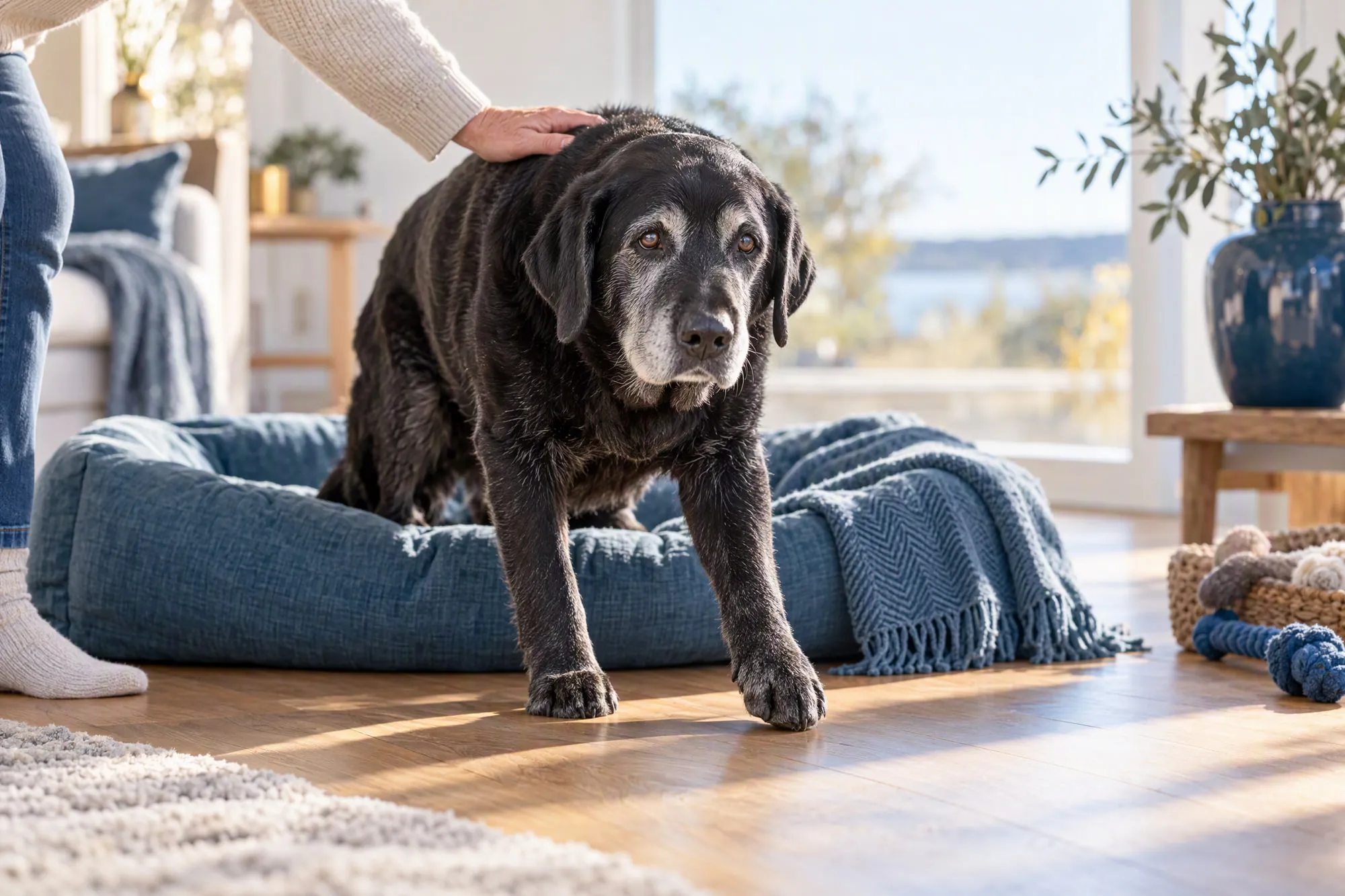
- If it gets stuck, help the back end. Pass a rolled-up towel or a support harness under its belly, just in front of the back legs.
- Support the movement, don’t haul it up in one go: take some of its weight while it pushes.
- Keep your back straight and bend your knees. With a large dog, do it with two people.
- Stay beside your dog for a few seconds once it’s up, while it finds its balance.
A support harness with handles at the front and back is an excellent investment for a heavy dog: it also lets you help on the stairs and when getting out of the car.
Exercises to rebuild strength
Do these exercises on a non-slip surface, once pain is under control and with your vet’s agreement. Stop if your dog limps more or seems reluctant.
Assisted sit-to-stands
- Stand your dog on a rug, against a wall or the sofa so it can’t drift sideways.
- Ask for a sit, then get it to stand back up slowly by guiding its head forwards with a treat.
- If needed, lightly support the hindquarters with the harness or towel.
- Start with 3 repetitions and build up to 8 to 10 over several weeks.
Good to know: this is exactly the movement your dog needs to get up. Practising it without stress makes it easier day to day.
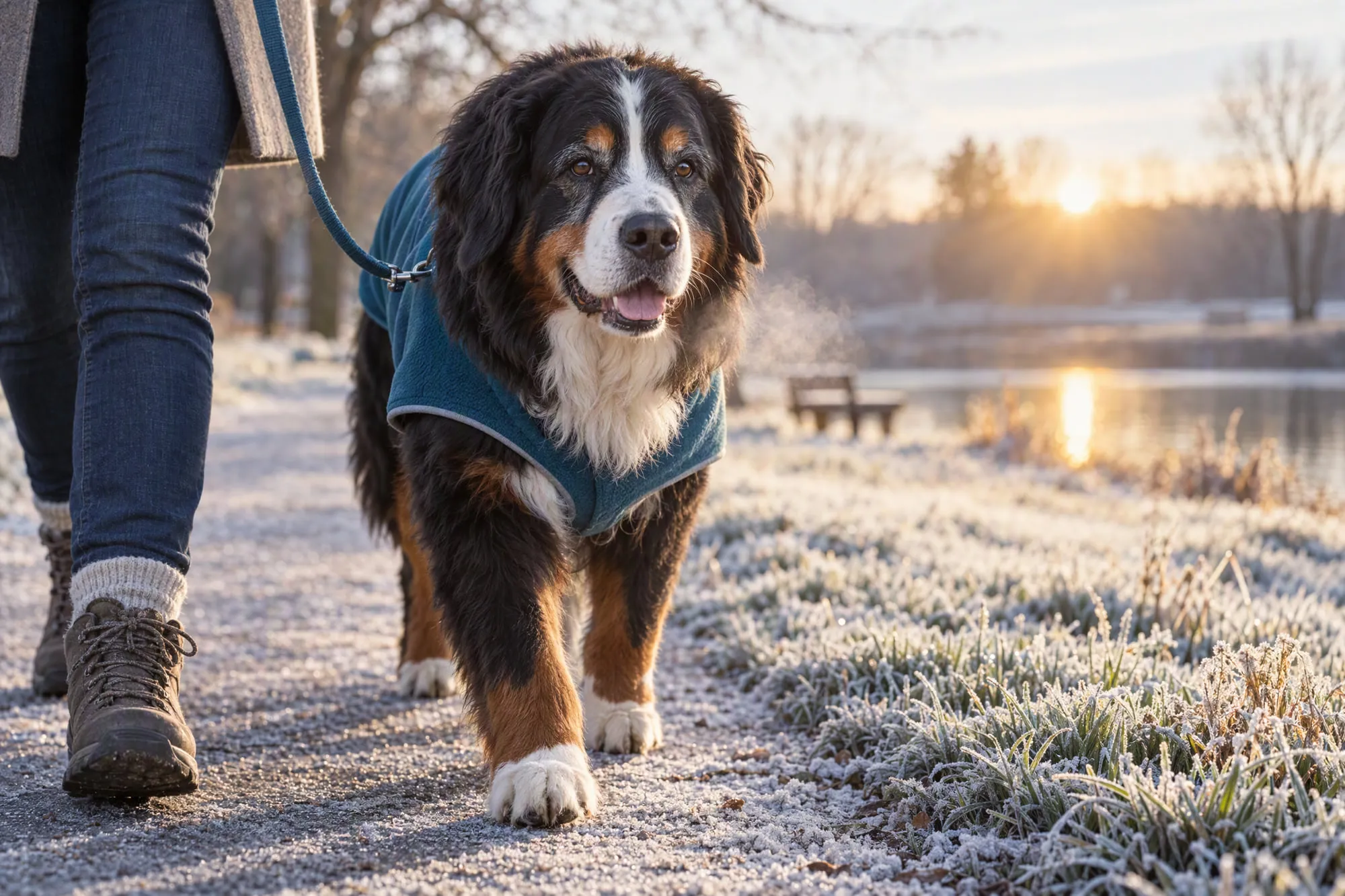
Slow walking up a gentle slope
- Choose a gentle grassy slope or a path with a slight incline.
- Walk up slowly on a short lead, without letting your dog break into a trot.
- Come back down on a flat path if possible, as going downhill puts more load on the front legs.
- Add a minute a week if all goes well.
Good to know: walking slowly makes your dog carry its weight on each leg, which builds muscle far better than a brisk trot.
To go further, try our programme of gentle exercises for dogs with arthritis.
A home that helps your dog get up
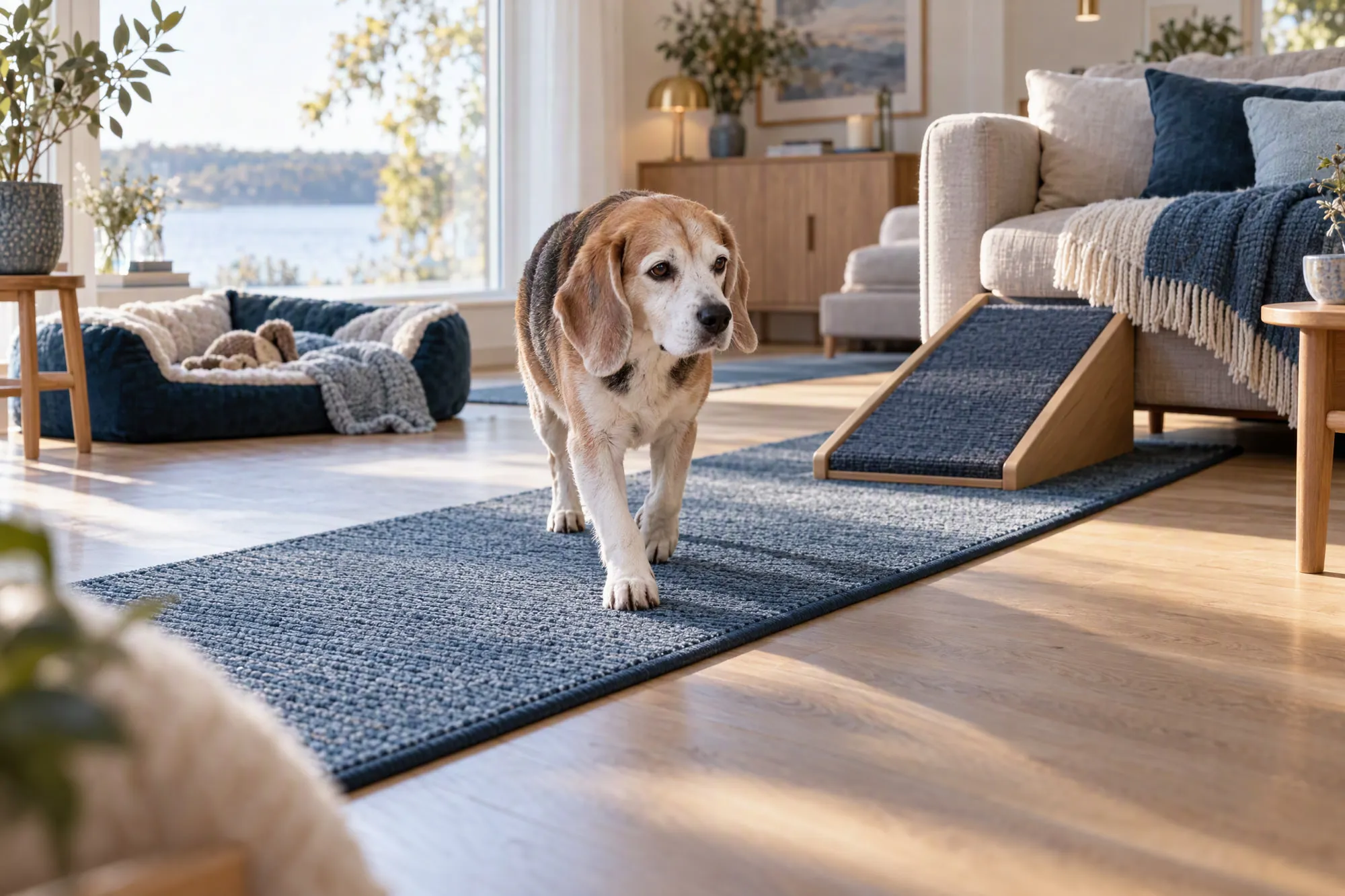
- Non-slip rugs along walkways and above all where your dog lies down: that’s where it needs to push off.
- A firm orthopaedic bed, big enough for your dog to stretch out fully, with a low edge so it’s easy to get out of. A cushion that’s too soft makes it sink and makes getting up harder.
- No bed on cold tiles or in a draught: cold makes stiffness worse.
- Claws kept short and the fur between the pads trimmed.
- Raised bowls if bending down is uncomfortable.
All our practical ideas are gathered in our article on home adaptations for a senior dog.
Weight and diet
Every extra kilo makes getting up harder. In overweight dogs with arthritis, even modest weight loss clearly improves mobility: ask your vet for a realistic target and read our advice on helping an overweight dog get back to a healthy weight. A diet rich in marine omega-3 is also worth considering for a senior dog’s joints. If you’re thinking about a supplement, Novalia Hip & Joint is a complementary feed for dogs designed to contribute to supporting joint function, alongside regular check-ups with your vet.
Tracking progress and protecting quality of life
Keep a simple notebook: how many attempts it takes to get up in the morning, how long walks last, whether stairs are possible, mood. These simple notes help your vet judge how well a treatment is working and adjust it. For senior dogs, a check-up every six months is recommended.
If your dog can no longer get up on its own, can’t go outside to toilet or seems to have lost interest in things, talk frankly with your vet. There are often still options (adjusting treatment, a mobility cart, day-to-day help), and your vet will also be there to support you through the harder decisions. You’ll find all our advice in our senior dog section.
Key points for helping an old dog stand up
An old dog struggling to stand up almost always has a medical reason, most often arthritis, and almost always a way to feel better. Have your dog examined to find the cause and manage the pain. At home, focus on floors with grip, a firm, warm bed, a harness to help, a gentle wake-up routine and a little exercise every day. Many owners are surprised to see their old companion regain its spark once the pain is under control.
Frequently asked questions
My dog struggles to get up but then walks normally. Is it serious?
This is the classic picture of arthritis: the joint is stiff after rest, then ‘loosens up’ with walking. It isn’t an emergency, but it is a sign of chronic pain that deserves a vet appointment. The right treatment often makes getting up much easier.
Why is my old dog stiff in the morning?
Overnight, the arthritic joint stays still and inflammation builds up, which causes stiffness on waking that fades within a few minutes. Cold, a bed that is too soft or placed straight on a tiled floor make this worse. A firm, warm bed and a few minutes of gentle walking before the real walk help a lot.
My older dog has weak back legs. What should I do?
Have your dog examined: weak back legs can be caused by arthritis in the hips or knees or by muscle loss, but also by a spinal cord problem such as a slipped disc or degenerative myelopathy. Treatment is completely different depending on the cause. In the meantime, make floors safe and help your dog with a harness.
How can I help a heavy dog stand up without hurting my back?
Use a support harness with a handle, or a rolled-up towel passed under the belly just in front of the back legs. Bend your knees, keep your back straight and support the movement rather than lifting the dog entirely. For a very large dog, do it with two people.
When should I worry about the quality of life of a dog that can no longer get up?
When your dog can no longer get up on its own several times a day, can’t go outside to toilet, soils itself or has lost interest in the things it loved, talk openly with your vet. There are often still ways to improve its comfort. Quality-of-life assessment scales can also help you see things more clearly.
This article is for information only and does not replace a veterinary consultation. If in doubt, or if your dog is in pain or changes suddenly, contact your vet.
Transparency: Novalia develops and sells a complementary feed for dogs. Our articles stay independent: the product is only mentioned where relevant, always clearly labelled, and never in place of veterinary advice.