Senior dogs Guide
When is a dog a senior? Age guide by size, and what changes as they get older
When is a dog a senior? Age guide by size and breed, dog years in human years, the signs of ageing to watch for and the senior health checks to plan.
Key takeaways
- There is no official age: a dog is generally considered senior once they have reached around 75% of the life expectancy for their breed or size.
- Giant breeds become seniors at around 5 to 6 years old, while small dogs can remain fit adults until 10 or older.
- The rule '1 dog year = 7 human years' is wrong: dogs age very quickly in their first two years, then more slowly.
- The first signs of ageing are often subtle: less stamina, stiffness on getting up, weight gain or loss, longer sleep, slower reactions.
- A vet check at least twice a year is recommended for senior dogs, with appropriate tests, to pick up arthritis and kidney, heart or hormonal disease early.
Contents
When is a dog a senior? As a rule, once they have reached around 75% of their life expectancy. So there is no single age: a Great Dane can enter this stage as early as 5 to 6, a Labrador or Border Collie more often at around 9 to 10, and many small dogs at 10 or older. Here is a guide by size, how dog years compare with human years, the changes to watch for and what you can do now.
Senior dogs: why there is no single age
In dogs, the pace of ageing depends mainly on size. Unlike most species, where larger animals live longer, big dogs age faster than small ones.
A large UK study published in 2024, covering more than 584,000 dogs, illustrates this well:
- median longevity across all breeds is 12.5 years;
- it is 12.7 years for small breeds, 12.5 years for medium breeds and 11.9 years for large breeds;
- the differences between breeds are considerable: 15.4 years for the Lancashire Heeler, but 9.0 years for the Mastiff and 8.1 years for the Cane Corso.
That is why vets think in terms of the proportion of a dog’s life rather than in years: a dog is described as senior from around 75% of their life expectancy, then geriatric in the very last stage. The age guides also vary between sources: the American Veterinary Medical Association (AVMA), quoted by the American Kennel Club, uses 7 years for small dogs and 5 to 6 years for large breeds, while VCA places the start of the senior years at between 10 and 12 for small breeds and around 5 or 6 for giant breeds.
When is a dog a senior? A guide by size and breed
Guide by size
| Size | Examples | Median longevity (UK study, 2024) | Senior age generally used |
|---|---|---|---|
| Small (under 10 kg) | Yorkshire Terrier, Miniature Dachshund, Bichon Frise, Jack Russell Terrier | 12.7 years | From 7 (AVMA) to 10–12 (VCA); about 9.5 with the 75% rule |
| Medium (10 to 25 kg) | Border Collie, Cocker Spaniel, Springer Spaniel, Beagle | 12.5 years | About 9 with the 75% rule |
| Large (25 to 45 kg) | Labrador, Golden Retriever, German Shepherd | 11.9 years | From 5 to 6 according to the AVMA; about 9 with the 75% rule |
| Giant (over 45 kg) | Great Dane, Mastiff, St Bernard, Bernese Mountain Dog | For example 9.0 years (Mastiff) and 9.3 years (St Bernard) | Around 5 to 6 (VCA) |
The differences between sources show that these are guides, not rules. A lean, active, well-cared-for large-breed dog can stay in great shape well beyond them, while an overweight small dog may show signs of ageing earlier.
The 75% rule applied to a few breeds
To estimate your dog’s senior age, multiply the median longevity for their breed by 0.75. Here is the calculation for a few breeds, using the medians from the UK study:
| Breed | Median longevity | 75% of that lifespan (senior guide) |
|---|---|---|
| Miniature Dachshund | 14.0 years | About 10.5 years |
| Border Collie | 13.1 years | About 10 years |
| Labrador Retriever | 13.1 years | About 10 years |
| Pug | 11.6 years | About 8.5 years |
| French Bulldog | 9.8 years | About 7 years |
| Mastiff | 9.0 years | About 7 years |
| Cane Corso | 8.1 years | About 6 years |
These medians depend on the population studied and change over time. They give an order of magnitude, not a use-by date: your dog’s health matters more than their date of birth.
Dog years in human years: forget the “× 7” rule
The rule “1 dog year = 7 human years” is simple, but wrong. Dogs grow and mature very quickly in their first two years, then their ageing slows down.
In 2020, researchers compared age-related changes in DNA (the “epigenetic” clock) in Labradors and in humans. From this they derived a logarithmic formula, which gives the following equivalents:
| Dog’s age | Approximate human equivalent |
|---|---|
| 1 year | 31 years |
| 2 years | 42 years |
| 4 years | 53 years |
| 7 years | 62 years |
| 10 years | 68 years |
| 12 years | 71 years |
| 14 years | 73 years |
Treat these figures as an illuminating curiosity rather than a truth for every dog: the formula was developed in Labradors and does not take into account the differences in ageing between small and large breeds.
Signs of ageing in dogs: what changes
Age is not a disease: that is one of the key messages of the AAHA guidelines for senior pets. But ageing affects every organ, and several health problems can develop at the same time.
Common, expected changes
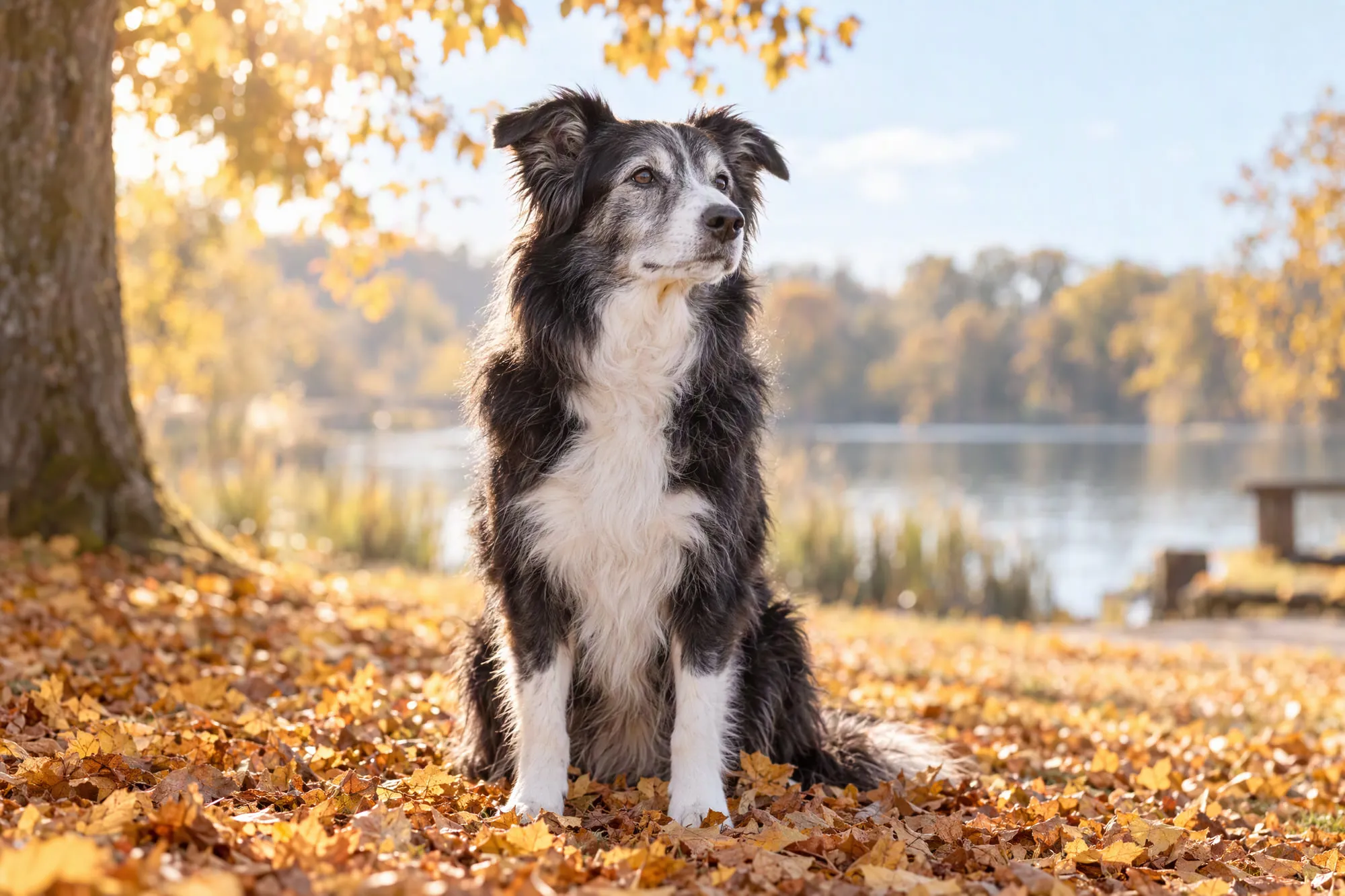
- A greying muzzle and eyebrows, sometimes a duller coat.
- Less stamina: walks get shorter, naps get longer.
- Muscle loss, especially over the thighs and back, which makes jumping and stairs harder.
- Lower energy needs, with a tendency to put on weight.
- Sometimes a weaker sense of thirst, which increases the risk of dehydration.
- Duller senses: hearing, sight, smell.
- Slower reactions, and a need for more stable routines.
The most common health problems in older dogs
According to VCA, the main conditions affecting senior dogs are arthritis, obesity, dental disease, hormonal disorders (such as diabetes), kidney, liver and heart disease, cancer and cognitive dysfunction syndrome, a kind of canine “dementia”.
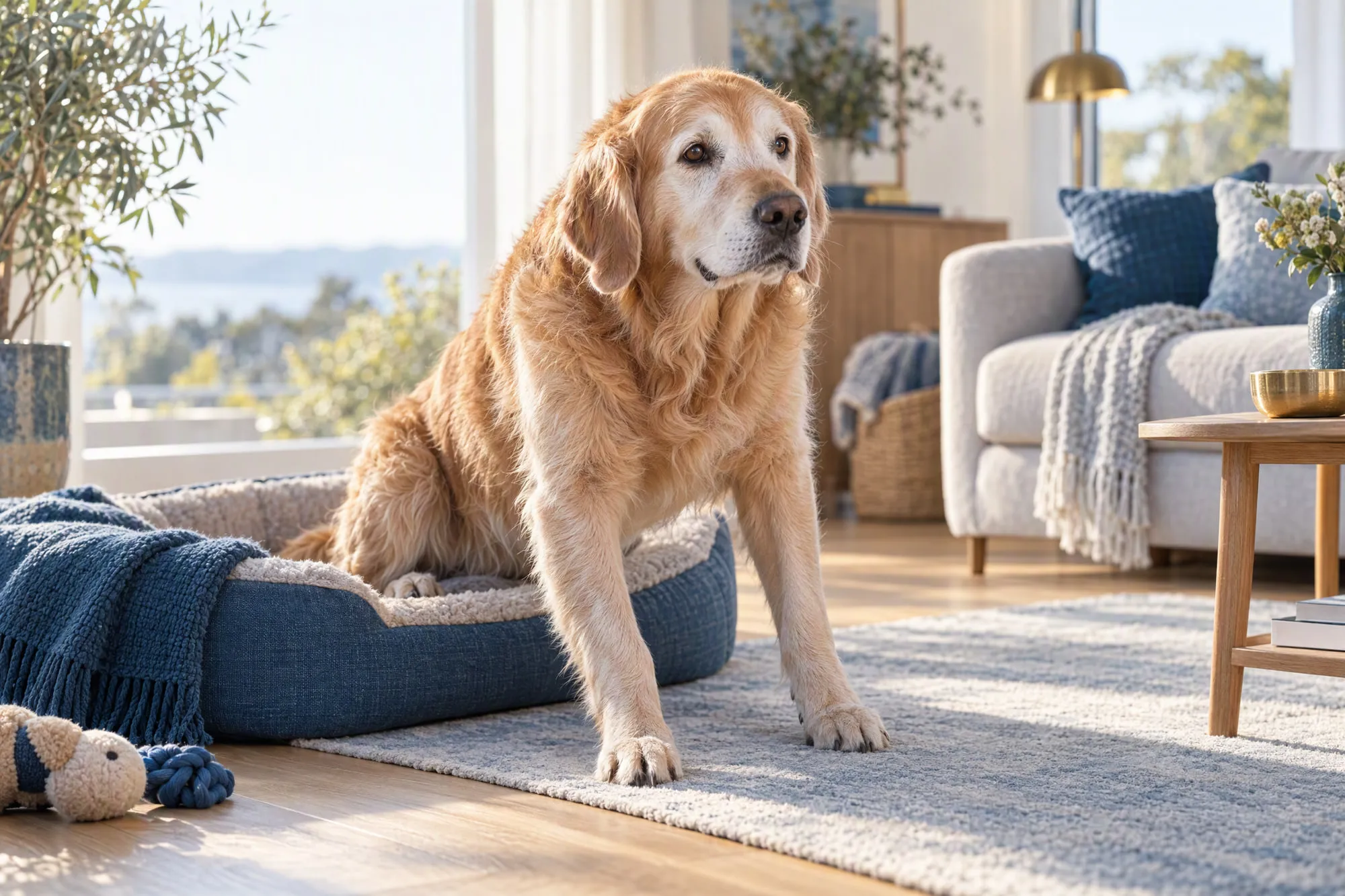
Arthritis in dogs deserves particular attention, because it is often confused with old age. A dog that struggles to get up, gives up on the sofa or lags behind on walks isn’t just “old”: they may be in pain, and that pain can be managed. If that sounds like your dog, read our advice for an old dog struggling to stand up.
The senior dog health check: when and how
Age-related changes are often gradual and subtle. VCA recommends a vet check at least twice a year for senior dogs: age-related diseases can progress significantly within a few months.
A senior health check generally includes:
- A detailed conversation: appetite, thirst, sleep, behaviour, mobility, toileting. Note down your observations before the visit.
- A full examination: weight, body condition, muscle mass, heart, mouth and teeth, eyes, joints, feeling the abdomen and skin.
- An assessment of pain and mobility, joint by joint.
- Further tests if your vet thinks they are worthwhile: blood and urine tests, blood pressure measurement, imaging.
- A review of preventive care: appropriate vaccinations, parasite control, dental care.
The aim is to pick up early anything that can be managed, and to measure changes from one visit to the next.
How to support your dog as they become a senior
Becoming a senior doesn’t mean slowing life down, but adjusting it. The most useful steps:
- Keep them at a healthy weight. Weigh them every two months on the same scales: a change in weight is often the first sign of a problem. Our advice on helping an overweight dog back to a healthy weight will guide you.
- Keep up regular activity, splitting walks into shorter ones rather than cutting them out. Older dogs lose muscle quickly, and muscle protects the joints.
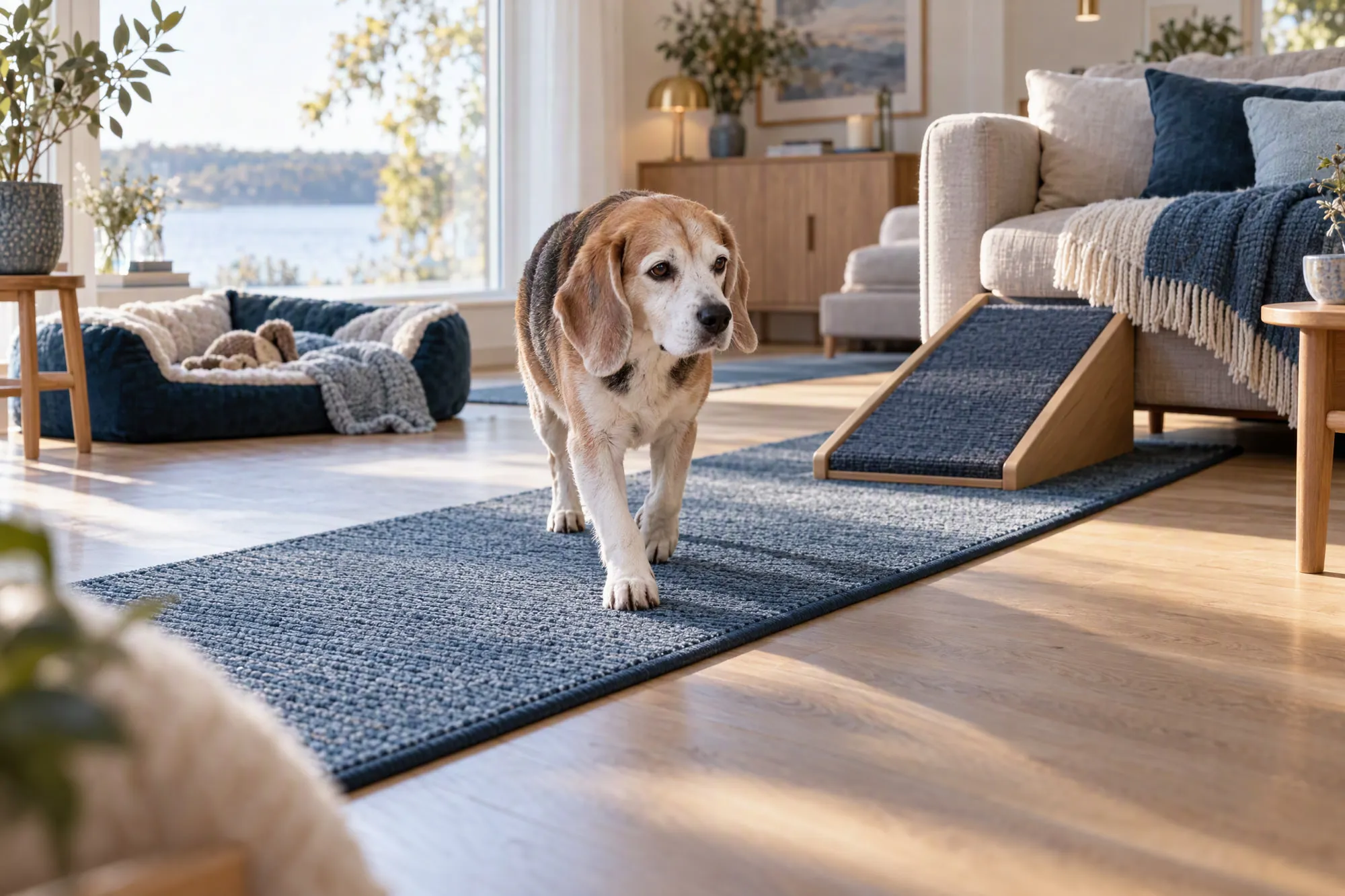
- Adapt your home: non-slip rugs, a car ramp, an orthopaedic bed. Here are some ideas for home adaptations for a senior dog.
- Look after the little things: short nails so they don’t slip, brushing so you can keep an eye on their skin, water bowls within easy reach on every floor.
- Keep their mind active: scent games, learning small new tricks, new quiet walking routes.
- Protect them from extremes of temperature, in summer as in winter. Cold often makes stiffness worse: our advice on dog arthritis in cold weather will help you prepare for the season.
As part of this overall care, alongside suitable activity and weight control, a supplement such as Novalia Hip & Joint can contribute to supporting joint function in your senior dog, given regularly and discussed with your vet.
When is a dog a senior? Key points
There is no magic age: a dog becomes a senior at around 5 to 6 if they are a giant breed, and often at around 10 if they are small. Rather than watching for a date, observe your dog, have them checked regularly and adjust their daily life as the years go by. Many senior dogs stay active, playful and happy for many years, especially when their pain and weight are well managed. Find all our advice in the senior dog section.
Frequently asked questions
At what age is a dog considered old?
A dog is described as senior once they have lived about three quarters of their life expectancy, and as geriatric in their final years. For a large breed this can happen as early as 6 or 7, whereas a small dog will often be considered senior at around 10. Your vet can give you a guide tailored to your dog.
How do I work out my dog’s age in human years?
Multiplying by 7 doesn’t reflect reality. A formula from a study of the epigenetic clock in Labradors gives better estimates: a 1-year-old dog is equivalent to a human of about 31, a 7-year-old dog to about 62 and a 12-year-old dog to about 71. It remains approximate, especially for very small and very large breeds.
When should my dog have a senior health check?
A first check is useful when your dog enters the senior category, which is earlier for a large dog than for a small one. After that, an examination at least twice a year is recommended, because age-related diseases can progress quickly. Your vet will decide which blood or urine tests or imaging are worthwhile.
Should a senior dog change their diet?
Not automatically, but their needs change: they often use less energy, which encourages weight gain, and some conditions call for a specific diet. Talk it through with your vet, who will take into account their weight, test results and appetite. Any change of food should always be made gradually.
My dog sleeps much more: is that normal with age?
An older dog sleeps more and rests more, which is to be expected. However, tiredness that comes on suddenly, a dog that no longer wants to get up, gets out of breath or changes in behaviour needs to be checked. Pain, particularly joint pain, is a common cause of reduced activity that is wrongly put down to old age.
This article is for information only and does not replace a veterinary consultation. If in doubt, or if your dog is in pain or changes suddenly, contact your vet.
Transparency: Novalia develops and sells a complementary feed for dogs. Our articles stay independent: the product is only mentioned where relevant, always clearly labelled, and never in place of veterinary advice.
Sources and references
- Senior Dog Care - Special Considerations
- Dhaliwal R. et al. 2023 AAHA Senior Care Guidelines for Dogs and Cats (PMID 36584321)
- McMillan KM. et al. Longevity of companion dog breeds: those at risk from early death
- Wang T. et al. Quantitative Translation of Dog-to-Human Aging by Conserved Remodeling of the DNA Methylome
- How to Calculate Dog Years to Human Years